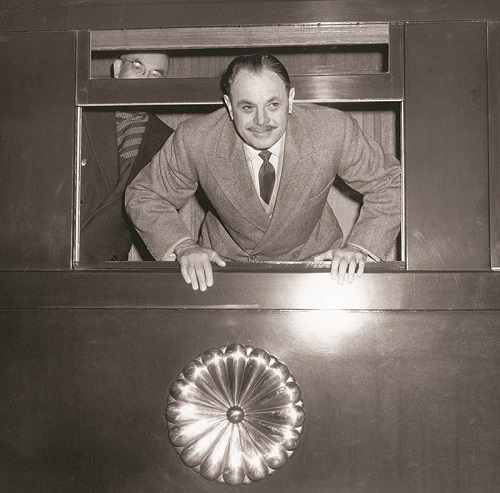
President Mohammad Ayub Khan is seen smiling as he leans out of his train on way to a US Marine Base in Okinawa, Japan, December 1960 - Photo: The Tahir Ayub Collection/Dawn
The Field Marshal and I
An Autobiographical Note
By Dr Akbar Ahmed
American University
Washington, DC

The cool looking hills around Islamabad and the greenery inside are deceptive. The city is blazingly hot in the summer months, especially if you are out in the sunshine. And standing under the hot searing sun with their hands raised to wave goodbye were President Ayub Khan and Maaji his wife.
I had come from Peshawar to bid them farewell as I was preparing to leave for my doctoral studies in the UK. I borrowed a car from a friend. It was a secondhand vehicle, and he had warned me of problems with the engine. As I got into the car and switched it on my worst fear came true. Pump the accelerator as I may and switch off and on the ignition as furiously as I could, the car would not start. This was ignominy as from the corner of my eye I could see the elderly couple standing there in the full blaze of the sun still waving goodbye. Admitting defeat, I jumped out of the car to look for a gardener in the hope of pushing the car to a start. I found someone and requested him to push the car which had to be rolled down to the main gate so that it came to life. As I looked back, I caught a glimpse of Ayub Khan and his wife still standing there. It would be my last glimpse of him as he passed away shortly afterwards in 1974.
The contrast could not be greater than when I first met him a decade prior at the Pakistan High Commission in London when he was president of Pakistan. Heads of Pakistan Societies in Britain had been invited to meet the president of Pakistan and as the president of the Pakistan Society, Birmingham University, I also attended. President Ayub stepped into the room where we had assembled, and we felt his presence. He was impeccably dressed and wore the karakuli hat made from the fur of the Karakul breed of sheep which would be his trademark. He carried himself with cool dignity and met each one of us with cordiality.
His youngest son Tahir Ayub Khan, who was at Burn Hall, Abbottabad, with me was joining Cambridge University and Ayub Khan asked me to look after him when I joined Cambridge. Later at Cambridge, Tahir and I were invited to have lunch with him in London at Clarridges where he was staying. We were ushered into a suite with President Ayub Khan and his foreign minister Zulfiqar Ali Bhutto, two of the most prominent and then popular leaders of Pakistan. Bhutto left after the meeting and just Tahir and I remained to have lunch with Ayub Khan.
When I met him next, I was staying with Tahir in the cottage at the President’s House in Rawalpindi. I was informed that I would have tea with the president. I walked across into the main house and onto the large lawn. The president was sitting in a deep cane sofa listening intently to a large Grundig radio placed next to him. As I walked across the large lawn, I saw him spotting me and then first switch off the radio and slowly push himself up to welcome me and shake hands. He was a big man and it took an effort to rise. He asked me to sit down, and he asked me about my education. With the happy innocence of youth, I proceeded to give him a lecture on what was wrong with Pakistani education and how it could be fixed. I felt passionate about promoting education among the young as a means of developing the nation. I was repeating the research I had done for my diploma in education at Cambridge University, but he did not once give a hint that he was talking to a young untried student. When I was in full flow, I realized that I was talking to a man who was running the nation, including its educational system, and abruptly in mid-flow ceased my oratory.
There are many biographies and articles about Ayub Khan, but recent history has not been kind to him. It seems all the ills of all the different military dictators of Pakistan have been placed in his corner and blamed on him. My article is simply to record my personal impressions based on the opportunity I had to interact with him as a good friend of his youngest son who was at school and at University with me. It is thus an autobiographical note.
Ayub Khan’s personality, which towered over the political landscape after he declared Martial Law, meant that every kind of power accumulated around him. He had become de facto a dictator. The Pakistani response in the tradition of South Asian culture was one of sycophancy and servility. Pakistan culture notoriously nurtures the flatterer, especially in dealing with those in power. A story circulated which illustrated the situation. A minister in the cabinet was said to have claimed to see the president in a dream. In the next cabinet meeting, another minister, not to be outdone in the sycophancy race, recounted that he had a dream in which he saw a group of angels flying in the heavens, and when he looked closer, he recognized President Ayub Khan’s face in front.
What was Ayub Khan’s reaction? I was interested in how he dealt with flattery. I knew how corrosive flattery can be. Had it all gone to his head? The Wali of Swat, whose eldest son had married Ayub’s eldest daughter, told me that when Queen Elizabeth and the Duke stayed with him in 1961, while they waited for Ayub Khan to join them for dinner, the Duke remarked to the Queen that Ayub had changed. He was more arrogant. The Wali felt the Duke may have wished to draw him into giving his opinion. But the Wali was non-committal.
My respect for the Field Marshal notwithstanding, I am firmly against military men running civil administration or imposing Martial Law. I believe that with the backing of government and the posting of committed officers, the civil service working within the law with the spirit of service and honesty are the best administrators for any country. Martial Law inevitably leads to a breakdown in law and order and creates a discontented population as we have seen in the history of Pakistan.
Ayub’s decade
As an undergraduate student in the UK in the early 1960s I could not but be proud of Ayub Khan’s status on the world stage and his international image. Pakistanis were benefiting from industrial and agricultural reform in the country. Ayub even implemented family laws restricting multiple marriages and promoting birth control. He moved the capital of the country from Karachi to a new location surrounded by hills and forests and called the future city Islamabad. A new Pakistan International Airlines, a brilliant cricket and hockey team, a thriving film industry, and a nascent atomic energy program added to the Pakistani sense of pride. The major dams of Pakistan were built by him. All this attracted developing countries like South Korea to send their experts to learn the secrets of Pakistan’s success. The World Bank and Harvard sent their experts to study Pakistan’s story. There was a picture in circulation of a meeting which took place months before the 1965 war between India and Pakistan at 10 Downing Street, the British Prime Minister’s residence. President Ayub Khan in his glamorous dark uniform, the blue patrol, was holding the hands of Mr Shastri, the Prime Minister of India, while towering over him saying, according to reports, “My armored division [considered the finest in Asia] could stroll down to Delhi.”
But Ayub approached high politics with a sense of balance and even compassion. When he deposed President Iskander Mirza, he allowed him to pack and catch a train with his luggage out of Pakistan and on towards London. This contrasts with the bloody violence created by dictators when they take power whether Gaddafi in Libya, Assad in Syria or Saddam in Iraq -–or nearer Pakistan the Ayatollahs in Iran and the Taliban in Afghanistan.
The West humored Ayub Khan as a valuable ally in the Cold War confrontation with the Soviet Union: Pakistan then stretched from the borders of Iran to the borders of Burma and was a key member of SEATO and CENTO. In 1960 a major international crisis that involved the US and Pakistan had hit the headlines. America’s U2 program which used the spy plane to fly at 70,000 altitude and was out of reach of Soviet weapons was downed. Its mission was to film military installations in the Soviet Union. It was based in Badaber just outside Peshawar and a furious Khrushchev warned Pakistan that the Soviet Union had taken note and put a red circle around Peshawar as a target for a nuclear strike.
Famous world figures interacted with Ayub Khan. I saw on black-and-white TV the Commonwealth conference in which president Kenyatta of Kenya said several times “as my good friend President Ayub Khan has said.” Then there was the reception he received when the who’s who of the Non-Aligned world came to the airport in Cairo to receive him. The Queen and the Duke of Edinburgh were warmly welcomed by Ayub Khan in Pakistan and spent several days in Swat in north Pakistan. Ayub Khan was also welcomed by the Kennedys in a rare state dinner at Mount Vernon, George Washington’s iconic home. Jackie had visited him solo in Pakistan, and I saw her
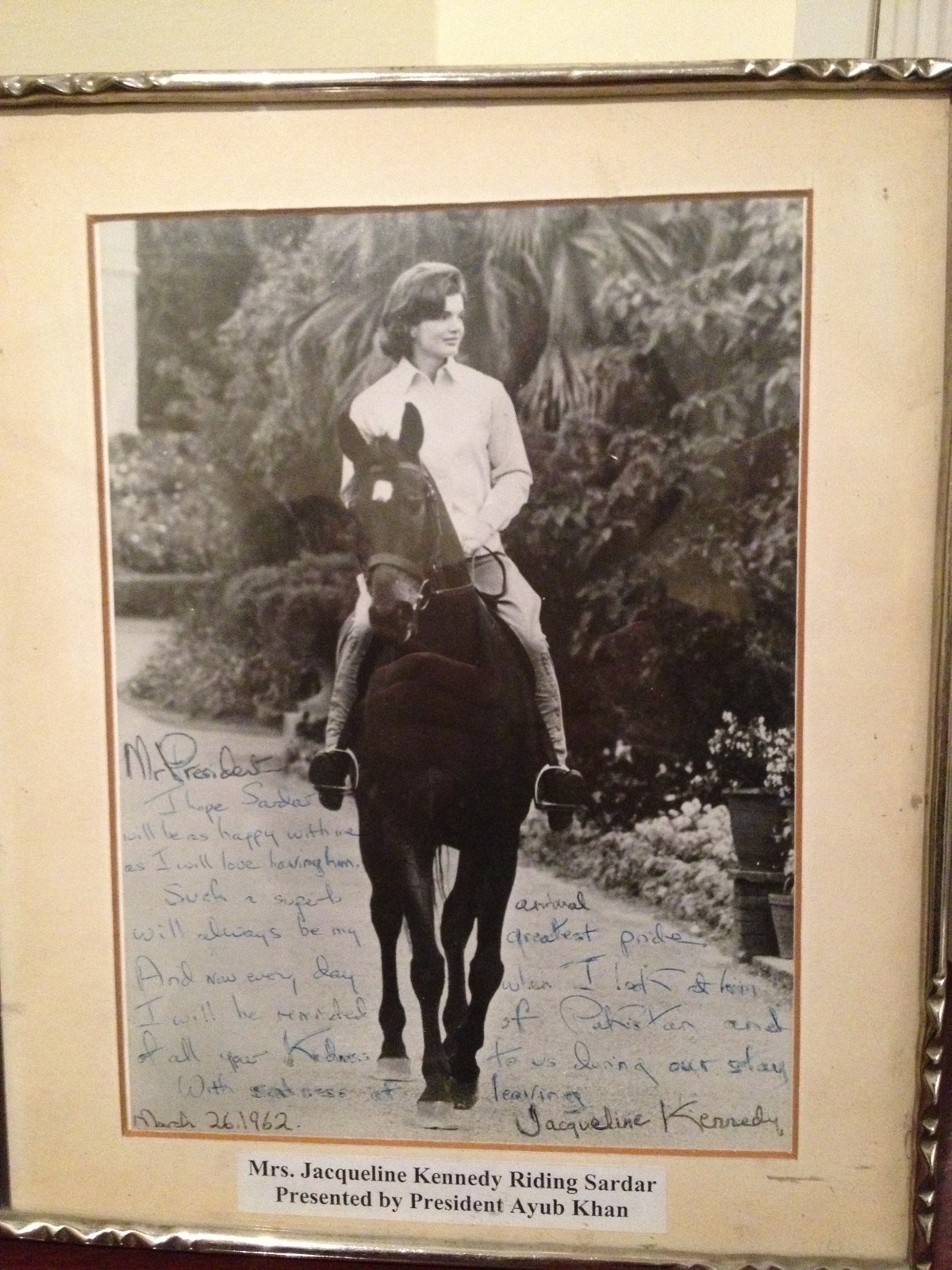
Ayub Khan was also welcomed by the Kennedys in a rare state dinner at Mount Vernon, George Washington’s iconic home. Jackie had visited him solo in Pakistan, and I saw her handwritten letter with the warmly signed photograph of her mounted-on Sardar the magnificent horse he had presented to her in the home of Ayub Khan’s eldest son, Gohar Ayub Khan
handwritten letter with the warmly signed photograph of her mounted-on Sardar the magnificent horse he had presented to her in the home of Ayub Khan’s eldest son, Gohar Ayub Khan. Sardar would tragically be part of President Kennedy’s cortege. Here is Jackie’s letter: “Mr. President I hope Sardar will be as happy with me as I will love having him. Such a superb animal will always be my greatest pride. And now every day when I look at him I will be reminded of Pakistan and of all your kindness to us during our stay. With sadness at leaving —Jacqueline Kennedy March 26, 1962.”
The Secret Service agent, Clint Hill, who wrote Mrs. Kennedy and Me served with her both during the good times and the bad. He thoroughly enjoyed their visit to Pakistan and admired president Ayub. There is a charming story recorded by Hill. When Jackie saw Ayub Khan wearing a karakuli cap she complimented him. He immediately took it off his head – in the age-old tradition of South Asia – and placed it on her head. She said she would send one to Jack Kennedy as she knew he would like it. Ayub replied that he would have several sent to her to choose from.
Ayub Khan was honored in the East and the West. He was warmly received in Beijing and when he arrived in Washington he was met at the airport by John and Jackie Kennedy (in contrast President Biden refusing to even talk on the phone to the Pakistani Prime Minister). Ayub Khan was given the rare honor of addressing the joint session of the US Congress and honored in a ticker-tape parade in New York. He was on friendly, even intimate, terms with world leaders. There is a remarkable photograph of President Johnson embracing Ayub Khan as the Pakistani President pats Johnson on the cheek in the tradition of rural Pakistan to express affection.
It was 1966, the year I entered the Civil Service of Pakistan, the CSP, when my father, then a senior director
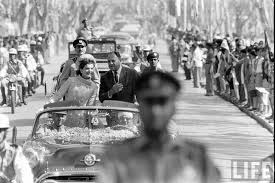
Jackie and Ayub Khan in an open car being warmly welcomed by Pakistanis
at the United Nations ECAFE headquarters in Bangkok, happened to be visiting Pakistan. During that visit he was invited to a grand reception in Karachi, attended by none other than President Ayub Khan. When my father was introduced, he mentioned quietly that he was my father. The president’s face lit up; his response was warm, almost affectionate. My father, ever concerned about my career,
then asked whether I might be better placed in the Foreign Service rather than the CSP, the cadre that had been offered to me. Ayub Khan’s reply was firm, almost commanding in its conviction. “No,” he said, “we need the best boys to serve here, in Pakistan.” Then, turning to my father with unmistakable earnestness, he added: “I am completely against his leaving. Please advise him to stay.”
Though I possessed this unusual access to the president, I never once sought to use it for personal advantage—never requested a posting, a promotion, or even the smallest favor. Ayub Khan respected me for that restraint, and our exchanges, whenever they took place, carried a quiet ease and mutual regard.
Decline and downfall
There is a story told about a high-level Pakistani delegation visiting King Faisal of Saudi Arabia in the late 1960s. The Pakistanis complained bitterly about the corruption of Ayub Khan’s sons. The king heard them patiently, and without answering, opened a drawer in his desk and pulled out a checkbook. He signed the checkbook, cut out a sheet from it and handed it to the Pakistanis. “This is a blank check,” he said. “I have signed it; fill in the sum you think Ayub Khan’s family has stolen from Pakistan. He is still worth it. When you lose him, you will lose Pakistan.” There may have been some truth in Faisal’s prediction. Ayub was forced to leave office in 1969 and Pakistan hurtled towards a violent break-up which finally came in 1971 with East Pakistan declaring itself an independent country by the name of Bangladesh.
Arriving in Islamabad just after the March action in East Pakistan in 1971, I stayed with my school friend Tahir Ayub Khan. I had come fresh from the raging civil war and widespread violence in East Pakistan. I was traumatized at the thought that I was witness to the possible disintegration of my nation. Distraught and disheveled, I decided to call on President Ayub Khan and seek his wisdom on the unfolding crisis and update him. He was recovering from his heart problems but, still wearing his silken nightgown, he came to the living room
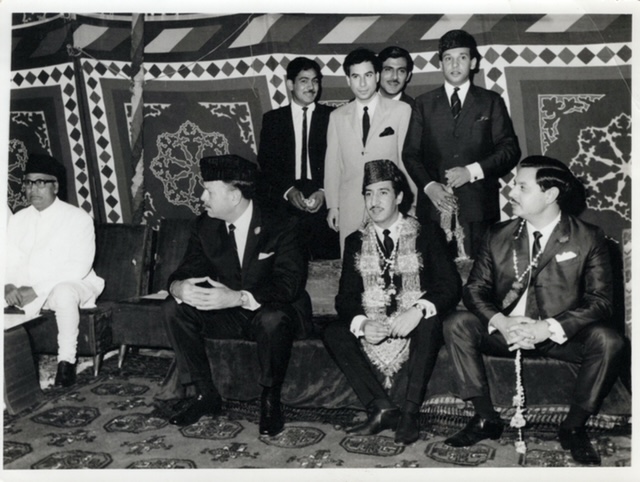
At Tahir’s wedding 1966: L to R seated: Ayub Khan, Tahir, Gohar, I am standing in a light suit right behind Tahir
He was carrying a book as he invariably did, and we had a long and frank conversation about East Pakistan and the geo-politics of Pakistan. Unlike other Pakistanis who were wallowing in a delusional state of jingoism, Ayub Khan was acutely aware of the dangers of any army facing a challenge on two fronts simultaneously.
Many were gleeful at the military action and that Bengalis had been “taught a lesson.” A crude xenophobia tinged with obvious racism had come to the surface. I heard Bengalis frequently being referred to as “black bastards” or bingos, the equivalent of the “n-word” for African Americans. Because my wife and I explained why it was important that Bengalis were made to feel part of Pakistan and given their rights with dignity we were contemptuously labelled “Bingo-lovers.”
In spite of the world affairs we had been discussing, his old army training which included Sandhurst had not left him. He had noticed my long hair and as I was leaving the house his wife who we called Maaji, or respected mother, gently and sweetly said he had requested me to have my hair cut. An officer must always look after himself and appear prim and proper. I took the advice and went straight to a barbershop. Before I left, Maaji quietly, as was her habit, slipped a note into my hands. It was ten rupees. It was a small note, but a big gesture of maternal affection and I was touched. I recall with affection her high regard for me. On a visit to the president’s house, still a bachelor, I remembered the friendly banter and discussion with her daughter Naseem Aurangzeb and her good friend Chano Aunty who was married to Brigadier Al-Idroos. Maaji sharply responded to them when they pooh-poohed me on hearing of my description of the ideal wife I sought—where will you get a perfect wife like that? they mocked. But look at my son, Maaji intervened, isn’t he perfect too? My great regret, Maaji added, was that I have no unmarried daughter left for Akbar.
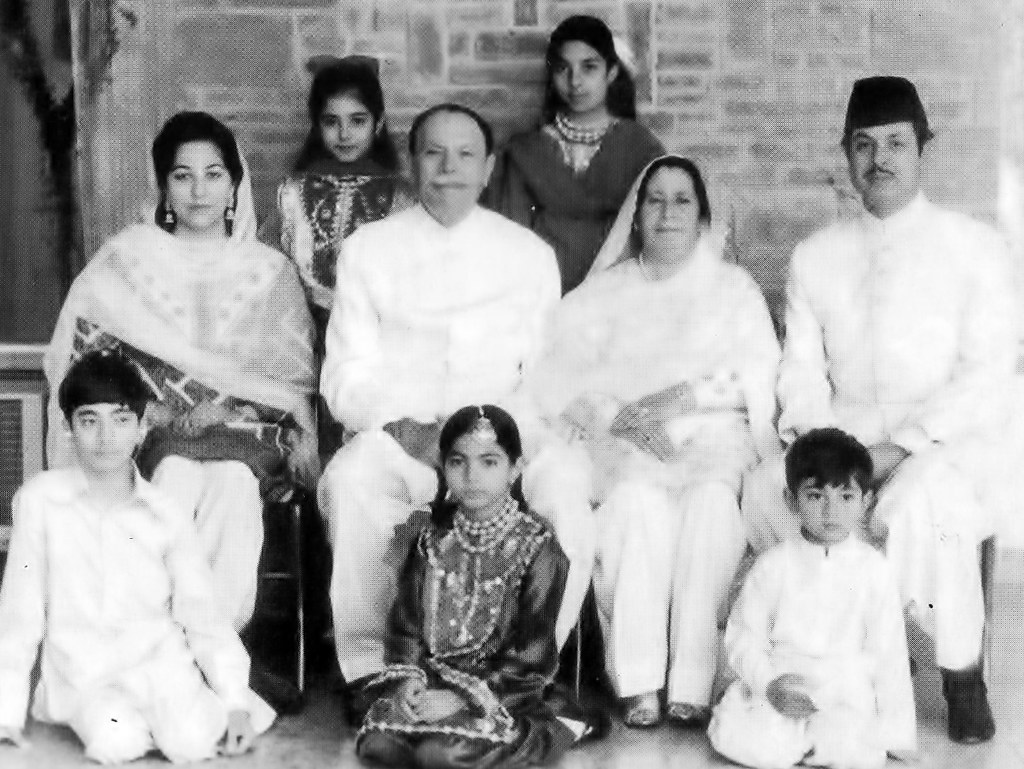
Ayub Khan’s last family picture, 1974 – Flickr/Dr Ghulam Nabi Kazi
Student leaders
In 1969, student leaders in Okara with tears in their eyes came to see me after Ayub Khan announced his intention to resign. They said he was like our father. They explained that they never wanted to remove him just to make him aware of the corruption. These students who drove about on bicycles now had shiny new motor scooters. Someone had been pumping money into the student body of Pakistan which was leading the protests to bring down Ayub Khan. There was, I believed, more than meets the eye. Ayub Khan had written his autobiography titled Friends not Masters. It was unmistakably directed at those Americans who regarded Pakistan as though it were a vassal state. Ayub sought to remind them that while Pakistanis welcomed friendship, they would never accept subjugation.
Later, after he resigned and had left office, images of Ayub Khan began to appear on trucks plying their goods across Pakistan. When I mentioned these to Ayub Khan, he said he had seen how much people really valued him in the stories of student processions that carried a dog on a chair while they chanted “down with Ayub Khan the dog.” At the same time, when the police, trying to stop a student procession from marching towards Islamabad, shot and killed a student leader, Ayub Khan said I will not allow any more killing. He was deeply saddened by the death, and it precipitated his decision to resign.
We know from recent history that dictators whether Assad in Syria or Saddam in Iraq do not surrender power without the use of their army and air force to suppress their population. They are prepared to sacrifice thousands of lives to stay in power. Yet after one student was killed Ayub Khan decided not to use force to cling to power and resigned.
I was in Peshawar when the so-called Decade of Development, an idea stale and exhausted by the end of Ayub’s tenure, was lumbering to a close. Tahir invited me to attend a public meeting which his father was addressing, and I went along and had a good vantage point just alongside the stage where I could see the thousands gathered to hear his speech. As Ayub began to speak a young man stood up from the audience a few yards away and fired several shots at the president. He missed his mark but at that moment I knew that the bubble of invincibility that had surrounded Ayub Khan had been pierced, and a political process would accelerate which would see Ayub Khan losing political power. With typical fatherly compassion Ayub Khan pardoned the life of the young man when his parents appealed to him.
Return to Rehana
When Ayub Khan resigned from office in early 1969, he headed for Swat to stay with his daughter Naseem in Saidu Sharif. I was in Peshawar to sit for some departmental exams and as Naseem invited me, I agreed to visit Swat. I spent several days in the same bungalow where Ayub Khan was staying and would join him for dinner. Naseem, her husband, Aurangzeb, and later Ayub Khan’s elder son, Gohar Ayub, joined us. Ayub was quiet at first but then asked me whether it was true that there was corruption in the administration. I said that although I had just joined the service, I was already seeing signs of incompetence and corruption. I felt it was a slippery slope.
During the conversations I observed Ayub Khan closely. His downfall was classic Shakespeare. I wondered how he would behave now that he had been removed from the pinnacle of power. I saw he was handling himself with poise and dignity. He wore ordinary open shirts, slacks and tennis shoes. His family treated him with kid gloves and avoided any mention of politics. Outside, opposition leaders like Zulfiqar Ali Bhutto and Asghar Khan were abusing him using foul language. I asked Ayub Khan if there was any hope of reconciliation so that there would be stability in Pakistan. Not once did he abuse his critics or express bitterness. He did seem bewildered. He said, “I have tried several times to reach out to them and promote dialogue. But they only continue to use foul language.”
In a profound sense after leaving high office, Ayub Khan was returning to Rehana , Haripur . Yet after decades of world adventures had he really left Rehana behind? He had carried the values and world view of Rehana with him, and that had sustained him. Beneath the medals and sashes on his military uniforms, the title of President and Field Marshal, and photographs alongside the Kennedys, the Queen of England, Jawaharlal Nehru, and Mao Tse- tung, and adulatory media, like the headline in a British newspaper on his arrival at Heathrow with a large photograph spread across two pages showing hundreds of cheering and waving Pakistanis, “A reception the Beatles would envy,” Ayub Khan remained at heart a simple soul. (Tahir has diligently built a vast collection of historic photographs of his father in his home.)
Ayub Khan was never far from his birthplace in Rehana, and his humble beginnings. The several times that I had opportunity to meet him over the years, it was this side that I encountered. The public Ayub and the private man were two very different things. It was the public Ayub, who was mired in controversy about dictatorship and corruption, that the country saw. In private he was content to be with his family and his long-time wife, a typical cousin marriage; his luxury was to spend time with a good book. The common courtesy that he instinctively displayed to me on several occasions reflects that simple soul. Life remained sober, disciplined and restrained within the bounds of tradition and cultural norms. Such a life contrasted with the stories about the big landlords and their extravagant behavior of excess and Dionysian revels. But Ayub Khan was no stiff-necked prude. I recall accompanying Tahir to a dinner given by General Shahid Hamid in his elegant home in Lalazar in honor of Ayub Khan. It was beautifully arranged in the cool of his garden and we enjoyed the food as Mehdi Hassan in person sang Faiz Ahmed Faiz’s popular ghazal Gullo Men Rang Bharey.
In his autobiography, Friends not Masters, Ayub mentions the tiny bit of land that his family owned in Rehana. The expression of culture and the rhythm of comfortable rural Islamic tradition of the self-respecting small farmer epitomized the ethos. The word that springs to mind is modest. Even the tribe that he belonged to, the Tarin, although Pathan according to genealogy, was widely acknowledged as not as dominant as the Wazir or Mahsud in the Tribal Areas or influential like the aristocratic Yousufzai with their large, irrigated tracts. A young ambitious man from Rehana would have to seek his fortune outside the district. As a young man Ayub left for Aligarh University in India. There, the legend goes, his imposing height and good looks caught the eye of an English officer who sponsored his attachment at Sandhurst in England. World War II, the Partition of India and the creation of Pakistan, and Ayub’s rapid rise to Commander-in-Chief and then the declaration of Martial Law and takeover as President of Pakistan followed in rapid succession. When it was all over, he lived a semi-retired life in Islamabad, a short distance from his ancestral village. Ayub’s life ended as it had started in the cultural sphere of his birthplace. When he passed away, he was buried in the ancestral graveyard in Rehana.
Even half a century and more had not dimmed the indignation Cookie, the wife of Tahir Ayub Khan , had felt about her father-in-law. A woman of great passion, intelligence and wisdom, and herself the daughter of a general, she said that the man who had created Islamabad, given Pakistan a decade of stability and dedicated his life to its causes, was disgracefully maligned and forced out of office. All the major dams, Tarbela, Warsak, Mangla, Cookie said, were built by him. Not a single dam after him. Yet the nation did not even name a street or public park in his honor, but the Almighty was merciful, and he passed away with his honor intact peacefully in bed with his wife and family standing around him.
|
|
In the end the old soldier had been stripped of everything that had been his right for the last two decades as president of Pakistan, as Field Marshal, and earlier as head of the Pakistani army--his privileges, his orderlies, ADCs, even his pension. There were even rumors that he would be tried.
But what they could not take away was his natural dignity. That was his superpower, and he guarded it fiercely. There he stood—erect and dignified, his values intact, despite a lifetime that took him to the pinnacle of power and then the depths of rejection; he had lived in the world, and he had endured. He stood straight and tall although frail with ill-health, waving goodbye with his faithful wife standing loyally by his side.
That was my last sight of President Ayub Khan.
(Ambassador Akbar Ahmed is Distinguished Professor of International Relations and holds the Ibn Khaldun Chair of Islamic Studies at the American University, School of International Service. He is also a global fellow at the Wilson Center Washington DC. His academic career included appointments such as Nonresident Senior Fellow at the Brookings Institution; the First Distinguished Chair of Middle East and Islamic Studies at the US Naval Academy in Annapolis, MD; the Iqbal Fellow and Fellow of Selwyn College at the University of Cambridge; and teaching positions at Harvard and Princeton universities. Ahmed dedicated more than three decades to the Civil Service of Pakistan, where his posts included Commissioner in Balochistan, Political Agent in the Tribal Areas, and Pakistan High Commissioner to the UK and Ireland.)