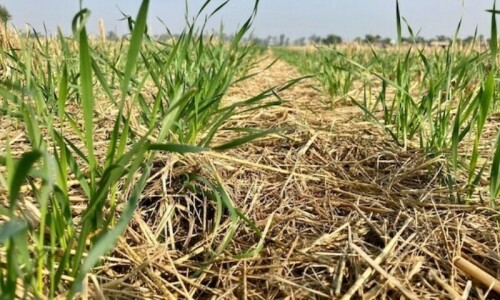
Without reforms continued land fragmentation, rising input costs, and climate challenges will only tighten the grip of poverty and debt on farmers who feed the nation - Photo Dawn
Agriculture: The Unfinished Dream of Land Reforms
By Drs Muhammad Ismail Kumbhar and Aslam Memon
Tandojam, Pakistan
Agriculture has always been the backbone of Pakistan’s economy. In 1947, most of the land was concentrated in the hands of large landlords, while peasants were denied equal rights.
The first major attempt at reform came in the 1960s under General Ayub Khan, who introduced a land reform program aimed at redistributing land from big landlords to small farmers. However, these reforms largely failed as landlords exploited political influence to divide land within families, preventing actual cultivators from receiving ownership.
In 1972, Prime Minister Zulfikar Ali Bhutto introduced another round of land reforms, but political pressures and administrative weaknesses once again rendered them ineffective. Subsequent governments experimented with subsidies, price controls on wheat and cotton, and investments in irrigation, but a coherent and sustained policy framework for small farmers never materialized.
By 2000, the government introduced the concept of corporate farming to attract both foreign and local investors. Policies included tax incentives, subsidies, and easier access to land, with the promise of modern technology and higher productivity.
However, issues of land fragmentation, legal complexities, and local communities’ concerns meant that corporate farming never took root on a national scale, remaining confined to limited regions. Ultimately, small farmers remained central to agriculture — without the necessary state support — making their situation even more precarious.
The 2010 Agricultural Census revealed a steady increase in the number of farms but a decline in their average size. Land inheritance practices, rising population, and forced subdivision of plots meant smaller and smaller farms, making mechanization, modern irrigation, and market access difficult for smallholders.
As of 2024, Pakistan has 11.7 million farms, up 41 per cent since 2010. But the average farm size has shrunk to just five acres, with six out of every 10 farms under 2.5 acres.
This fragmentation severely limits small farmers’ ability to adopt modern technologies, access quality seed and fertilizers, or manage irrigation efficiently. Meanwhile, livestock has emerged as a dominant force, contributing nearly two-thirds of agricultural GDP — signaling a major structural shift as farmers increasingly rely on dairy, meat, and animal by-products due to stronger market demand.
Regionally, Punjab is striving to maintain farm stability, yet small farms are increasing there as well. Sindh faces acute land fragmentation and inequitable water distribution, worsening rural poverty. Khyber Pakhtunkhwa has seen agricultural land expand, but average farm sizes continue to decline. In Balochistan, traditional farming is gradually being replaced with water-saving models and new methods adapted to arid conditions.
Broader systemic issues
The census further highlighted deeper, structural flaws, including the failure of the land reforms since the 1960s to empower smallholders. The small sizes of farms also make mechanization and productivity gains difficult. Furthermore, water scarcity and inequitable distribution, particularly in Sindh, worsen the productivity crisis.
There are also many financial drawbacks, such as lack of access to credit and insurance, leaving farmers financially vulnerable, while middlemen dominate the markets, depriving farmers of fair returns.
Finally, the ever-increasing environmental risks, such as rising temperatures, erratic rainfall, floods, and droughts, compound the already-existing challenges.
The future of farming
The future of Pakistan’s agriculture now depends less on the size of farms and more on how effectively productivity is enhanced, how smallholders are strengthened, and how far they can access technology, markets, and finance. Real progress requires placing small farmers at the heart of policy.
Instead of promoting corporate farming, cooperative farming models should be encouraged so that smallholders can pool resources, share machinery, and access better markets.
Investment in livestock must focus on veterinary services, animal feed, and direct market access. Equitable water distribution and the adoption of modern irrigation systems such as drip and sprinkler are essential. Beyond this, building value chains — from processing to packaging and exports — will ensure farmers earn real profits.
Research universities must be revitalized to develop climate-resilient seeds and promote smart, digital agriculture through mobile apps and data systems, providing farmers with real-time information on weather, prices, and markets.
Pakistan’s agricultural future lies not in large estates or corporate ventures but in empowering its millions of small farmers. If given access to resources, technology, fair markets, and institutional support, they can ensure not just national food security but also enable Pakistan to emerge as a competitive player in global agricultural markets.
Without such reforms, however, continued land fragmentation, rising input costs, and climate challenges will only tighten the grip of poverty and debt on farmers who feed the nation.
(Dr Muhammad Ismail Kumbhar is a professor at the Sindh Agriculture University, Tandojam, and Dr Aslam Memon is the director of PARC-SSRI, Tandojam. Dawn)