
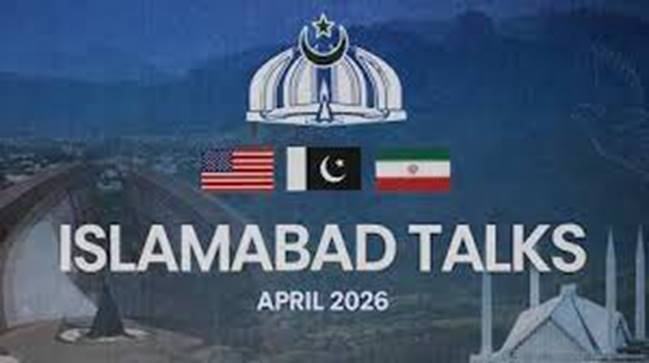
Iran, America, and the Road to Peace via Islamabad
By Karamatullah K. Ghori
Toronto, Canada

Peace hangs in the balance, not only in Iran’s immediate neighborhood in the Gulf but also around the world far beyond the shores of the Straits of Hormuz.
While the world holds its breath about the next move by Iran and US—the two combatants in the Iran-US War—President Trump has ordered a naval blockade of Iran.
This latest Trump decision has come swiftly on the heels of the stalemate resulting from a marathon 21-hour, face to face negotiations between Iran and US in Pakistan’s capital city, Islamabad, on the weekend of April 11.
It was no mean achievement of Pakistan’s diplomatic skills that Iranian and American negotiators—with a 47-year-long gulf of deep distrust keeping the two adversaries apart—sat face to face with each other and went through a trying session spanning 21 hours.
That even after those nerve-wrecking hours the gulf of distrust couldn’t be bridged was no fault of Pakistan.
Diplomacy may have the reputation of being the art of impossible but squaring a circle—which is what the art of diplomacy is all about—demands patience and forbearance.
Ergo, no wonder that Vice President J.D. Vance who led the American side in the marathon negotiations with Iran, decided to leave the table, in the end, without reaching an agreement with his Iranian interlocutor. Vance has presidential ambitions and is widely expected to be the Republican nominee in the 2028 Presidential elections in US. Vance wouldn’t like to be seen as deviating from, or deserting, the tough-man legacy of his boss.
So, the war which started six-weeks ago, on February 28, by Israel and US is still far from a denouement, aggressive or pacific, and peaceful.
This scribe, who has spent at least one-third of his 36-year-long diplomatic career among the Arabs of the Gulf and the Middle East is fond of spending the holy month of Ramadan there among the Arabs. Ramadan has a unique flavor of its own in the Arab culture and the Middle East.
So, for years I have been observing the month of Ramadan at my daughter’s, who lives on the Eastern seaboard of Saudi Arabia, at Dahran-Dammam.
As per habit, I landed at Dammam on February 25, the 6 th day of Ramadan. Because of the war clouds hanging over the entire Gulf region, for the first time in my experience, Ramadan seemed to have lost its flavor and colors of festivity. The man-on-the-Gulf Arab street was disheartened and desolate.
The dissonance was spawned by the uncertainty of what could follow, especially on the eve of another round of negotiations between Iran and the Americans, in Vienna.
Iran’s retaliatory strikes against American targets in its Arab neighboring countries—every one of them housing American military bases—fueled despondency on the Gulf Arab street, thus robbing it of the traditional rituals anchored in the month of Ramadan.
While the common citizen of the se oil-rich Gulf Sheikhdoms and Kingdoms was worried about his personal and family safety—because of sirens going off intermittently at odd hours, alerting about the Iranian drones fired against American targets—the intelligentsia was concerned about the political fallout of the war going on, literally at their doorsteps.
Brainstorming sessions with old diplomatic and academic friends and colleagues left me with an indelible impression that those enlightened and well-informed mates of mine were rankled and riled by the fact that American military bases on their soil were attacked.
The situation spawned by the American-Iranian conflict is forcing wealthy Gulf Sheikhdoms to review their decades-old reliance on US to ensure and guarantee their security and integrity.
President Trump is still wielding stick and carrot in the wake of stalled negotiations with Iran in Islamabad. He lost no time in unveiling his intent to blockade Iran, on the high seas but then, tried to soften that blow by being optimistic about another round of talks with Iran, in the next few days.
No doubt that his charm offensive of reposing faith in the current Pakistani leadership won the hearts of the many in Islamabad, yet it couldn’t be good news for the Gulf Arab rulers taking note of Iran’s warning that it may target energy facilities on their lands if the US pressed on with its naval blockade of Iran.
This scribe, at this juncture, can’t help recall what the great bard and philosopher—our national poet—Iqbal had said about Iran’s potential, a century ago.
We adulate Iqbal as a visionary (Hakeem-ul-Ummat) who could read the future and prognosticate about it with certitude.
Iqbal’s dream, of a century-ago, about China reawakening from its deep slumber has come true. He had predicted:
گراں خواب چینی سنبھلنے لگے
ہمالہ سے چشے ابلنے لگے
So, China is the most advanced country in terms of progress and advancement in the economic field.
Iqbal’s other dream was about Iran. He said, at times of the League of Nations, in Geneva, being the beacon of hope to revamp the world order fractured in World War I:
طہران ہو گر عالمِ مشرق کا جنیوا
شائد کرہء ارض کی تقدیر بدل جائے
We, the denizens of the East, should hope that this vision of Iqbal also bears fruit. Hope is a redeeming asset! -K_K_ghori@hotmail.com
(The author is a former ambassador and career diplomat)
