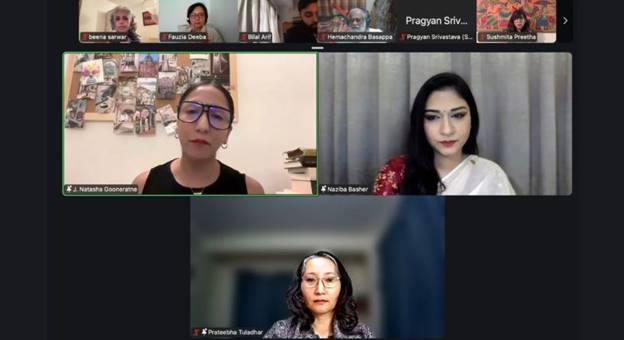
5th anniversary 2026: (L-R) Three discussants: Natasha Gooneratne, founder of Perspective South; Naziba Basher, dancer, writer, and actor; and Pratubha Tuladher , columnist and lecturer at the Asian Centre for Journalism - Screenshot
Five Years of Keeping South Asian Hope Alive
By Bilal Arif
London, UK

The South Asian region borders are more than just geographical markers; they are deep fractures that dictate who we can see, who we can mourn, and who we can call a friend. Across the heavily guarded borders of the seven primary nations of South Asia, there are constant tragedies of rigid visa regimes and political posturing that turn natural neighbors into mandated adversaries.
Yet, there are spaces for hope, where the longing to connect and converse across divides refuses to be extinguished. This becomes even more critical in today’s fragile global landscape, “New World Disorder.” With autocracies replacing democracies, armed conflicts looming over a World War III scenario, more than 100 million people forcibly displaced worldwide, and catastrophic humanitarian and hunger crises unfolding from Gaza to Sudan, the urgent need to prioritize our shared humanity over militarization and division has never been more important.
For the past half-decade, the South Asia Peace Action Network (Sapan) has been on the frontlines to challenge these norms. What Sapan does is an act of gentle, stubborn defiance: creating a virtual room where South Asians can simply exist together.
Recently, the network marked a milestone with a global virtual gathering – “Five years of Sapan: Connecting and keeping hope alive.” The event brought together a diverse coalition of journalists, activists, and writers from across the subcontinent and the diaspora.
Watching the event unfold across time zones, spanning from the early morning on the Pacific coast to the late evening in Dhaka, was a masterclass in grassroots solidarity. It was not merely an anniversary celebration but a vital taking stock in a region that has endured constant battles against disasters, pandemics, mass uprisings, and violence.
A look back
Following a warm welcome from Sapan co-founder and curator, journalist Beena Sarwar, the gathering was anchored from Dhaka by activist and journalist Sushmita Preetha of the Daily Star. Her opening remarks perfectly captured the exhaustion and the resilience of the South Asian public over the last five years.
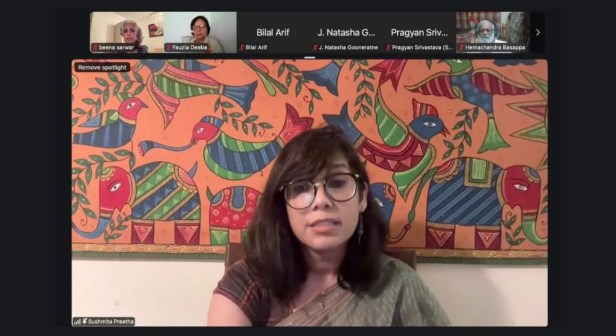
Writer and activist Sushmita Preetha - Screenshot
Preetha painted a poignant picture of the region’s recent history. One in which citizens have survived a once-in-a-lifetime pandemic, only to watch their economies fold under severe debt and inflation, while simultaneously battling cyclical, devastating climate disasters. Against this backdrop of survival, they have witnessed mass political uprisings — from Colombo to Dhaka to Kathmandu — that briefly opened new political spaces, only to run into familiar autocratic forms of government control.
The In Memoriam presentation, with its moment of silence, was an emotional segment, a vital reminder of the dedication and activism that those who are no longer with us spent their lives on. Sapan aims to take forward their legacies to achieve that brighter future, one with hope.
“Over the last five years, public life in our countries has felt increasingly brittle, with intolerance and polarization settling in more deeply,” commented Preetha. It is a sobering reflection of daily life in the region, where ordinary citizens feel their fundamental freedoms are steadily shrinking.
It is against this backdrop of unresolved violence in multiple places around the region, like Kashmir, Dhaka, and Kathmandu, that Sapan’s mission becomes not just admirable but essential. When governments lean into discourses that frame differences as threats, Sapan insists on making space for cross-border empathy, fostering peace through dialogue.
Gen Z in a misinformation era
The core analytical weight of the event rested on a panel discussion exploring how the region’s youth, the Gen Z population, is inheriting and reshaping these fragile democracies.
The conversation brought together three activists: J. Natasha Gooneratne, founder of Perspective South and a specialist in public diplomacy and international law from Colombo; Naziba Basher, a dancer, writer, and actor from Dhaka; and Pratibha Tuladhar, a journalist-turned-columnist and lecturer at the Asian Centre for Journalism from Kathmandu.
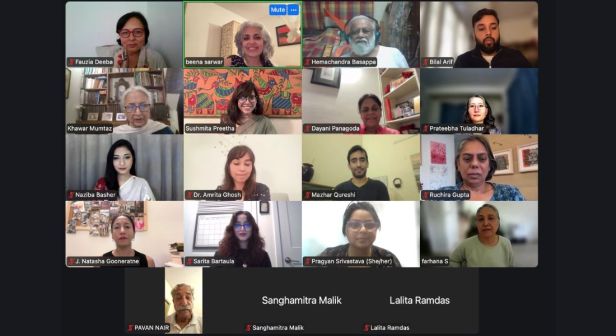
Sapan 5th anniversary 2026 panel group - Screenshot
This segment offered a real-time pulse-check on a generation coming of age in the shadow of political upheaval. The panelists unpacked their commonalities within Sri Lanka, Bangladesh, and Nepal – violence, mass mobs forming after uprisings often leading to police brutality, sexist systems where barely meeting quotas is seen as just, and the rise of non-lethal but toxic online tools such as hate speech and biased media narratives.
The panelists discussed what democracy looks like through the eyes of young people, navigating corruption, the rise of misinformation, the pressures of social media’s hyper-visibility, and the proximity to conflict. They analyzed the specific challenges of Gen Z, discussing how vastly the Global South is affected by global powers and corporations. Their conversation explored how this dynamic has led to a political fixation via social media, driving a systematic shift to rewrite the rules across South Asia, and diverging almost completely from the historical baggage of their predecessors.
Confronting systemic violence – The “Epstein mindset”
Sapan has never hidden from the uncomfortable truths of the region, and the inclusion of Emmy-winning documentarian and lifelong anti-trafficking activist Ruchira Gupta highlighted this.
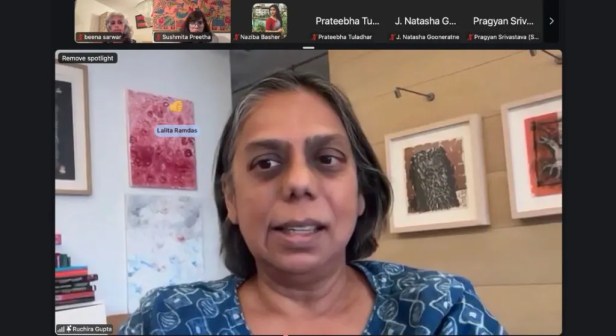
Ruchira Gupta, journalist, activist and founder of Apne Aap - Screenshot
Gupta is a founder of the survivor-led organization Apne Aap (on one’s own), and author of two young adult novels, I Kick and I Fly (2023) and The Freedom Seeker (2025). During her appearance, she shifted the focus to the normalization of exploitation. She spoke powerfully about her personal accounts and her research countering patriarchal/fascist oppression, and what she termed the “Epstein mindset” – an entrenched societal echo chamber and imbalance of power that allows severe violence against the vulnerable to be normalized and sustained. In her words, “Epstein is a mirror for these large establishments.” A stark reminder that true peace in South Asia requires not just silencing guns at the borders but dismantling systemic violence within our own homes and societies.
A tangible vision for peace
Moving from dialogue to definitive action, the event approached its conclusion with a major policy stance. From Colombo, Dr Dayani Panagoda, a prominent Sri Lankan voice in reconciliation and women-led development, presented Sapan’s latest resolution , which includes a call to uphold a 1971 United Nations Resolution that termed the Indian Ocean as a “Zone of Peace.”
The five key points of the resolution:
1. Uphold UN Resolution 2832 of 1971 to recognize and maintain the Indian Ocean as a “Zone of Peace”
2. Support Afghan women, resolve Pakistan-Afghanistan hostilities
3. Release the incarcerated upon completion of jail terms, especially cross-border prisoners
4. Revive cross-border trade, let people access medical facilities
5. Revive SAARC Summit
Overall, a powerful reminder of the impactful work that Sapan has done over five years and a testament to the necessity of their mission moving forward.
Beneath the high-level resolutions and profound dialogue, this remains Sapan’s most enduring plea.
(Bilal Arif is a London-based entrepreneur with an MSc in Diplomacy, International Business and Trade. This is his first article as an intern with Sapan.)
https://www.sapannews.com .