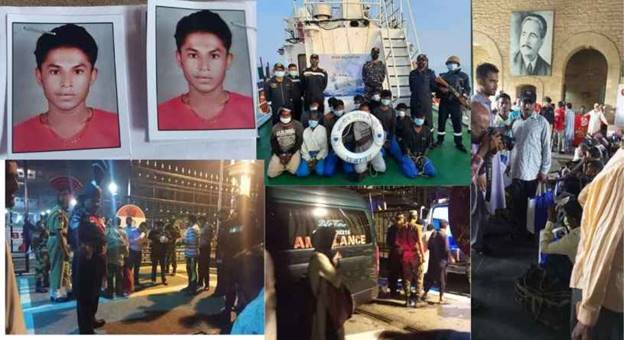
Fisherfolk suffer while governments bicker: (Clockwise from top left): Indian fisherman Jagdish Mangal died in Pakistani prison, 6 Aug 2023; Pakistani fisherfolk arrested by Indian coastguard, Sept 2021; Indian fisherfolk waiting to be repatriated at Lahore railway station, 2023; body of Pakistani fisherman Amir Hamza who died in Indian prison repatriated via Wagah border, 14 Sept 2021; Indian fisherfolk being repatriated at Wagah, 15 Nov. 2012. — Beena Sarwar archive photos.
Appeal to India, Pakistan to Release, Repatriate Incarcerated Cross-Border Fisher People
By Beena Sarwar
Boston, MA

As India and Pakistan get ready to mark their respective Independence Days, the families of imprisoned fisherpeople on either side of the border along with various organizations have jointly written to the Prime Ministers of India and Pakistan demanding “the immediate release and repatriation of all imprisoned fisherpeople who have completed their sentences and nationality verification” as a goodwill and humanitarian gesture.
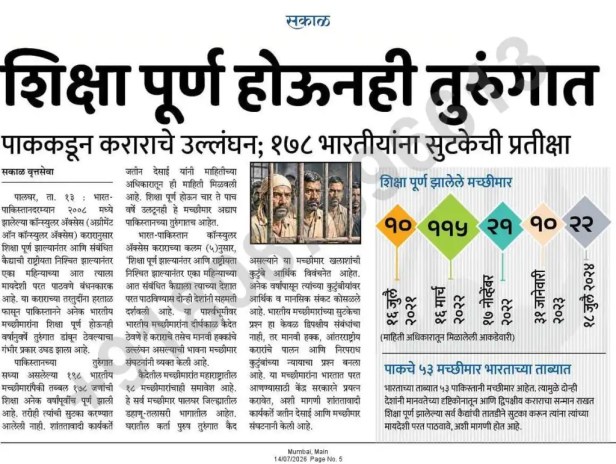
Clipping from Marathi paper ‘Sakal’ headlined: “In prison even after completion of sentences”, 14 July 2026
The letter also calls for accountability for continued detentions despite completion of prison sentences, which is in violation of the bilateral Agreement on Consular Access, 2008.
Section 5 of the Agreement categorically states: “Both Governments agree to release and repatriate persons within one month of confirmation of their national status and completion of sentences.”
“Unfortunately, this provision has not been implemented in letter and spirit,” says a press statement issued jointly on Friday by the Pakistan-India Peoples’ Forum for Peace and Democracy (PIPFPD), the National Fishworkers Forum, the Pakistan Fisherfolk Forum and families of Imprisoned Fisherpeople.
The letter urges both governments to implement mechanisms to prevent such delays in the future, and to pursue a ‘No Arrest Policy’ for fisherpeople who inadvertently cross the maritime boundary while pursuing their livelihoods. This is something that activists have long been calling for.
The number of arrests have declined significantly over the past couple of years — nearly 750 fisherfolk were imprisoned in jails across Pakistan and India in April 2023.
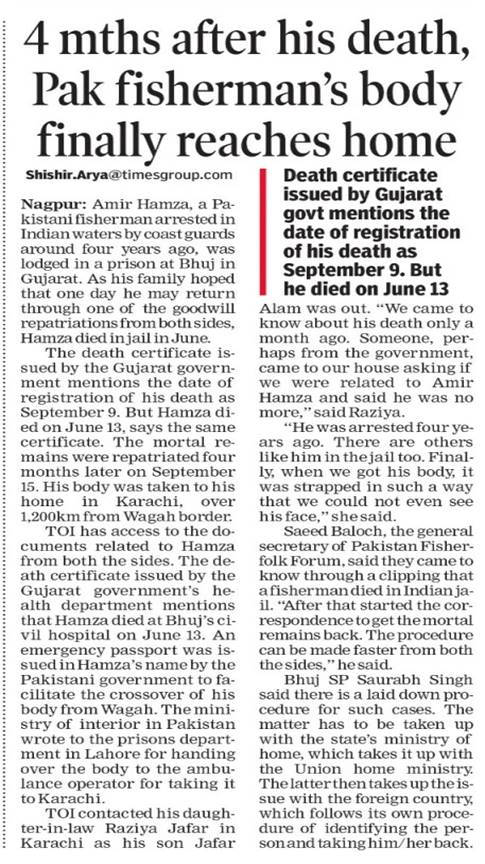
Report about Pakistani prisoner Amir Hamza’s death in Indian prison, by Shishir Arya, Times of India, 17 September 2021
The statement suggests that this is because “fisherpeople avoid going towards the International Maritime Boundary Line to catch fish”.
According to the press statement there are “shocking” stories about Indian fisherpeople arrested by Pakistan and vice versa.
“Their prolonged incarceration deprives them and their family members of basic human rights and causes severe hardship to their families,” subjecting them to “economic and emotional distress,” says the statement, urging that the arrest and detention of fisherpeople be viewed from a humanitarian perspective.
As many as 198 Indian fisherpeople are currently imprisoned in Pakistan, including 78 who have completed their sentences but continue to remain in custody, according to the data released in the statement.
“Every year, an estimated four to five Indian fisherpeople die while imprisoned in Pakistan. In March last year, an Indian fisherperson also died by suicide in prison,” says the statement.
According to the latest prisoner exchange list released on 1 July this year, Pakistan holds 250 prisoners (52 civilian prisoners and 198 fishermen) “ who are Indian or believed-to-be-Indian ” as India’s Ministry of External Affairs put it in a media release.
Meanwhile, India holds 439 Pakistani “or believed-to-be-Pakistani prisoners , including 386 civilian prisoners and 53 fishermen,” to quote Pakistan’s Ministry of Foreign Affairs.
This language of ‘believed-to-be’ used by the bureaucracies on either side is a reflection of the need to verify identity before proceeding with repatriation or even consular access. The detained fisherfolk rarely carry identity documents while out fishing. Once arrested, verifying their identity is a cumbersome process that typically takes far longer than necessary, especially in this digital age.
Yet, despite their ongoing tensions, both countries have regularly exchanged prisoner lists twice a year, in January and July, since the practice began in 2008, following the constitution of a Joint Judicial Commission on Prisoners in 2007.
Comprising four retired justices from either side, the committee met twice a year and worked on expediting the release of cross-border prisoners.
However, it has not met since its last convention in October 2013 in India.
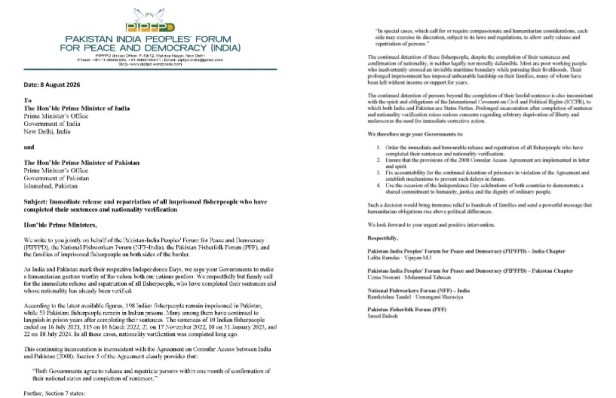
A heartfelt appeal: Joint letter to the Prime Ministers of India and Pakistan from the Pakistan-India Peoples’ Forum for Peace and Democracy (PIPFPD), National Fishworkers Forum (NFF) India, and Pakistan Fisherfolk Forum (PFF) - sapannews.com