
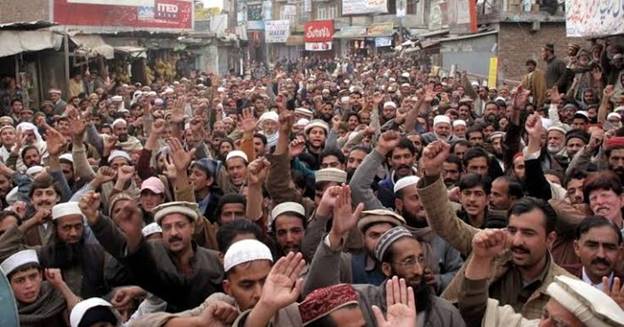
If smaller provinces are to be created it would be better to put the question to a national referendum under Article 48(6) of the Constitution, so that the people of Pakistan have a chance to decide their own future. In the event of an affirmative vote, the constitutional provisions could then be invoked to bring about the sub-division of provinces – Photo NBC News
More Provinces? Let the People Decide
By Jawad Sohrab Malik
Pakistan
The evolution of provincial alteration in British India began with the Regulating Act of 1773, after which the colonial state repeatedly altered India for its own purposes. The process culminated in the Government of India Act, 1935, which introduced provincial autonomy and proposed the creation of a Federation of India — and, in turn, shaped the constitutions of both India and Pakistan.
In 1947, India and Pakistan inherited provinces which had been created, altered, sub-divided and named for colonial reasons. Both countries faced a fundamental question: should their respective internal state boundaries preserve colonial arrangements, or redraw them to reflect the linguistic, cultural, geographical and administrative realities of their peoples?
India’s response was that the union could alter its internal geography without threatening the unity of the union itself.
India is a federation: Article 1 of its constitution declares that “India shall be a union of states.”
Articles 2 and 3 empower parliament to admit or establish new states and, in doing so, to increase or diminish their areas, alter their boundaries and change their names. Parliament is supreme; the affected states have no veto.
India’s States Reorganisation Commission, appointed in 1953, submitted its recommendations in 1955; these were enacted through the States Reorganisation Act, 1956 and the 7th Constitutional Amendment.
Indian states were reorganised extensively along linguistic and territorial lines. Where British India had 17 provinces at the time of Independence, today India comprises 28 states and 8 union territories — and the union stands strengthened.
Pakistan’s history is the converse of India’s.
At independence in 1947, it had five provinces: East Bengal, West Punjab, Sindh, the North-West Frontier Province and Balochistan (the last, then a chief commissioner’s province, granted full provincial status only in 1970).
Yet where India progressively accommodated linguistic diversity by creating smaller states, Pakistan repeatedly centralised, abolished and then restored provincial identities. In 1955 the One Unit Scheme merged West Punjab, Sindh, the North-West Frontier Province and Balochistan into a single province, West Pakistan, leaving the country with just two units — East and West — in order to create administrative and political parity between the two wings.
The One Unit Scheme was doomed from the start. By suppressing the historic identities of the four western provinces it bred deep hostility, and the experiment failed: after fifteen years, One Unit was abolished in 1970. Such belated reversals could not prevent the dismemberment of Pakistan.
After the secession of East Pakistan in 1971, the four western provinces remained the principal constituent units of Pakistan. Article 1 of the Constitution of Pakistan, 1973 declares that “Pakistan shall be a federal republic” and that its territories shall comprise “the provinces of Balochistan, the Khyber Pakhtunkhwa, the Punjab and Sindh”.
Article 239(4) declares that “a bill to amend the Constitution which would have the effect of altering the limits of a province shall not be presented to the President for assent unless it has been passed by the Provincial Assembly of that province by the votes of not less than two-thirds of its total membership.” In effect, the article grants a veto to the affected state: the federal legislature alone cannot alter provincial boundaries.
History shows that provincial boundaries have never been immutable — but constitutional possibility is not constitutional wisdom. Much depends on the specifics of any alteration, and on the disposition of the provincial assemblies.
The crucial distinction is who possesses the constitutional power to redraw the map of a province: in India, Parliament is supreme; in America, it is Congress plus the affected state; in Britain, Parliament alone; and in Pakistan, it is Parliament plus the affected provincial assembly.
Compared to India, an alteration of an existing province in Pakistan is much more complex constitutionally and democratically: the affected state legislature may not allow it; the constitutional and democratic legitimacy of federal and Provincial legislatures is widely contested here and abroad; the requisite constitutional and democratic processes lack transparency and public credibility; political calculations cannot be ruled out; and, not least, who is to decide whether sub-dividing the provinces serves the national interest and strengthens the federation?
The arguments over smaller provinces are much the same in every federation. In their favour, it is said that they bring government closer to citizens, correct population imbalances, narrow economic and developmental disparities, provide direct political representation, preserve historical and linguistic identity, allow local control over resources and promote federal stability.
Conversely, the arguments against are equally well settled: more provinces entail prohibitively high administrative costs, ethnicise politics, create new boundary disputes, fragment historic provinces and negate equal representation in the Senate; political calculations may weaken the federation; and ethnic-based restructuring in Sindh can itself generate conflict.
Imagine a multiplicity of provinces, each entailing its own assembly, chief minister, cabinet, high court and the rest; the sheer cost of such duplication might be too high for the smaller provinces to bear.
Pakistan is, moreover, a state of acute political polarisation , and any tinkering with the existing provinces risks inflaming an already volatile situation.
If smaller provinces are to be created it would be better to put the question to a national referendum under Article 48(6) of the Constitution, so that the people of Pakistan have a chance to decide their own future. In the event of an affirmative vote, the constitutional provisions could then be invoked to bring about the sub-division of provinces.
(The author has served as a special assistant to the prime minister. Dawn)
