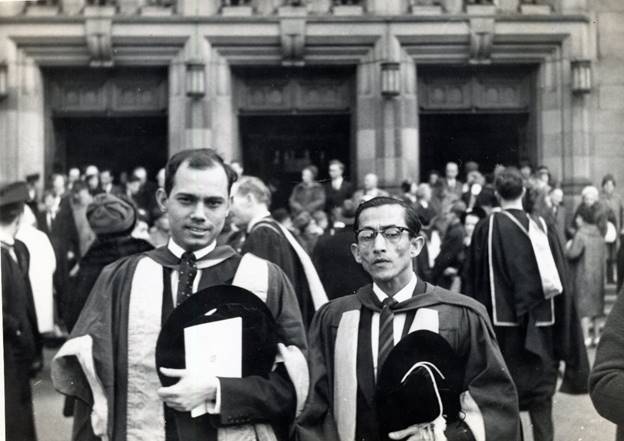
The author (left) and his friend Dr Ayub Bukhari receiving PhD degrees at the University of Birmingham, England, 1963
Saying Goodbye Can Be Hard
By Dr Syed Amir
Bethesda, MD
It is a story from long ago, from the fifties, when my parents still lived in Sahaswan, our ancestral hometown in Uttar Pradesh. I was a student at the Aligarh Muslim University (AMU) and came home several times a year during the summer and winter breaks. In my small town, almost everyone was either related to me or a friend of my father, who practiced Unani medicine and followed his forefathers' profession.
I was usually spoiled with good food and a lot of attention, especially from my mother and sister, so when it was time to return to Aligarh, I was sad to leave. While my mother and sister were visibly sad to see me go, my father did not take it too seriously, knowing I would be back in a few months.
I have fond memories of our family servant, who had become part of the family and unfailingly came to the bus stop to see me off. Often, he was the only one who did. At the time, I did not appreciate his quiet attachment to me, as he had known me since I was born.
Student life at the AMU, where I shared a room with my cousin, was spartan. Sahaswan was not connected by railway. Instead, rickety buses carried us to the nearest railway station, some 17 miles away. These days, no one would consider it a long distance, but the journey was often rough. The buses frequently broke down, ran out of gas, and had to share the road with bullock and camel carts. In the monsoon season, the road was often washed away.
After completing my MSc at AMU, I decided to move to Pakistan, where many of my close relatives, including my married sister, had already relocated. It was a major decision, potentially involving renunciation of Indian citizenship, with no certainty about when I would return, given the perpetual bad relations between India and Pakistan. Personally, I was reluctant to leave the town permanently, where my forebears had lived for five centuries. However, the dismal prospects of a career in India convinced my father and me that migration to Pakistan was the best option.
For many years, my father had hoped that AMU would have a functioning medical college by the time I was ready to enroll. Dr Zia Uddin Marhoom had raised sufficient funds to start the project, but the turmoil of the partition forced the authorities to put the plan on hold. Thus, I was deprived of the opportunity to follow the profession of my ancestors.
My departure from Sahaswan for Pakistan was an out of the ordinary event. Many of my relatives and friends came to the bus stop to say goodbye. As the bus moved, I was deeply emotional and tearful, knowing I might never see some of them again—as proved true. Sahaswan was then a small town of about 22,000 people. It had little industry or commerce, and most residents owned land, whether in large or small holdings. After the zamindari system was abolished after independence, the town fell on hard times. Many service people who had relied on modest wages from more prosperous landlords found themselves in an unviable situation as the rich had little left to offer. Today, when I look back on the plight of sweepers, water carriers, and domestic servants who served us, I feel deeply emotional. It is hard to imagine how they fed and supported their families. Many were expected to offer their services for free until a wedding or other celebratory occasion, when they would receive meager payment.
I recall our water carrier going around at night collecting leftover food from various homes he served. It is amazing how, growing up, one can become insensitive to the misery of others and accept it as God's will. Now I regret that I can do nothing to make up for the sufferings of those people. In any event, all those who suffered this way are no longer around.
The most emotionally fraught visit I can recall was the one I made before leaving for England on a government grant to pursue graduate studies. I came to Sahaswan on a farewell visit. My parents and other relatives knew they would not see me for at least three years. It is difficult today to imagine what it was like in the early sixties to go to England for education. Air travel was expensive, long, and nothing like what it is now. Most students like me, who received a scholarship, were given two air tickets--one for the trip there and another for the return trip.
A large crowd of friends and relatives gathered at the bus stop, including my father, who had rarely done so before. I can now gauge the degree of anguish my parents must have felt at the time by how I feel when my son, Zubair, a professor of English at a university in Chicago, leaves after spending some time with us.
My planned three-year stay in England stretched to six when I accepted a three-year postdoctoral fellowship to gain experience in the new field of Endocrinology. Remarkably, my parents did not complain, believing the extra years would advance my career. This acceptance was even more impressive when you consider that, at the time, there were no Zoom, email, or smartphones, and our town had no telephone connection. My letters took nearly ten or twelve days to reach Sahaswan. I don’t recall my parents asking me to wrap up my work and return
There were about 25 to 30 students at Birmingham University when I was there Among them, Dr Akbar Ahmad joined the Pakistan Civil Service and later became an acclaimed author and professor. Dr Kaleem ur Rehman returned to serve as head of the English Department and Dean of the Faculty of Arts at the University of Karachi. Dr Khurshid Alam Khan became the director of the PCSIR Publication Division. Dr Noor Mohammad Butt served as Scientist Emeritus at Pakistan Atomic Energy Commission after his retirement, and Shaukat Mirza became the CEO of Exxon, but lost his life in a terrorist attack. None of them, as I recall, visited Pakistan during their studies at Birmingham. Most of us did not have the money to buy air tickets. I feel envious when I see people traveling between Karachi and London virtually every few months for business or pleasure.
During my six-year stay at Birmingham University, I had to admit that I was too busy working in the laboratory and engaging in other social activities to think much about my parents, who were waiting for me. Today, in retrospect, what I would not give to spend some time with them, both gone a long time ago.
On my return to Pakistan, I joined the Pakistan Council of Scientific and Industrial Research, which had sponsored my PhD studies; the perennial bad relations between India and Pakistan made it difficult to secure a visa to India. When I finally obtained it, it was restricted to three cities. I could not legally visit my beloved AMU. It was a joy to return to my hometown and my parents. Sahaswan had changed during the preceding seven years I had been away; several of my relations had departed. However, the visit brought back many warm, happy childhood memories. I knew I was home.
(The writer is a former assistant professor, Harvard Medical School and retired health scientist administrator, US National Institutes of Health)