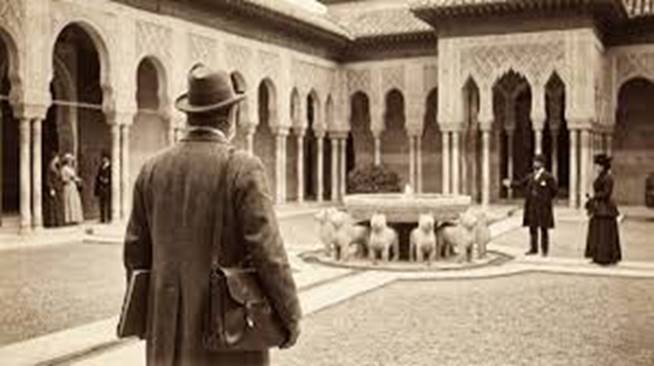
The Friday Times
Washington Irving and the Mystique of Alhambra
By Dr Syed Amir
Bethesda, MD

As a school student, I read Washington Irving’s Tales of the Alhambra, published in 1832, and translated a century later by the renowned Urdu writer Gulam Abbas. I was enthralled. Even after all these years, I have not lost my enchantment with the stories written nearly two centuries ago. The blend of fact, romance, and myth in these stories continues to have enduring appeal for many South Asian Muslims, who admire and marvel at architectural masterpieces left by Muslims in Spain, such as the Alhambra and the Mosque in Cordoba.
Washington Irving was an American writer, storyteller, and diplomat, born in New York in 1783. It was an era of turmoil in America. The war had just concluded, and England had agreed to grant independence to America. Irving began his writing career with fiction, including the short stories "Rip Van Winkle" (1819) and "The Legend of Sleepy Hollow" (1820), which launched him as a professional writer. He became a prolific author, completing his five-volume biography of George Washington in 1859, which is considered one of the most authoritative biographical works.
His interest in Spain and Granada was sparked when his friend, a diplomat in Spain, invited him to visit, promising that archival documents on Columbus’s expedition to America would be available for his study. Irving eagerly accepted. The invitation initiated a lifelong interest in Spain and its Moorish past.
Irving first visited the Alhambra in 1828 and returned a year later for a longer stay. He obtained permission from the Governor of the Alhambra to reside in the ramshackle, desolate palace for three months. During his stay, Irving made extensive notes on what he saw and heard, which later formed the basis of his popular book, The Tales of the Alhambra. The book drew attention in Europe to the plight of the Moorish monument, which is now a World Heritage Site.
Meanwhile, Irving developed a romantic attachment to Spanish Muslim history and culture, as evidenced by his two books, Chronicle of the Conquest of Granada and The Tales of Alhambra. The latter incorporates his personal observations with romantic fiction drawn from exotic legends he heard. Many of his observations offer a window into Spain and the Alhambra of two centuries ago, places very different from what they are today.
I visited Spain in the early sixties, when I was a graduate student in England. General Franco was firmly in power, and the country was among the poorest in Europe. As I stepped out of the modest Cordoba railway station, I was mobbed by people scrambling to take me home, offering a bed and meals at a moderate price. The prices were a bargain compared with hotel rates.
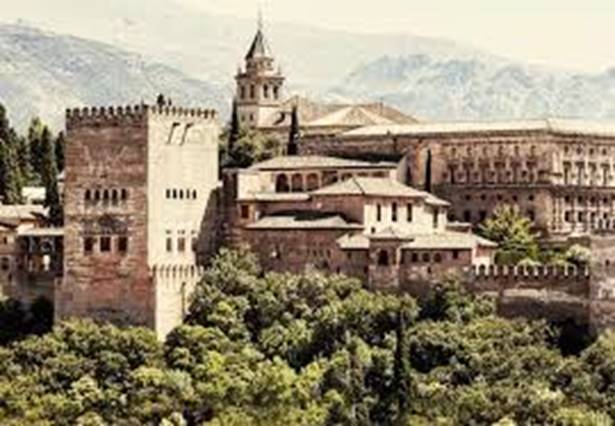
Pancho Tours
also encountered something familiar in that strange, distant land, the fragrance of Rat ki Rani (Night ‑Blooming Jasmine) and Chumbeli, evoking fond memories of my hometown in Uttar Pradesh. More than a century earlier, famed author Somerset Maugham had smelled the same sweet aroma wafting in the air: “Cordoba has that sweet, exhilarating perfume of Andalusia, than which nothing gives more vividly the complete feeling of the country.” He remarked in his book, The Land of the Blessed Virgin.
It was summer, the high tourist season, when I traveled to Granada. Surprisingly, I found the Alhambra not particularly crowded. More recently, on my second visit, I found that Spain, under a democratic government, had become much more prosperous, while the Alhambra and its heavenly gardens were so popular that visitors were limited in how long they could stay.
Irving’s The Tales of Alhambra provides a vivid description of the palace's sorry state, which served as home to 23 Nasrid Sultans who ruled Granada from 1232 to 1492. While the bygone splendor of the royal palace built in the shadow of the snow-covered Sierra Nevada was still discernible, many of the related buildings no longer existed.
After the Christian conquest of Granada in 1492, the last Muslim king, Muhammad XII Abu Abdullah (Boabdil),
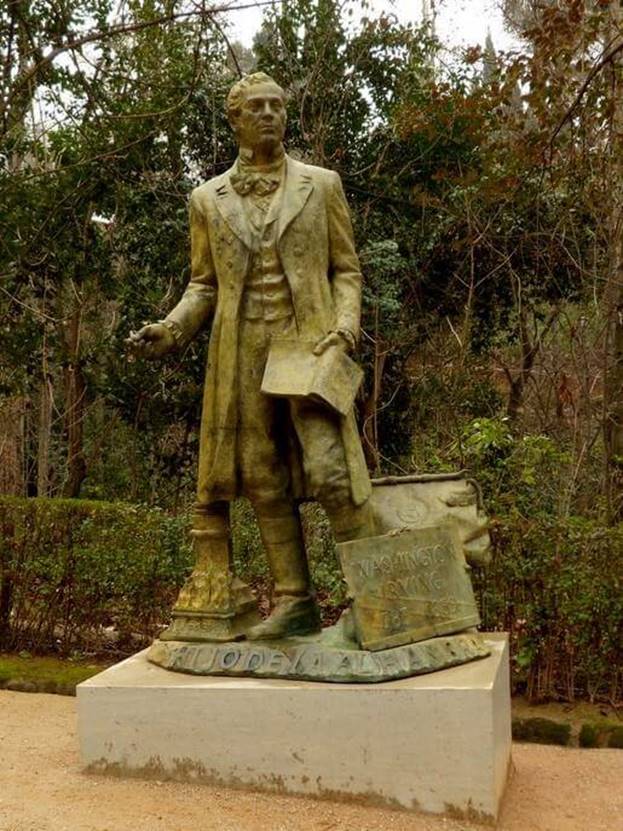
Washington Irving’s statue at Alhambra
was forced into exile, while the victorious King Ferdinand and Queen Isabella spent little time in the Alhambra. Thereafter, the citadel was intermittently used by various Christian rulers and was largely abandoned. Irving described it exquisitely. “Alhambra’s beautiful halls became desolate, and some of them fell to ruin: the gardens were destroyed, and fountains ceased to play.” As expected, it became home to lawless elements, bandits, smugglers, and rogues who operated from the safety of its isolated halls and terraces.
The Alhambra fell under French occupation in the early nineteenth century, during the Napoleonic occupation of Spain, when some French soldiers were stationed there. They performed minimal repairs and renovations, temporarily restoring it to some of its erstwhile elegance.
Irving was powerfully motivated to explore monuments and the vast archaeological treasures that lay buried in their ruins. During his stay at the Alhambra, he wandered at all hours through its abandoned, once-majestic halls, exploring its obscure corners and defunct fountains. He developed an easy rapport with the monument's caretakers and heard exotic, incredible stories about Muslim kings who once inhabited the palace, stories passed down among Spaniards for generations. There was a common belief that the Alhambra was haunted and under a spell cast by Muslims who returned often in the dead of night, seeking their treasures buried centuries earlier.
Irving drew his knowledge and inspiration not solely from the poor concierges of the Alhambra. He studied history and the Muslim culture of Andalusia at the University of Granada, and his books, Chronicles of the Conquest of Granada and The Tales of Alhambra, betray his deep understanding of Moorish culture. He developed empathy for the Nasrid rulers of Granada who built the Alhambra, transforming it into an architectural masterpiece.
In his book, he is especially expansive in defending Abu Abdullah, the 21 st and last Muslim ruler, against false allegations. Today, guides to the Alhambra usually take the visitor to the Hall of Abencerrages (Banu Sarraj), where it is alleged that some thirty noblemen were mercilessly beheaded; their bloodstains can still be seen in the marble basin. Abu Abdullah has been blamed for this atrocity. However, Irving argues that the Abencerrages were, in fact, victims of palace intrigues in which Abu Abdullah’s father, Muley Abul Hasan, not he, was instrumental
Abu Abdullah remains a tragic historical figure, and some historians have held his weak and irresolute character, as well as his collusion with the Christian monarchs against his own father and uncle, responsible for the fall of Granada. In his landmark book, History of the Arabs, Professor Philip Hitti suggested that the siege of Granada, which brought terrible starvation, forced Abu Abdullah to surrender to the Catholic Monarchs.
The most poignant description in The Tales of Alhambra recounts Abu Abdullah's handing over the keys of the Alhambra to Ferdinand and Isabella. To experience the anguish firsthand, Irving retraced his path to the barren stretch of land where “Boabdil uttered his sorrowful exclamation, as he turned his eyes from taking the last farewell gaze at Alhambra.” Who can gauge the anguish and humiliation Abu Abdullah must have felt at surrendering the Kingdom and the Alhambra, founded and nurtured by his ancestors over two centuries?
(Dr Syed Amir is a former Assistant Professor, Harvard Medical School, and a health science administrator, US National Institutes of Health)