
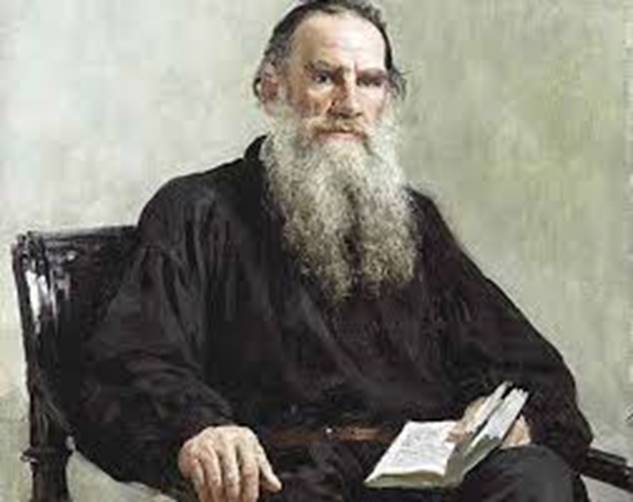
As a writer, Tolstoy stands as a literary giant among giants, emerging from a period of high-quality writers like Pushkin, Dostoevsky, and Turgenev. Tolstoy’s novels like War and Peace and Anna Karenina are widely considered to be among the greatest ever written. He was also known for his pacifist views and his ideas of peaceful “non-resistance” against oppressive and violent. – Photo statesawcunited.org
Leo Tolstoy: Apostle of Love in a Time of Chaos and Cruelty
By Akbar Ahmed, Frankie Martin, Dr Amineh Hoti


In 2012, as we worked on our study of the war on terror’s impact on Muslim tribal societies, we searched for a metaphor to frame and explain the dynamic we were observing across the world. It was at the time of the precipitous rise in the use of drones as a weapon of war, and we found, in the forty case studies of Muslim peoples we examined, that these weapons were being used first and foremost in tribal societies. These were peoples living at the peripheries of modern states, often in difficult to access locales like mountains and deserts—places like the Pakistan tribal regions, Afghanistan, Somalia, and Yemen.
For centuries, Muslim tribes had attempted to preserve their independence from modern centralized states, but now, in the context of the “war on terror,” the attention of the entire world and the most advanced military technology was being focused on these regions. This is because US policymakers had identified them as the “ungoverned spaces” where terrorists were hiding. Local state governments, attempting to extend their own central authority and defeat perceived threats to their rule and legitimacy, linked up with Washington to carry out the war on terror. Yet while vast societies were thrown into chaos and hundreds of thousands of people were killed—in Afghanistan, Iraq, Pakistan, Somalia, Nigeria, the Philippines, Yemen, and Mali to name a few—the problem of terrorism did not cease.
We found that many people in such societies living on the periphery viewed the relentless violence they experienced at the hands of governments to be an existential threat to themselves and their way of life, and they held firm in fighting the “center.” Not only were the tribes subjected to attacks from the US, its allies, and state governments, but they also faced violence from militant groups from within their own societies. Nowhere was safe. While the 9/11 attacks had initiated the “war on terror,” people in these tribal societies would say, “every day is like 9/11 for us.”
We soon discovered that over a century prior, the great Russian novelist Leo Tolstoy had given the perfect metaphor for the interaction between the state and the tribes in his novel Hadji Murad, which he completed in 1904. The novel was about a real-life Muslim tribal leader in the Caucasus who fought against Russia, which was attempting to bring the mountainous region under its rule in the nineteenth century. Tolstoy was a first-hand witness to Russia’s attempt to subjugate the tribes while he served in the Russian army. And yet, Tolstoy was impressed by the pride and courage of both Hadji Murad and his people.
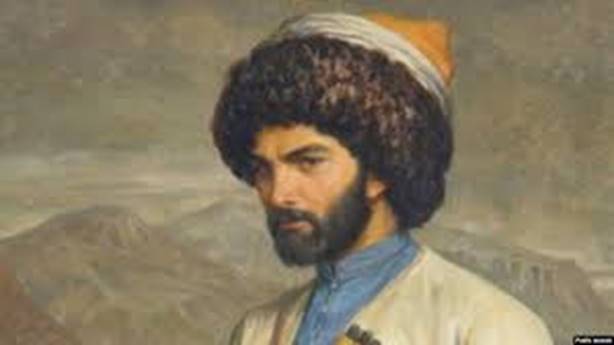
The novel was about a real-life Muslim tribal leader in the Caucasus who fought against Russia, which was attempting to bring the mountainous region under its rule in the nineteenth century. Tolstoy was a first-hand witness to Russia’s attempt to subjugate the tribes while he served in the Russian army. And yet, Tolstoy was impressed by the pride and courage of both Hadji Murad and his people – Hadji Murad PhotoRadio Free Europe/Radio Liberty
Tolstoy expressed his feelings in the novel’s opening scene through the narrator, who, while on a walk collecting a bouquet of flowers, noticed a thistle. He leaned down “to pluck the flower. But this proved a very difficult task. Not only did the stalk prick on every side—even through the handkerchief I wrapped round my hand—but it was so tough that I had to struggle with it for nearly five minutes, breaking the fibers one by one; and when I had at last plucked it, the stalk was all frayed, and the flower itself no longer seemed so fresh and beautiful.” The narrator concludes: “But what energy and tenacity! With what determination it defended itself, and how dearly it sold its life!…‘What energy!’ I thought. ‘Man has conquered everything, and destroyed millions of plants, yet this one won’t submit.’” The thistle, Tolstoy wrote elsewhere, “fights for life till the end and, alone in the middle of the whole field, somehow manages to win the fight.”
Russia, Tolstoy was saying, could attempt to brutally subdue the tribes, but at what cost? The tribes would not yield—they would cling tenaciously to their religion, culture, and identity. The tribes were rejecting the Russian argument that incorporation into the mighty Russian Empire would be a blessing as they would join the modern world and receive the benefits of scientific advancement and “civilization.”
With Tolstoy’s image in mind, we titled our study The Thistle and the Drone. The title captured the ongoing struggle across the world between modern technology such as drones and instruments of surveillance used by centralized, hierarchical, and often corrupt state structures, and tribal societies, which have an ethos of egalitarianism and attempt to preserve their independence and identity. In the current world, the thistle was refusing to yield against the onslaught of the drone.
At the book’s conclusion, we presented ways in which the conflicts and violence between center and periphery could be resolved, including treating tribal peoples with empathy, dignity, and honor and enabling them to be a part of and benefit from states on their own terms, such as via federal arrangements. This would allow them to preserve core aspects of their identity and integrity while also joining the modern world. If this could be done, the US and the nations of the world would be much safer from the threat of terrorism and people of different backgrounds could live their lives in peace, prosperity, and security.
The Thistle and the Drone gave us further insight into the genius of Tolstoy. As a writer, Tolstoy stands as a literary giant among giants, emerging from a period of high-quality writers like Pushkin, Dostoevsky, and Turgenev. Tolstoy’s novels like War and Peace and Anna Karenina are widely considered to be among the greatest ever written. He was also known for his pacifist views and his ideas of peaceful “non-resistance” against oppressive and violent states. Tolstoy was a sensitive person grappling with the big questions of life and society, sincerely seeking God and trying to live a simple and moral life. He attempted to rouse the consciousness of the world and lead it in a more just, peaceful, compassionate, and loving direction. His pacifism became a movement in his own lifetime and profoundly influenced great figures like Mahatma Gandhi and Martin Luther King, Jr. Yet today the man who inspired them is much less well known, and if he is, it is as a novelist rather than the public intellectual, philosopher, and social activist he also was.
For us, the authors, Tolstoy is a great “Mingler,” a person who embraced all of humanity regardless of race, ethnicity, nation, or religion. Tolstoy saw all the world’s people as part of a single unitary whole, and in his own impassioned work which included but went far beyond his novels, he attempted to spread this message. His literature, renowned for its realism, introduced his audience to many ordinary people of different backgrounds and their struggles in life. Through Tolstoy’s empathetic eye, the audience feels for these characters, understands them, and is able to reflect on morality and the universal aspects of life which all humans face. Deeply inspired by Jesus Christ, Tolstoy tried to break down all barriers which separated people from one another. He spoke incessantly and above all else of the power and necessity of love. In his work such as Hadji Murad he displayed a keen cross-cultural curiosity and sensitivity, and in his extensive educational efforts he attempted to open the Russian mind to the great wealth of humanity’s diverse religious and cultural legacy. With these lessons, Tolstoy felt that Russia and humanity in general would be able to meet the profound challenges of the modern age: urbanization, mechanization, industrialization, wealth disparity and the concentration of wealth in the hands of a small elite, technological development, and the accumulation of totalitarian state power. While the world of Tolstoy’s time was rapidly transforming and many hailed a new age of human and scientific progress, Tolstoy felt that if not handled in the right way, these developments could lead to the deaths of untold millions of people and global catastrophe. While Russia was embroiled in political debates between groups such as Marxist revolutionaries, liberal reformers, and conservative nationalists, Tolstoy presented an alternative to all of them in the moral positions he took. Tolstoy looked at the rapidly changing modern world through the lens of love and compassion, values which were constantly being challenged in the real world. In his thinking, style of public writing and communication, and even appearance, he resembled a Biblical prophet bringing a message of love to humanity.
In this piece, we wish to highlight Tolstoy’s thinking on the “Other”—people who are ethnically, racially, religiously, or nationally “different” from one’s own self and group. Over a lifetime of scholarship, artistic work, and philosophical study, Tolstoy seriously and soberly reflected on the problem of discord, ignorance, hatred, and violence between peoples and how these ills could be ameliorated. Our world today, as Tolstoy’s was, is beset by wars, violence against minorities, government authoritarianism, exclusionary nationalism, surveillance, societal polarization, stark wealth disparities, massive and rapid technological changes such as the coming of AI, and fears for the future of humanity. In this perilous environment, Tolstoy’s lessons and solutions for our predicament are crucial for us to consider and learn from.
The life of Tolstoy
Tolstoy was born in 1828 at Yasnaya Polyana, his family estate, near Tula, Russia, 200 kilometers south of Moscow. His family was aristocratic and one of the most prominent in Russia. Tolstoy’s ancestor was said to have arrived in what is today Ukraine from Lithuania in the fourteenth century, and his descendants settled a century later in Moscow, which was quickly becoming the political center of Russia. The Grand Prince of Moscow, in gratitude for the family’s service, gave Tolstoy’s ancestor the affectionate name “tolstoy,” meaning “fat.” In 1724, Tolstoy’s great-great-great grandfather, Peter, was made a Count of the Russian Empire by Tsar Peter the Great, a title Tolstoy inherited. In the nineteenth century, prominent Tolstoys made their mark in different fields—Alexander Ivanovich Osterman-Tolstoy (1770-1857), a military commander in Russia’s victory over Napoleon, the painter Feodor Petrovich Tolstoy (1783-1873), the Russian Minister of Education Dmitri Andreevich Tolstoy (1823-1889), and the poet and playwright Alexei Constantinovich Tolstoy (1817-1875). Tolstoy’s father, Count Nikolai Tolstoy, was a veteran of the 1812 war against Napoleon, while his mother, Mariya, was a princess of the Volkonsky family. The Volkonskys claimed descent from the Rurikid Dynasty, which Russians hold to have to have originated the Russian Monarchy in the ninth century.
Tragedy struck early in Tolstoy’s life as his mother died when he was two years old, and his father died when he was nine. This left Tolstoy in the care of relatives who raised him. Growing up, Tolstoy was taught by tutors, a usual practice among the aristocracy. At the age of 15, he began his studies in at the University of Kazan, east of Moscow. Kazan was the former capital of the Tatar Khanate of Kazan prior to its conquest by Russia. Even at this early age, Tolstoy’s cross-cultural interests were perceptible, as he applied to this university due to its reputation for Oriental languages. Tolstoy’s great-great-great grandfather, Peter, had been Russian ambassador to the Ottoman Empire, and Tolstoy was interested in becoming a diplomat himself. He embarked on his studies in the Arabic and Turco-Tatar languages, and was taught by the renowned Azerbaijani Orientalist scholar and philologist Mirza Kazem-Bek. He failed the freshman year exam, however, and decided to take up law instead, which he similarly dropped, and left university without securing a degree.
Upon leaving university, Tolstoy inherited his parents’ estate, including the village of Yasnaya Polyana. Tolstoy now owned the manor house, the village, and the serf population of 350, in addition to their families. In Russia, a lord had total power over their serfs. The lord could “make them his personal servants or send them into the army, permit or forbid their marriages, flog them within an inch of their lives.” Yet soon after securing this inheritance, Tolstoy displayed what would be a lifelong dedication to educating and uplifting the Russian peasantry, a commitment that would further intensify following the emancipation of the serfs in 1861. He began in Yasnaya Polyana, opening a school for peasants in the late 1840s.
What mainly characterized his life during this period, however, was what he described as pleasure, gambling, and debauchery among the aristocracy in places like Moscow and Saint Petersburg. In 1851, he joined the army, and was posted to the Caucasus, where he fought against Chechen tribes as an artilleryman. Subsequently, he commanded an army unit during the Crimean War. Here he experienced the famous siege of Russian-held Sevastopol by Britain, France, the Ottoman Empire, and Sardinia, which inspired great literary works including Tennyson’s “The Charge of the Light Brigade” and Tolstoy’s own Sevastopol Sketches. Tolstoy had already begun writing at this point, but the publication of Sevastopol Sketches brought him celebrity. In his writing on the siege, Tolstoy has been described as “one of the first ‘war correspondents.’”
Tolstoy left the army and returned to St Petersburg, where he moved in literary circles alongside such figures as Turgenev. He now decided to focus more intently on education, opening another peasant school in 1859, and some twenty schools were founded by 1862. At a time when most peasants were illiterate, Tolstoy believed that education was a human right and that every person should have access to education—as Tolstoy said, humans seek education “as they love and seek air for breathing.” Tolstoy also traveled west during this period to places like Britain, Germany, and France to learn about how they approached education while attempting to develop his own “Russian” method, with a particular focus on the peasantry. While his schools did not last very long due to government interference and he was not able at this stage to form a school movement for Russia’s peasantry, the experience was formative for him and shaped many of his later passions in improving the life of the poor. Later, his ABC Book was adopted by the Russian Ministry of Education for use in Russian public schools.
Following his marriage in 1862 and the birth of his first child, Tolstoy settled down to a domestic life at his Yasnaya Polyana estate where he would remain for the
Leo Tolstoy, Hadji Murád. Translated by Aylmer Maude. (New York: The Modern Library, 2003), pp. 3-5.
Tolstoy’s Diaries, Volume II: 1895-1910. Edited and translated by R. F. Christian. (London: The Athlone Press, 1985), p. 429.
Akbar Ahmed, The Thistle and the Drone: How America’s War on Terror Became a Global War on Tribal Islam (Washington, DC: Brookings Institution Press, 2013).
Harlow Robinson, “Six Centuries of Tolstoys,” The New York Times, November 6, 1983.
Alan Pinch, “The historical background.” In Alan Pinch and Michael Armstrong, eds., Tolstoy on Education: Tolstoy’s Educational Writings 1861-62. Translated by Alan Pinch. (Rutherford: Fairleigh Dickinson University Press, 1982), p. 11.
Pinch, “The historical background,” p. 13.
Pinch, “The historical background,” pp. 12-13.
Alain Refalo cited in Alexandre Christoyannopoulos, Tolstoy’s Political Thought: Christian Anarcho-Pacifist Iconoclasm Then and Now (Abingdon, Oxon: Routledge, 2020), p. 7.
Pinch, “The historical background,” p. 18.
Linda Torresin, “Not Only a Writer, but also an Educator: Leo Tolstoy, Children, and Pedagogical Stories.” In Leo Tolstoy, Writings for Young Children. Translated and edited by Michael R. Katz. Illustrated by Jake Scott. (Boston: Cherry Orchard Books, 2025), pp. viii-ix.
Torresin, “Not Only a Writer, but also an Educator,” p. xvi.
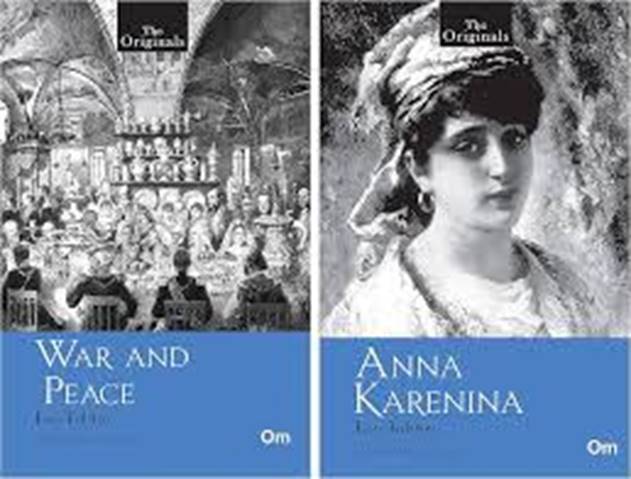
Following his marriage in 1862 and the birth of his first child, Tolstoy settled down to a domestic life at his Yasnaya Polyana estate where he would remain for the rest of his life. Here he wrote prodigiously, including the vast and sprawling War and Peace, which he began in 1863 and finished in 1869. He followed this masterwork with Anna Karenina, published in 1878. These works were immediate sensations, and Tolstoy’s fame grew in Russia and around the world
rest of his life. Here he wrote prodigiously, including the vast and sprawling War and Peace, which he began in 1863 and finished in 1869. He followed this masterwork with Anna Karenina, published in 1878. These works were immediate sensations, and Tolstoy’s fame grew in Russia and around the world.
Tolstoy as prophetic figure
Yet, despite his success, Tolstoy was unhappy. While working on Anna Karenina, he experienced a personal crisis of meaning. “I felt lost and fell into despair,” he said, afflicted with an “inner disease.” He told himself, “Well fine, so you will be more famous than Gogol, Pushkin, Shakespeare, Molière, more famous than all the writers in the world, and so what?”
While Tolstoy until this point had not considered himself to be religious, he now embarked on and became consumed by a religious quest which lasted the rest of his life. Tolstoy found meaning in the example and teachings of Jesus, which Tolstoy took very seriously in terms of his own life. In his attempt to understand Jesus, Tolstoy looked not to the institution of the church or to its rituals and dogmatic rules, but to what he saw as Jesus’ inner or core message. He became convinced that the message of Jesus was one of total and complete pacifism and non-violence, that there was, as he put it, an “impossibility of reconciling Christianity with force and war.” Of particular importance was Jesus’ Sermon on the Mount, with its exhortations to love your enemies and to be peaceful in every aspect of life. In the Sermon on the Mount, Jesus says “Do not resist evil,” a statement which shaped Tolstoy’s view of non-violent resistance.
Tolstoy saw violence all around him. He had witnessed it firsthand in the army. But he detected and was disturbed by violence even beyond the great numbers of people who were being killed in wars as the nineteenth century progressed into the twentieth. One stark example was the subjection of the peasants. Even after they were emancipated from serfdom, they were being brutalized and held in check by violence, for example in their treatment by the upper classes and business and factory owners. With his growing religious awareness, Tolstoy was increasingly conscious of his own class position and the manner in which the monarchy and aristocracy was running Russia, remarking, “our life, the life of the wealthy classes, is non-stop theft and robbery. He perceived vast class discrepancies forming—a small elite was growing increasingly prosperous while the vast majority of people could not secure the basic wages it took to live a decent life. While Tolstoy was observing these trends in Russia, he also observed them in different levels of intensity across Europe and beyond.
As his thinking developed, Tolstoy focused in particular on the modern state. The state operated primarily through violence, Tolstoy argued, and did not protect the interests of the citizenry. Instead, the state was run by the upper classes who used it to perpetuate their privileged status at the expense of the larger population. While Tolstoy lived in autocratic Russia, he also argued that the same pattern was evident in democracies, because in these states politicians were preoccupied with retaining power. In democracies, he pointed out, a majority group which secures 51 percent of the vote can then use mechanisms of state violence to oppress the losing 49 percent. Aristocrats and elected leaders both, then, had an interest in using state power to preserve their position.
Tolstoy believed that the people who run modern states also use violence almost unthinkingly because they have bleak views of human nature. They often believe that humans are “dreadful creatures…governed by nothing except hatred and madness” and they must act in the name of protecting the “good” from “bad” people. The rulers of states have grown up since childhood in such an environment, Tolstoy contended, which leads them to overlook their common humanity with the people their policies directly impact, and they fail to question their underlying bleak assumptions which are reinforced by “scientific” theories.
Tolstoy explained that unlike in past centuries, when one kingdom conquered another and many ordinary people were basically left alone, the modern state seeks to control the lives of people, and it does this through coercive and violent means—the police and security services, the judicial system, the penal system, the use of capital punishment, and the army, which turns men into “machines.” Humans used to kill each other face to face, forcing them to deal with the consequences of their deeds, but now with new technology, “the consequences of our cruelty are so carefully removed and concealed from us, that there is no restraint on the bestiality of the action.” Tolstoy described the modern state, citing the Russian writer Alexander Herzen, as “Genghis Khan with the telegraph,” which perpetuated “atrocious infamies, inconceivable under the Neros.” Tolstoy additionally observed that in modern states, armies are most often used not against other countries, but against their own citizens.
It is notable that Max Weber, who provided among the most durable definitions of the state which is still widely cited, “a human community that (successfully) claims the monopoly of the legitimate use of physical force within a given territory,” reached this conclusion “after Weber had been studying Tolstoy at length and had been considering writing an essay or even a book about him.”
None of the modern state’s violent practices, Tolstoy believed, were compatible with Christianity and the message and example of Jesus. He noted how in Russia, the Orthodox Church in its close partnership with the state was endorsing and making this situation possible. Tolstoy believed that modernity was causing Russians, and many people around the world, internal psychological distress and despair. Deep down, he argued, people knew that the immense scale of violence, killing, and oppression the modern state participates in is immoral, but they keep going and try not to think about it. This, Tolstoy says, is hypocrisy. Violence and killing must never be accepted, Tolstoy taught, and he implored the Christians of Russia to follow what he believed was the authentic message of Jesus.
On this basis, Tolstoy urged non-compliance with the modern state, whether in Russia or elsewhere in the world. While Tolstoy condemned all violence such as that by non-state actors including terrorists, revolutionaries, and anarchists, he always pointed out that no entity kills more than states. Tolstoy had little confidence in the leadership of Russia or any other modern country, remarking, “I am seriously convinced that the world—countries and estates and houses—is governed by people who are quite mad. Those who are not mad refrain from taking part.”
Tolstoy’s solution to the problems of his age was a revolution of love. In his own life, Tolstoy adopted simple, peasant-style dress, made his own shoes, and renounced his celebrated title of “Count.” While Tolstoy advocated a simple life on Jesus’ model, he repeatedly made the point that Jesus’ message of brotherhood, non-violence, and human unity was also found in other religions, and he closely studied the world’s major religious texts and took much from them. He published a series of works outlining his new outlook on life and how others could follow this path including Confession (1882), What I Believe (My Religion) (1884), and The Kingdom of God is Within You (1894), in addition to a myriad of essays, letters, statements, and fictional stories using these themes, such as the short story “Where Love Is, God Is” (1885). He took up public causes in support of persecuted pacifist religious sects and organized aid programs for the urban poor as well as famine victims. He believed that raising people’s consciousness through his works was contributing to a progression of human society towards being more loving to one another, which Tolstoy believed was the only way for humans to coexist and deal with modernity without facing destruction.
For many of Tolstoy’s adoring fans, however, the work he embarked on after his religious awakening was a bizarre and unwelcome deviation from his sublime earlier literary creations. “Why, I ask myself,” said the great composer Pyotr Ilyich Tchaikovsky, “should this man, who more than all his predecessors has power to depict the human soul with such wonderful harmony” relegate himself to being “a preacher and set himself up to be our teacher and monitor?” US President Theodore Roosevelt similarly complained, “Tolstoy, his novels are good, but his so-called religious and reformatory writings constitute one of the age-forces which tell seriously for bad.” Furthermore, Roosevelt said, Tolstoy now “dresses like a clown.” In fact, many of the themes of Tolstoy’s religious and political writing are evident in his earlier novels such as War and Peace.
Tolstoy’s religious and political writings also apparently accounted for his not being granted the Nobel Prize in Literature, one of the most famous Nobel snubs in history. According to Carl David af Wirsén, head of the Swedish Academy which bestowed the prize, Tolstoy had “detestable opinions on art, government, and civilization” and possessed a “hostility to all forms of civilization.” Yes, novels like War and Peace and Anna Karenina were “immortal creations,” Wirsén stated, but he believed that if the Academy so honored Tolstoy, it would be perceived as endorsing his opinions, which was out of the question.
In Russia, Tolstoy’s views put him on a collision course with the government as both attempted to define Russian identity—as one journalist put it, “We have two tsars, Nicholas II and Leo Tolstoy.” Tolstoy received death threats, he was constantly monitored by the Tsar’s secret police, his works were banned, and he was excommunicated by the Russian Orthodox Church, which declared him “dangerous” and an “enemy.” The government minced no words in condemning what it called “Tolstoy’s abominations” and many of Tolstoy’s followers were punished by the state for possessing his writings.
Leo Tolstoy, “A Confession.” In Leo Tolstoy, A Confession and Other Religious Writings. Translated by Jane Kentish. (London: Penguin Books, 1987), p. 28.
Tolstoy, “A Confession,” p. 29.
Leo Tolstoy, The Kingdom of God is Within You. Translated by Constance Garnett. (New York: Warbler Classics, 2024), p. 2.
Tolstoy’s Diaries, Volume II, p. 606.
Alexandre Christoyannopoulos, Tolstoy’s Political Thought: Christian Anarcho-Pacifist Iconoclasm Then and Now (Abingdon, Oxon: Routledge, 2020), p. 61.
Christoyannopoulos, Tolstoy’s Political Thought, p. 62.
Christoyannopoulos, Tolstoy’s Political Thought, p. 61.
Leo Tolstoy, “The Law of Love and the Law of Violence.” In Leo Tolstoy, A Confession and Other Religious Writings. Translated by Jane Kentish. (London: Penguin Books, 1987), p. 210.
Christoyannopoulos, Tolstoy’s Political Thought, p. 70.
Christoyannopoulos, Tolstoy’s Political Thought, p. 76.
Leo Tolstoy, “Thou Shalt Not Kill.” Translated by Aylmer Maude. In Leo Tolstoy, Last Steps: The Late Writings of Leo Tolstoy. Edited by Jay Parini. (London: Penguin Books, 2009), p. 113.
Leo Tolstoy, “What is Religion and of What Does its Essence Consist?” In Leo Tolstoy, A Confession and Other Religious Writings. Translated by Jane Kentish. (London: Penguin Books, 1987), p. 100.
Tolstoy, The Kingdom of God is Within You, pp. 121, 203.
Tolstoy, The Kingdom of God is Within You, p. 112.
Christoyannopoulos, Tolstoy’s Political Thought, p. 49.
See Tolstoy, The Kingdom of God is Within You.
Tolstoy’s Diaries, Volume II, p. 528.
Tolstoy’s Diaries, Volume II, p. 479.
Nathan Haskell Dole, The Life of Lyof N. Tolstoï (New York: Charles Scribner’s Sons, 1923), p. 251.
H. W. Brands, ed., The Selected Letters of Theodore Roosevelt (Lanham, MD: Rowman & Littlefield, 2001), p. 409.
Steven G. Marks, How Russia Shaped the Modern World: From Art to Anti-Semitism, Ballet to Bolshevism (Princeton: Princeton University Press, 2003), p. 133.
Donald Fleming, “Nobel’s Hits and Misses,” The Atlantic, October 1966.
Naboth Hedin, “Winning the Nobel Prize,” The Atlantic, October 1950.
Donald Fleming, “Nobel’s Hits and Misses,” The Atlantic, October 1966; Naboth Hedin, “Winning the Nobel Prize,” The Atlantic, October 1950.
“Leo Tolstoy.” In Leo Tolstoy, Hadji Murád. Translated by Alymer Maude. (New York: The Modern Library, 2003), p. vii.
Christoyannopoulos, Tolstoy’s Political Thought, p. 126.
Jane Kentish, “Introduction.” In Leo Tolstoy, A Confession and Other Religious Writings. Translated by Jane Kentish. (London: Penguin Books, 1987), p. 9.
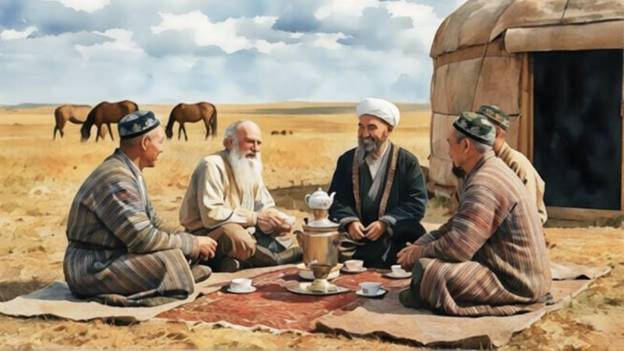
Tolstoy’s impact outside of his home country was vast, and he attracted disciples from across the world who came to meet him in Yasnaya Polyana. He was “one of the first international mass-media celebrities,” and greatly impacted the literatures of nations including China, Turkey and Egypt. In Bulgaria, there were four publishing houses that existed solely to publish Tolstoy’s work, and he was by far the most translated foreign writer in Japan in both the nineteenth and twentieth centuries. He corresponded with people across the world, including Gandhi, who named one of his ashrams “Tolstoy Farm” and described himself as “a humble follower of that great teacher.” Gandhi stated that he had been “ a believer in v- iolence” until he read Tolstoy’s work, which “made me a firm believer in ahiṃsā [non-violence] Photo Alex and Books
And yet, Tolstoy was unfazed and kept up his work. His impact outside of his home country was vast, and he attracted disciples from across the world who came to meet him in Yasnaya Polyana. He was “one of the first international mass-media celebrities,” and greatly impacted the literatures of nations including China, Turkey and Egypt. In Bulgaria, there were four publishing houses that existed solely to publish Tolstoy’s work, and he was by far the most translated foreign writer in Japan in both the nineteenth and twentieth centuries. He corresponded with people across the world, including Gandhi, who named one of his ashrams “Tolstoy Farm” and described himself as “a humble follower of that great teacher.” Gandhi stated that he had been “ a believer in violence” until he read Tolstoy’s work, which “made me a firm believer in ahiṃsā [non-violence].” Tolstoy’s decision to wear peasant clothing also inspired Gandhi to adopt Indian peasant clothing including his iconic loincloth and shawl. Tolstoy, Gandhi said, was “the greatest apostle of nonviolence produced by this age.”
Another admirer was Muhammad Abduh, the prominent Islamic scholar and Grand Mufti of Egypt, who told Tolstoy, “may God…preserve your strength and may He open the doors of men’s hearts to understand what you say, and may He urge their souls to imitate what you do.” In the United States, Black rights organizations such as the NAACP (National Association for the Advancement of Colored People), the Urban League, and CORE (Congress of Racial Equality), were founded by followers of Tolstoy. The great sociologist W. E. B. Du Bois, co-founder of the NAACP, said of Tolstoy, “Now and then a human being has courage enough to do the extraordinary thing…here is a man that dared try. Who had before him a vision of simplicity, poverty, unselfishness and peace, such as would transform the world and make it anew if a sufficient number of people would follow in his footsteps.” Tolstoy’s followers in the Tolstoyan movement set up their own small societies and settlements in Russia and around the world where they could live a life of peace and non-violence. Tolstoy was writing of love and peace until almost the moment of his death in 1910.
Tolstoy on God
To understand Tolstoy’s thinking on the “Other,” it is necessary first to understand how he interpreted God. For Tolstoy, God is “everything,” an unlimited total unity. He uses terms to describe God including the “one,” “the All,” “being,” the “Source,” and the “one essence.” While, from one perspective, humans draw distinctions between people, plants, animals, or anything else—and “there can be an infinite number of divisions of the world—from another perspective, all these differentiated things are connected, and this connection is God. As Tolstoy explains, “everything which we know is nothing but just such a division of God” and “we must understand him as filling all and at the same time as one.” “A flower on a blossoming tree can think that it is a separate being,” Tolstoy said, “but all flowers are parts of the same blossoming of one apple tree, and they all come from one seed.” The human relationship to God is captured in Tolstoy’s phrase, “I am a part, he is everything.” All of us, Tolstoy affirmed, are “members of one great body.”
From the perspective of the individual ego, we often think ourselves and our own wants and desires to be the most significant, but this according to Tolstoy is a kind of reversal of the actual order of things: “We are so accustomed to the thought that everything is for us, that the earth is mine, that when we come to die we are surprised that my earth, something belonging to me, will be left, but not me. The chief mistake here is thinking of the earth as something acquired, an appendage of me, whereas I am acquired by the earth and am an appendage of it.”
As Tolstoy understood it, religion is all about the desire of the individual to seek God, to seek one’s incorporation into the unity of which we all are a part. As Tolstoy writes of his empathetic central character Pierre in War and Peace, “Pierre glanced up at the sky and the play of the stars receding into the depths. ‘And it’s all mine, and it’s all within me, and it all adds up to me!’ thought Pierre.” For Tolstoy, this unitary God is not neutral, but good and loving. As he writes, “I cannot fall anywhere except into him, and in him there is full joy and goodness.”
In order to know God, all humans have the capacity to use their reason, Tolstoy taught, as through reason, we may know ourselves, and then our relationship to the divine unity. We may then gain an “awareness of our unity with everything.” The person who discovers God “in
Marks, How Russia Shaped the Modern World, pp. 110-111.
Marks, How Russia Shaped the Modern World, p. 110.
M. K. Gandhi, “An Introduction to A Letter to a Hindu.” In Leo Tolstoy, A Letter to a Hindu. Translated by Damian Westfall. (Redding, CA: Yehoshuai Press, 2025), p. 26.
Marks, How Russia Shaped the Modern World, pp. 110-111.
Marks, How Russia Shaped the Modern World, p. 110.
M. K. Gandhi, “An Introduction to A Letter to a Hindu.” In Leo Tolstoy, A Letter to a Hindu. Translated by Damian Westfall. (Redding, CA: Yehoshuai Press, 2025), p. 26.
All Men Are Brothers: Life and Thoughts of Mahatma Gandhi as Told in His Own Words. Compiled and edited by Krishna Kripalani. (Paris: UNESCO, 1958), p. 175.
Marks, How Russia Shaped the Modern World, p. 127.
Damian Westfall, “Preface: Tolstoy’s Spiritual Epiphany.” In Leo Tolstoy, A Letter to a Hindu. Translated by Damian Westfall. (Redding, CA: Yehoshuai Press, 2025), p. 13.
Mourad Wahba, The Problematics of Enlightenment: Human Reason, North African Philosophy, and the Global South. Translated by Zeyad el Nabolsy. (Lanham, MD: Lexington Books, 2025), p. 46.
Marks, How Russia Shaped the Modern World, p. 137.
W. E. B. Du Bois, “Tolstoy tribute, August 2, 1928,” W. E. B. Du Bois Papers, University of Massachusetts Amherst: https://credo.library.umass.edu/view/full/mums312-b046-i561
Count Lev N. Tolstóy, “Thoughts on God.” In Lev N. Tolstóy, My Religion, On Life, Thoughts on God, On the Meaning of Life. Translated and edited by Leo Wiener. (Boston: Dana Estes & Company Publishers, 1904), p. 414.
Tolstóy, “Thoughts on God,” p. 423.
Leo Tolstoi, Bethink Yourselves! (Boston: Ginn & Company, 1904), p. 20.
Tolstóy, “Thoughts on God,” p. 423.
Leo Tolstoy, “What’s to Be Done.” Translated by Aylmer Maude. In Leo Tolstoy, The Russian Revolution. (Christchurch: The Free Age Press, 1907), p. 61.
Count Lev N. Tolstóy, “The Commune and the World.” In Count Lev N. Tolstóy, Letters and Essays, Life, General Index, Bibliography. Translated by Leo Wiener. (Boston: Dana Estes & Company Publishers, 1904), p. 436.
Tolstoy’s Diaries, Volume II, p. 463.
Tolstóy, “Thoughts on God,” p. 425.
Tolstóy, “Thoughts on God,” p. 424.
Leo Tolstoy, A Calendar of Wisdom: Daily Thoughts to Nourish the Soul Written and Selected from the World’s Sacred Texts. Translated by Peter Sekirin. (New York: Scribner, 1997), p. 40.
Tolstóy, “Thoughts on God,” p. 414.
Tolstoy, A Calendar of Wisdom, p. 82.
Tolstoy’s Diaries, Volume II, p. 446.
Leo Tolstoy, War and Peace. Translated by Anthony Briggs. (London: Penguin Books, 2005), p. 1134.
Tolstóy, “Thoughts on God,” p. 418.
Tolstoy’s Diaries, Volume II, p. 552.
ourselves discovers Him in everybody else, and vice versa.”
The importance of love
While we can use our reason to understand, comprehend, and make sense of these relationships between each other and between humans and God, the ultimate way we experience them for Tolstoy is by feeling, and specifically through the emotion of love. It is analogous, Tolstoy states, to the feeling a baby has in its mother’s arms. A baby does not know who this person is who feeds and looks after it but “understands that there is someone who does this” and loves this force in whose power the baby rests. Tolstoy at different times records himself experiencing such emotions of connection to the divine unity that he tells us he is unable to adequately reproduce in writing—in one example, he is out riding his horse when he has an experience in which “I...thought about my being a part of him…I felt love for him…I felt so happy.”
Tolstoy defines love as “the striving of men’s souls towards unity.” The relationship between humans and God is characterized by love, and “God is love” for Tolstoy. This is at once a love for God, a desire to unite with the unity through love, and also to link oneself with the different elements of this unity, for example, other human beings. When we love someone, Tolstoy affirms, it seems as if we are in them and they are in us, and the separation dissolves.
Tolstoy presents a kind of sequence of loving awareness: “to know yourself through love of yourself, and then to know other creatures through love of these creatures: to transfer oneself in thought into another person, animal, plant or even stone.” He elucidates, “First the family, then the commune, then the state, then mankind, then all living creatures, then the whole world.” This is love itself, the “restoration of the seemingly broken unity between creatures. You go out of yourself and enter into another person. And you can enter into everything. Everything—you can merge with God, with Everything.” In his literature, Tolstoy attempts to give us a sense of this possibility of transferring oneself in thought to others through love and empathy. In his story Kholstomer (1886), we are even taken inside the mind of a horse, and we view life and humans from his perspective.
Tolstoy advocates a universal love that knows no boundaries. Thus, we should, following Christ, love our neighbors and our enemies alike. While we commonly possess ill will for various people for different reasons, and particularly have stereotypes and negative perceptions about them, Tolstoy affirms, “if there is hatred even for one person, there can be no true love.” We should love “especially…those who are alien to us and hate us.” While “To love a bad person seems impossible,” Tolstoy argues, “one can and must love not the person, but the crushed and stifled God in him, and love that God and try to set Him free. That is not only possible, but a source of joy.”
In any case, Tolstoy states, we are often ignorant of each other in our perceptions of them, and “Man has the faculty of not seeing the sufferings he doesn’t want to see.” Tolstoy urges us to reach out, to come closer to the suffering of others and try to help. When we do reach out, ignorance turns to knowledge and a correct understanding. We should act to “break down” the “wall” of “ignorance of what is going on in the souls of other people…and strive towards a union with the souls of other people.”
This is the message of another of his stories, “Esarhaddon, King of Assyria” (1903). In this tale, King Esarhaddon conquers an enemy kingdom and is about to execute its king, Lailie. Before he can do so, however, a wise sage magically sends his consciousness into Lailie’s body. Now, Esarhaddon is Lailie and finds himself at war with Esarhaddon, and is defeated in battle. Just before Esarhaddon’s men execute Lailie (who is Esarhaddon), he wakes up from this experience and the sage tells him, “all life is one…You thought life dwelt in you alone, but I have drawn aside the veil of the delusion…You can only improve life in yourself by destroying the barriers that divide your life from that of others, and by considering others as yourself, and loving them.”
Through his writings and advocacy, Tolstoy pursues and seeks to facilitate a “union of all, absolutely all people, without exception,” which is a reflection and fulfillment of the unitary nature of the divine. It is possible for us to “love everyone and everything,” all living things, and, Tolstoy is confident, replace “the law of violence” with “the law of love. Love, Tolstoy says, “must save us and become the basis of our life.”
Tolstoy and the “Other”
While Tolstoy’s thinking is based in the message of Jesus, he was also curious to learn about other religions, and studied them assiduously over the course of his life. Tolstoy’s exploration of the thinking of the “Other” helped him consider and develop his own ideas about religion and the meaning of life. He felt great pleasure in reading the masterworks of religion from over the millennia and synthesized them into his own thought. In turn he presented this wisdom to the Russian people, the Christian world, and the wider world. On God, for example, Tolstoy stated, “we can say only what Moses and Mohammed said, —that he is one…that he is unicentric.”
Tolstoy likewise expressed the value in harmonizing oneself and outlook to the rhythms of nature in the manner of Eastern thought, writing, “Lao-Tzu says—one ought to be like water. When there are no obstacles it flows.” It is a reminder of how, Tolstoy wrote, human happiness is linked to nature: “a life under the open sky, in the light of the sun, in the fresh air: a communion with the soil, with plants, and with animals.” Of Lao Tzu’s idea of the “fulfilment of the law of nature,” Tolstoy affirmed, “that is wisdom, that is strength, that is life.”
Tolstoy’s reading of non-Christian thinkers also helped him understand and interpret Christianity—he said, “Without him [Confucius] and Lao-Tzu the Gospels are not complete.” In another example, this time drawing on Hindu philosophy, Tolstoy stated that in order for people to truly love each other, “they must, at least for a time, free themselves from what the Hindoos call ‘sansara,’ that turmoil of life which more than anything else keeps people from understanding the meaning of their existence.”
There are links between Lao Tzu’s concept of Wu Wei or nonaction and Tolstoy’s philosophy of non-resistance. Tolstoy explained, citing “the Chinese sage” [Lao Tzu], that “men would be freed from all personal and especially from all social misfortunes…if they practiced non-acting [Wu Wei].” This message he felt was compatible with Jesus, and Tolstoy likened the Chinese word “Tao,—the Way” meaning “an activity in conformity with the eternal and fundamental law of human life” with Jesus’s statement that the truth will set you free. In addition to drawing on such thinkers in his own work, Tolstoy also published works by sages like Lao Tzu and Confucius in Russian translations, thus playing a “significant role…in introducing Asian religious thought to the West.”
Tolstoy believed that what he had observed in the message of Jesus was in fact present in other religions, as they all are engaged in the same pursuit: the human striving to reach and understand God, or the unity of all things. Tolstoy affirmed that “in every nation teachers have appeared” including “Confucius, Buddha, Moses, Socrates, Christ, Mohammed,” who taught “what it is most necessary for men to know” and were concerned with “the true welfare, of each man and of all men.” These religions reflected what Tolstoy called “the highest good for which that society strives” which was akin to “a flowing river. If a river flows, there is a direction in which it flows. If a society lives, there is a religious consciousness that indicates the direction in which all the people of this society more or less consciously strive.” The founders of the great religions, Tolstoy believed, were like architects: “one architect makes one estimate, another makes a second, and so on. The estimates are a little different, but they are separately correct; and every one sees that, if each estimate is fulfilled, the house will be erected. While the “religions differ in their external forms,” due to “geographical, ethnic and historical conditions,” Tolstoy contended, they “are all the same in their basic principles.”
Tolstoy’s view of the unity of religions is well captured in his short story “The Coffee-House of Surat” (1893). In the coffee house, members of different religions dispute the nature of God, including Sunni and Shia Muslims, Catholic and Protestant Christians, animists, Jews, Hindus, and Confucians. There is disagreement because each worships God in a different way from the others. Yet during the course of the conversation, God is compared to the light of the sun, and the participants begin to reach an understanding. Like God, different people see the sun differently. Some who live among mountains think it sets only over mountains they are familiar with, others believe it sets over the ocean, others who have sailed around the world understand that the sun shines on the whole world, and still others know it even shines on other planets, while those who are blind don’t see the sun and doubt it is there. The story concludes, “Each man wants to have a special God of his own, or at least a special God for his native land. Each nation wishes to confine in its own temples Him whom the world cannot contain…The higher a man’s conception of God the better will he know him…let him who sees the sun’s whole light filling the world, refrain from blaming or despising the superstitious man who in his own idol sees one ray of that same light. Let him not despise even the unbeliever who is blind and cannot see the sun at all.”
Tolstoy explains that while adherents of different faiths believe different things theologically, for example, regarding miracles associated with Jesus, Prophet Muhammad, and Buddha, he wanted religious people across the world to discern and “hold on to what is common” between them. For example, Tolstoy noted the ubiquity of the “Golden Rule” across traditions, to do unto others as you would want them to do unto you. The Golden Rule, Tolstoy affirmed, “was expressed almost simultaneously by Confucius and Buddha and the Jewish teacher Hillel and by Jesus,” as well as in the “Mahomedan…and Brahminic world.” Tolstoy explained, “to the question, ‘Is it right to act towards others as you would have them act towards you? Is it good to love men, to pardon their offences and to be merciful?’ the reason of all men, at all times, answers: ‘Yes it is right, it is good.’” The “eternal law of God,” he said, “is alike in all the teachings.”
All religions, Tolstoy stated, come down to “the opposition between personality, the ‘I’ divorced from the whole, and the awareness of this whole (God) together with the ‘I’…in this opposition lies the whole essence and secret of life which people were aware of thousands of years ago.” Religions had reached strikingly similar conclusions on seeking to bring humanity closer to God—and each other—through love. What Tolstoy described as “a unity based on love” was present “In the Christian world and in the Mahometan world close to it.” Concerning Buddhism, Tolstoy asserted, “That with which man commingles, or into Which he is absorbed in Nirvana, is the same Origin that is called God in Hebraism, Christianity and Mohammedanism.” Tolstoy further believed, because of the innate interconnectedness of all in God, that non-violence was also present in the world’s religions, for example through the “Golden Rule.”
In his own life and career, Tolstoy particularly reached out to the “Other” through his advocacy for justice and religious freedom. In Russia, Tolstoy witnessed extensive religious persecution, which he linked to the exercise of raw power in the modern state—the religion of the rulers of a state tends to be what is enforced on the rest of the population. In this environment, Tolstoy made appeals
Tolstóy, “The Commune and the World,” p. 436.
Tolstoy, A Calendar of Wisdom, p. 259.
Tolstóy, “Thoughts on God,” p. 428.
Letter from Leo Tolstoy to Mahatma Gandhi, September 7, 1910. In Leo Tolstoy, A Letter to a Hindu. Translated by Damian Westfall. (Redding, CA: Yehoshuai Press, 2025), p. 65.
Leo Tolstoy, “Love One Another.” Translated by Aylmer Maude. In W. L. Courtney, ed., The Fortnightly Review, vol. 83, January to June 1908 (London: Chapman and Hall, 1908), p. 30.
Tolstoy’s Diaries, Volume I: 1847-1894. Edited and translated by R. F. Christian. (New York: The Scribner Press, 1985), p. 326.
Tolstoy’s Diaries, Volume I, p. 294.
Tolstoy’s Diaries, Volume I, p. 326.
Tolstoy’s Diaries, Volume II, p. 674.
Tolstoy, “Love One Another,” p. 28.
Tolstoy’s Diaries, Volume II, p. 572.
Tolstoy’s Diaries, Volume II, p. 451.
Tolstoy, A Calendar of Wisdom, p. 214.
Tolstoy’s Diaries, Volume II, p. 437.
Leo Tolstoy, Esarhaddon and Other Tales. Translated by Louise and Aylmer Maude. (New York: Funk & Wagnalls Company, 1903), pp. 37-38.
Leo Tolstoy, What is Art? Translated by Richard Pevear and Larissa Volokhonsky. (London: Penguin Books, 1995), p. 128.
Tolstoy’s Diaries, Volume II, p. 591.
Count Lev N. Tolstóy, “The Non-Acting.” In Count Lev N. Tolstóy, Miscellaneous Letters and Essays. Translated by Leo Wiener. (London: J. M. Dent & Co., 1905), p. 64.
Leo Tolstoy, The Inevitable Revolution. Translated by Ronald Sampson. (London: Housmans, 1975), p. 24.
Tolstoy, “Love One Another,” p. 29.
Tolstóy, “Thoughts on God,” p. 423.
Tolstoy’s Diaries, Volume I, p. 204.
Count Lev N. Tolstóy, “My Religion.” In Count Lev N. Tolstóy, My Religion, On Life, Thoughts on God, On the Meaning of Life. Translated and edited by Leo Wiener. (Boston: Dana Estes & Company Publishers, 1904), p. 158.
Tolstoy’s Diaries, Volume I, p. 204.
Tolstoy’s Diaries, Volume I, p. 206.
Tolstóy, “The Non-Acting,” pp. 63-64.
Tolstóy, “The Non-Acting,” p. 49.
Leo Tolstoy, “Letter to a Chinese Gentleman.” Translated by V. Tchertkoff and E.A. In Leo Tolstoy, The Russian Revolution (Christchurch: The Free Age Press, 1907), p. 80.
Marks, How Russia Shaped the Modern World, p. 116.
Lyof N. Tolstoi, “What is to Be Done?” In Lyof N. Tolstoi, What is to be Done?, Life (New York: Thomas Y. Crowell Co., 1899), p. 228.
Tolstoy, What is Art?, p. 124.
Tolstoi, “What is to Be Done?,” p. 229.
Leo Tolstoy, “Religion and Morality.” In Leo Tolstoy, A Confession and Other Religious Writings. Translated by Jane Kentish. (London: Penguin Books, 1987), p. 135.
Leo Tolstoy, “What is Religion and of What Does its Essence Consist?,” p. 119.
Leo Tolstóy, “The Coffee-House of Surat (After Bernardin De Saint-Pierre).” In Leo Tolstóy, Twenty-Three Tales. Translated by Mr. and Mrs. Aylmer Maude. (London: For the Tolstóy Society, Oxford University Press, 1928), pp. 275-276.
Tolstoy’s Diaries, Volume II, p. 642.
Leo Tolstoy, Reciprocity or The Golden Rule, The Only Means. Translated by V. Tchertkoff and A. C. Fifield. (Creighton, NB: Viola Mizell Kimmel, Kimmel Sanitarium and Health School, 1921), p. 10.
Tolstoi, Bethink Yourselves!, p. 46.
Lyof N. Tolstoï, The Christian Teaching. Translated by V. Tchertkoff. (New York: Frederick A. Stokes Company Publishers, 1898), p. 114.
Leo Tolstoy, “The Meaning of the Russian Revolution.” In Leo Tolstoy, The Russian Revolution. (Christchurch: The Free Age Press, 1907), p. 51.
Tolstoy’s Diaries, Volume II, pp. 610-611.
Tolstoy, The Inevitable Revolution, p. 9.
Leo Tolstoy, “What is Religion?” Translated by Aylmer Maude. In Leo Tolstoy, Last Steps: The Late Writings of Leo Tolstoy. Edited by Jay Parini. (London: Penguin Books, 2009), p. 157.
Count Lev N. Tolstóy, “On Religious Toleration.” In Count Lev N. Tolstóy, Miscellaneous Letters and Essays. Translated by Leo Wiener. (Boston: Dana Estes & Company Publishers, 1905), p. 307. such as “don’t despise Jew or Tatar, but love them,” and he called the Jews “my brothers, whom I love.”
In a letter to Tsar Nicholas II, Tolstoy asked him to “review and destroy the existing laws about persecution for religion’s sake.” He also appealed to the Tsar to “Permit religious gatherings and religious preaching to all the faiths”; “Not keep the people of the different faiths from bringing up their children in the confession which they regard as the true one”; “Admit to all the schools the persons belonging to all the nationalities and religions, not excepting the Jews, who for some reason are deprived of this right”; and “Not interfere with the teachers when they carry on the instruction in those languages spoken by the children who attend school.”
Following the horrific Kishinev Pogrom in 1903 perpetrated against the Jewish population in the Russian province of Bessarabia (now Moldova), Tolstoy blamed the Russian government directly, stating, “it is the Russian government that is to blame, in the first place, because it deprives the Jews of the most primitive and natural rights and makes of them a separate caste.” When the Jewish writer Sholem Aleichem, whose stories were later the basis of the musical Fiddler on the Roof, asked Tolstoy to contribute to an anthology to benefit Jews affected by the pogroms, Tolstoy agreed and wrote “Esarhaddon, King of Assyria” discussed above, and two other stories. Aleichem then translated the tales into Yiddish and published them in Warsaw the following year.
Finally, concerning Tolstoy and the “Other,” it is important to note his educational efforts, which were intended to raise the awareness of Russians about the wider world and impart valuable lessons about life from the world’s different religions and traditions. Tolstoy was frustrated that in his own era, men of “science” had no time for religion and instead stressed scientific “progress.” They anticipated the developments of the future, while leaving relegated to the past humanity’s great moral teachers who Tolstoy felt could provide guidance as Russians and humanity grappled with morality amid modernity.
For children, his ABC Book, mentioned above, which was completed and published in the 1870s, presented pedagogical material for spiritual growth and included both Tolstoy’s own stories and those from diverse sources which imparted moral lessons. Among the many stories in this work are tales of Arabic, Hindu, Greek, and Hebrew origin, those featuring locales such as China and Bukhara, and stories featuring Muslim peoples including “A Prisoner of the Caucasus” (see below), a Tolstoy original.
Perhaps the most outstanding example of Tolstoy sharing the wisdom of the world’s great religious teachers and traditions is his last major work, A Calendar of Wisdom. In this book, Tolstoy presents succinct thoughts and quotes for a person to read and absorb every day of the year, both from Tolstoy himself and the great global thinkers and traditions which so enriched him. As he stated as he compiled it, “The nearer death is, the stronger I feel the obligation to say what I know, what God says through me.” It was a work in which Tolstoy sought to speak directly to the reader about their own life “and about the Good Way of Life.” Tolstoy was especially pleased the book would be easily understandable by ordinary people. Among the many sources in A Calendar of Wisdom are Jesus, the Bible, the Prophet of Islam and the Qur’an, Confucius, Lao Tzu, the Talmud, the Dhammapada containing the sayings of Buddha, Maimonides, Marcus Aurelius, and proverbs and sayings from diverse cultures including India and China. Additionally, there are sources from closer to Tolstoy’s own time such as Thomas Jefferson, the wisdom of the Babists, the Persian forerunners of the Baháʼí, the Native American leader Black Hawk, the American writer and publisher Lucy A. Mallory, Jean-Jacques Rousseau, Ralph Waldo Emerson, and Johann Wolfgang von Goethe.
Tolstoy and Islam
Tolstoy had a particularly interesting and significant relationship with Islam and Muslims throughout his life which had a substantial impact on his writing and outlook. As a child, he was fascinated with The Arabian Nights and listed it among the most important works of his childhood and adolescence. We recall that Tolstoy’s first subject of interest at university in Kazan were the Arabic and Turco-Tatar languages. He then, while serving in the Caucasus, interacted directly with and was impressed by Muslim peoples. One of Tolstoy’s first stories, “The Raid” (1853), which depicted Russian troops in the Caucasus grappling with the horrors of war, was also his first serious encounter with government censorship—in this case, “the censor removed all those passages which appeared to question the justifiability of Russian soldiers gunning down Muslim tribesmen in their native mountain villages.”
Subsequently, in 1862 while at Yasnaya Polyana working on peasant education, Tolstoy began to feel fatigued and depressed. He decided to leave the area to clear his head and improve his health in the province of Samara, on the open steppes. For over two months, he lived with nomadic Muslim tribesmen of the Bashkir people, which was restorative for him. He stayed in a tent, breathed the fresh air, and drank kumyss, a curing drink consisting of fermented mare’s milk. Tolstoy already had knowledge of Tatar from university, and this eased his communication with the tribesmen, who called him “the Count” and “Prince Tul” (Tula Prince).
Nearly a decade later, in 1871, suffering from ill health, Tolstoy decided to seek relief by returning to this same area, this time journeying further into the open steppe. The Bashkirs welcomed him back as an old friend. On the steppe, he arranged with a mullah to use a tent, which he lived in adjacent to the mullah’s tent. He followed the Bashkir diet and he once again recuperated. The region was one of many peoples and cultures, and a biographer noted that Tolstoy noticed “with pleasure the good relations and complete religious toleration that existed in those parts between the Orthodox peasants and their Mohammedan neighbors.” At one point, Tolstoy attended an annual fair in which Bashkirs, Kirghiz, Russians, and Cossacks all mingled together.
Tolstoy was also fascinated with the Bashkir themselves, remarking, “I have listened to speeches in the English Parliament, which is considered very important, and it seemed to me dull and insignificant; but there, are flies, dirt, and Bashkir peasants, and I, watching them with intense respect and anxiety, became absorbed in listening to them.” On his return journey home Tolstoy’s brother in law, who accompanied him, reported, “evidently under the influence of what he had seen and heard among the Bashkirs,” Tolstoy “read through the Koran.”
While on this second trip, Tolstoy learned that the family of the Governor-General of Moscow was selling a significant tract of land, which Tolstoy decided to purchase. This vastly expanded Tolstoy’s land holdings, and he subsequently purchased an even larger tract, this time from an aide to a senior Russian military official. Tolstoy, now owning considerable land on the steppe, returned every summer apart from two during the 1870s, including with his wife and children. He formed a particular bond with a sophisticated Bashkir, Muhammad Shah Rakhmatullin, who he hired to assist him, and Tolstoy and his family frequently spent time with him in his tent.
In 1878, Tolstoy organized a two-day sporting festival featuring wrestling and races in which he involved Bashkirs, Kirghiz, Cossacks, and Russian peasants—the Bashkirs and Kirghiz “arrived with their tents, plenty of koumis [kumyss], boiling-coppers, and sheep.” Several thousand people attended, and “To this day, locals commemorate Tolstoi by holding horse races on the same spot.”
Over time, as his social and political consciousness developed, Tolstoy grew more unhappy with his status as a landowner of such large properties. He decided to liquidate his steppe estate in 1883 and divest himself of it in 1892. He was concerned with the difficulties faced by Russian peasant settlers on the land, as well as those of the Bashkirs. Muhammad Shah Rakhmatullin told of how the Bashkir way of life had deteriorated with the loss of both their pasture lands and aspects of their culture and traditions, and, as traditionally nomadic people, they struggled at farming.
Tolstoy’s experience in Samara and with Islam and the Bashkirs influenced his thinking in important ways. The model for Tolstoy’s ideal life in many ways were the small rural communities of Samara. Initially, Tolstoy prized and heralded autonomous agricultural communities, but eventually he came to see these as a step towards “civilization” which led to increasing centralization and thus oppression—in other words, in many ways the perspective of the tribes. Tolstoy stated, “I have very vivid pictures of life in Samara: the steppe, the struggle between the nomadic patriarchal way of life and the civilized, agricultural one. It draws me very much.” He concluded, “Agriculture, which is replacing the nomadic conditions I experienced in Samara, is the first step towards wealth, luxury, dissipation and suffering. It’s obvious from the first step. We must make a conscious effort to return to the simple tastes of that time.” He believed that property was “the root of all evil,” wished to dissociate himself from it, and noted, “Land cannot be the subject of property.”
In “How Much Land Does a Man Need?” (1886), among Tolstoy’s most popular short stories and hailed by James Joyce as the greatest story in world literature, a rural male Russian peasant hears his wife’s sister, who is visiting from a town, extoll the virtues of “civilization.” These include access to fine clothes, expensive food, and visits to the theater. While he seems uninterested in things like the theater, the conversation does rouse his interest in possessing land—a desire he voices and is overheard by the Devil who is also in the room. The Devil decides to play a “game” and gain control over him by facilitating this desire. At several points in the story the peasant hears of opportunities to buy land, each time in higher quantities for low prices. Eventually, he winds up on the open steppes among the Baskir tribes, who tell him that they will let him have as much of their land as he can reach on foot and mark within one day. The peasant so overextends himself in a frantic effort to cover vast distances that he drops dead, and is buried in a grave, “six feet from head to heel, which was exactly the right length”—the answer to the question of how much land a man needs.
By expressing such views of “civilization,” Tolstoy was challenging the assumptions of many in his reading audience that technological “progress” was inherently good. Tolstoy was there to remind people what they were giving up by too readily accepting the premises of “civilization.” In one statement, he captures the cost of civilization by discussing flowers, as in Hadji Murad: “I picked a flower and threw it away. There are so many of them that I wasn’t sorry. We don’t value the inimitable beauty of living creatures and destroy them without pity—not only plants, but animals and human beings. There are so many of them. Culture—civilization—is nothing else but the destruction of these beautiful things and their replacement. What by? The tavern, the theatre.” “People usually measure the progress of mankind by its technical and scientific successes, supposing that civilization leads to good,” Tolstoy argued, but “That isn’t true…Increasing the good of people only comes from increasing love, which by its very nature makes all people equal.” The reality is, Tolstoy stated, “The less love a person has, the more he suffers,” regardless of whether someone is living in an “advanced” society or not.
In Hadji Murad, which Tolstoy wrote in the late years of his life, he juxtaposes the two societies, Russian and Muslim, with integrity, authenticity, and empathy. Tolstoy demonstrates how people in both operate ordinarily within their own contexts—as Hadji Murad says, “Every nation has its own customs.” We experience the way Hadji Murad lives his life and thinks, how he relates to his associates, how he carries out Islamic rituals such as praying and performing ablutions, and we see him riding his horse under the stars. We see the masquerade ball of the Tsar, the singing of songs of the tribes, the hierarchies and class divisions of the Russians and clan divisions of the tribes, and the clothing and roles of the different genders in each society. Most of all, we see both the Russians and Muslims as fully formed humans who, while having their own customs and particular contexts, experience the common struggles of life. To a Russian reader, Tolstoy is essentially issuing an invitation to see the interaction between the two systems from the thistle’s perspective, to ask whether its critique of modern Russian society and wish to preserve its own has logic and merit.
Tolstoy does something similar in his short story “A Prisoner of the Caucasus,” except this time the audience is Russian children. In the tale, which Tolstoy included in his ABC Book, two Russian army officers, Zhilin and Kostilin, are taken prisoner by Muslim fighters. A good-natured Muslim girl, Dina, takes pity on the captured men, giving them milk and food. Subsequently, she helps Zhilin escape as an act of kindness. Children reading the story would have seen the virtue of Dina, who represents compassion and humanity amid the brutality of war. They would have also understood why the tribes in the Caucasus might think ill of the Russians. One character, an old man, is described like this: “He’s a great man! He was the bravest of our horsemen; he killed many Russians, and at one time he was very rich. He had three wives and eight sons, and they all lived in one village. Then the Russians came, destroyed the village, and killed seven of his sons.”
When a group of tribesmen leave the village where the protagonists are being held in high spirits and later return crestfallen, with the body of one of their fellows who was killed, Tolstoy describes the funeral: “The mullah was in front…All cast their eyes down and sat in silence. This continued a long time, until the mullah raised his head and said: ‘Allah!’ (which means God). He said that one word, and they all cast their eyes down again, and were silent again for a long time. They sat quite still, without moving. Again, the mullah lifted his head and said, ‘Allah!’ and they all repeated: ‘Allah! Allah!’ and fell silent again. The body lay motionless on the grass, and they sat still as though they too were dead. Not one of them moved. There was no sound but that of the leaves of the plane trees stirring in the breeze. Then the mullah said a prayer, and they all rose. They lifted the body and carried it in their arms to a hole in the ground. It was not an ordinary hole, but was hollowed out under the ground like a vault. They took the body under its arms and by its legs, bent it, and let it down gently, pushing it under the earth in a sitting posture, with its hands folded in front.” The scene concurrently captures aspects of local culture and depicts the cost of war on the small community.
In another story, “After the Ball,” which Tolstoy wrote in 1903, we see the Muslim “Other” intruding unexpectedly and unsettlingly in a familiar, quintessentially Russian setting. It is a tale of a young man who falls in love with a young woman and is invited by her father, a mustached military colonel, to dance with her at a resplendent aristocratic ball. After the ball, the young man is over the moon, and yet as he walks down the street a few hours after departing the affair, he comes across a bleak sight heading towards him. It is a procession of Russian soldiers, led by his beloved’s father, thrashing a Tatar on his bare back which is coated in blood. Mere hours earlier, the colonel had been the picture of dignified elegance, but now he was screaming at his troops for not beating the Tatar hard enough. Initially, the protagonist thinks to himself, “He obviously knows something that I don’t…If I’d known what he knows, I’d have understood what I was seeing and it wouldn’t have upset me.” But he cannot get the image out of his head. He begins to feel alienated from society, stops seeing the colonel’s daughter, and drops plans to join the military.
In terms of Islamic intellectual influences on Tolstoy, we can see the impact of Islam clearly in the aforementioned A Calendar of Wisdom. In addition to the Qur’an and sayings of the Prophet, Tolstoy included Muslim cultural sources including Persian and Arab proverbs and verses from poets such as the great Persians Saadi Shirazi and Omar Khayyam. Tolstoy also features a Sufi saying which captures his universal outlook and mentions another Persian poet, Hafiz: “If you are a Muslim go and live amongst Christians; if you are a Christian go and live amongst Jews; and if a Catholic, amongst Orthodox. Whatever your religion, associate with people of other religions. If you are not offended by what they say, and if you can associate with them freely, you have achieved peace. Hafiz has told us that all religions say the same thing; all people are looking for love, and the entire world
Tolstoy’s Diaries, Volume I, p. 278.
Count Lev N. Tolstóy, “Letter to a Jew.” In Count Lev N. Tolstóy, Miscellaneous Letters and Essays. Translated by Leo Wiener. (Boston: Dana Estes & Company Publishers, 1905), p. 503.
Count Lev N. Tolstóy, “Letter to Nicholas II.” In Count Lev N. Tolstóy, Letters and Essays, Life, General Index, Bibliography. Translated by Leo Wiener. (Boston: Dana Estes & Company Publishers, 1904), p. 355.
Count Lev N. Tolstóy, “To the Tsar and His Associates.” In Count Lev N. Tolstóy, Letters and Essays, Life, General Index, Bibliography. Translated by Leo Wiener. (Boston: Dana Estes & Company Publishers, 1904), pp. 483-484.
Tolstóy, “Letter to a Jew,” p. 505.
Harold Behr, “Tolstoy and the Jews,” The Times of Israel, March 3, 2021.
Tolstoi, “What is to Be Done?,” p. 232.
Torresin, “Not Only a Writer, but also an Educator,” p. xvii.
Aylmer Maude, The Life of Tolstoy: First Fifty Years (London: Constable and Company Limited, 1917), p. 341; Leo Tolstoy, Writings for Young Children. Translated and edited by Michael R. Katz. Illustrated by Jake Scott. (Boston: Cherry Orchard Books, 2025).
Tolstoy’s Diaries, Volume II, p. 576.
Peter Sekirin, “Tolstoy and the Creation of A Calendar of Wisdom.” In Leo Tolstoy, A Calendar of Wisdom: Daily Thoughts to Nourish the Soul Written and Selected from the World’s Sacred Texts. Translated by Peter Sekirin. (New York: Scribner, 1997), p. 7.
Piotr Stawinski, “Leo Tolstoy and Islam: Some Remarks on the Theme,” The Quarterly Journal of Philosophical Meditations, vol. 2, no. 5, 2010, p. 5.
A. N. Wilson, “Introduction.” In Leo Tolstoy, How Much Land Does a Man Need? and Other Stories. Translated by Ronald Wilks. (London: Penguin Books, 1993), p. ix.
Maude, The Life of Tolstoy, p. 335.
Edyta M. Bojanowska, “Was Tolstoi a Colonial Landlord?: The Dilemmas of Private Property and Settler Colonialism on the Bashkir Steppe,” Slavic Review, vol. 81, no. 2, 2022, p. 329.
Maude, The Life of Tolstoy, p. 335.
Maude, The Life of Tolstoy, p. 335.
Maude, The Life of Tolstoy, p. 363.
Maude, The Life of Tolstoy, pp. 336-337.
Maude, The Life of Tolstoy, p. 366.
C. A. Behrs, Recollections of Count Leo Tolstoy. Together with A Letter to the Women of France on “The Kreutzer Sonata.” Translated by Charles Edward Turner. (London: William Heinemann, 1896), p. 96.
Behrs, Recollections of Count Leo Tolstoy, p. 96; Bojanowska, “Was Tolstoi a Colonial Landlord?,” pp. 334-335.
Behrs, Recollections of Count Leo Tolstoy, pp. 96-97.
Behrs, Recollections of Count Leo Tolstoy, p. 100.
Bojanowska, “Was Tolstoi a Colonial Landlord?,” p. 326.
Bojanowska, “Was Tolstoi a Colonial Landlord?,” p. 334.
Bojanowska, “Was Tolstoi a Colonial Landlord?,” p. 338.
Tolstoy’s Diaries, Volume II, p. 428.
Tolstoy’s Diaries, Volume I, p. 257.
Tolstoi, “What is to Be Done?,” p. 266.
Bojanowska, “Was Tolstoi a Colonial Landlord?,” p. 345.
Rachel Hurn, “How Much Land Does a Man Need,” The New Yorker, February 15, 2011.
Leo Tolstoy, “How Much Land Does a Man Need?” In Leo Tolstoy, How Much Land Does a Man Need? and Other Stories. Translated by Ronald Wilks. (London: Penguin Books, 1993), p. 110.
Tolstoy’s Diaries, Volume II, p. 470.
Tolstoy’s Diaries, Volume II, p. 508.
Leo Tolstoy, A Calendar of Wisdom, p. 202.
Tolstoy, Hadji Murád, p. 117.
Leo Tolstoy, “A Prisoner of the Caucasus (A True Story).” In Leo Tolstoy, Writings for Young Children. Translated and edited by Michael R. Katz. Illustrated by Jake Scott. (Boston: Cherry Orchard Books, 2025), p.
208.
Tolstoy, “A Prisoner of the Caucasus (A True Story),” p. 210.
Leo Tolstoy, “After the Ball.” In Leo Tolstoy, The Death of Ivan Ilyich and Other Stories. Translated by Ronald Wilks, Anthony Briggs, and David McDuff. (London: Penguin Books, 2008), p. 231. is the abode of love—so then why start talking of mosques and churches?”
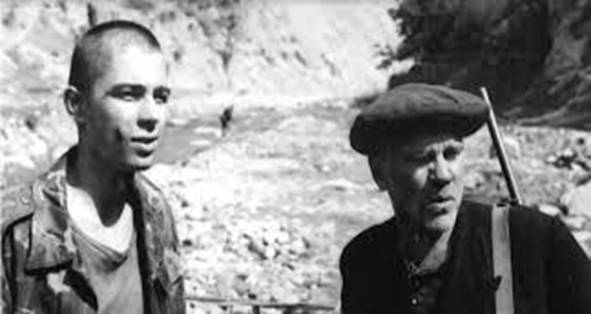
Concerning the Prophet of Islam, Tolstoy wrote in 1909, “The Qur’an is consistent and Muhammad forbids war as a mean to expand Islam and killing,” and “What is common to religions is also in the Qur’an: Proclamation of Love.” Yet, he said, “we do not know Islam as Muslims know Christianity.” In 1910, Tolstoy published a book in Moscow in which he collected some 95 hadiths or sayings of the Prophet, The Sayings of Mahomet Not Included in the Koran. This was intended to spread knowledge about Islam and the wisdom of the Prophet’s sayings to Russians. It was shortly thereafter published in Arabic in Egypt as The Wisdom of Prophet Muhammad Presented by Philosopher Tolstoy (1915) – Photo The Friday Times
Tolstoy also, when discussing his own identity which was a matter of perplexity for many after he began publishing on political and religious topics, invoked Islam. In 1884, he stated, “ Some people—liberals and aesthetes—think me mad or feeble-minded like Gogol; others—revolutionaries and radicals—think me a mystic or a gas bag; government people think me a pernicious revolutionary; Orthodox people think me the devil. I confess this hurts me…it is even harder when everyone turns on you with bitterness and reproaches. And so please regard me as a good Mohammedan, and then all will be splendid.” Two decades later, Tolstoy wrote a letter to Muhammad Abduh, the Grand Mufti of Egypt, in which he expresses his gratitude that he is able “to correspond with an enlightened man, despite the difference between his creed, and the creed that I was raised to hold. Yet he belongs to the same religion for creeds differ and multiply, but there is only one religion, namely the religion of truth.”
Furthermore, concerning the Prophet of Islam, Tolstoy wrote in 1909, “The Qur’an is consistent and Muhammad forbids war as a mean to expand Islam and killing,” and “What is common to religions is also in the Qur’an: Proclamation of Love.” Yet, he said, “we do not know Islam as Muslims know Christianity.”
In 1910, Tolstoy published a book in Moscow in which he collected some 95 hadiths or sayings of the Prophet, The Sayings of Mahomet Not Included in the Koran. This was intended to spread knowledge about Islam and the wisdom of the Prophet’s sayings to Russians. It was shortly thereafter published in Arabic in Egypt as The Wisdom of Prophet Muhammad Presented by Philosopher Tolstoy (1915). In the introduction, Tolstoy wrote, “The essence of Islam is the unity of God, and therefore the non-worship of many gods, the loving and just nature of God...that everything on earth is transient and perishable, and only God exists eternally. Love for God consists in prayer, help, and forgiveness...A person who has realized the true God should strive to destroy everything that contributes to the development of passions.” When Tolstoy died, in a rail station in southern Russia in November 1910, he was on his way to the Caucasus. While it is uncertain precisely what his plans would have been there, it is notable that at the end of his life he sought to return to the region which had made such an impact on him from the time he was a young man.
Nations, Nationalism, and Patriotism
In Tolstoy’s consideration of the obstacles to human coexistence in the modern world, he frequently discussed the sentiment of national patriotism which mobilizes members of one nation against another. Tolstoy interpreted nationalism, which he essentially equated with patriotism, as a problem of the “ego,” and he thought that it should be similarly seen as immoral. If egoism means “a love for oneself more than for others” which many
Leo Tolstoy, A Calendar of Wisdom. Translated by Roger Cockrell. (Surrey: Alma Classics, 2015), p. 192.
Stawinski, “Leo Tolstoy and Islam,” p. 20.
Leo N. Tolstoy, Tolstoy’s Letters: Volume II (1880-1910). Edited and Translated by R. F. Christian. (New York: Charles Scribner’s Sons, 1978), pp. 376-377.
Wahba, The Problematics of Enlightenment, p. 46.
Stawinski, “Leo Tolstoy and Islam,” p. 20.
Stawinski, “Leo Tolstoy and Islam,” p. 20.
Mikhail Rodionov, “Leo Tolstoy and Ameen Rihani: The Interaction Between Two Creative Worlds.” In Nathan C. Funk and Betty J. Sitka, Ameen Rihani: Bridging East and West, A Pioneering Call for Arab-American Understanding (Lanham, MD: Ameen Rihani Institute, American University Center for Global Peace, University Press of America, 2004), p. 74.
Sagdiev Khabibullo, “Reflection of the Prophet’s Hadith in Tolstoy’s Works,” Modern American Journal of Social Sciences and Humanities, vol. 1, no. 2, 2025, p. 203.
See Pavel Basinsky, Leo Tolstoy: Flight from Paradise. Translated by Huw Davies and Scott Moss. (London: Glagoslav, 2015). consider “stupid and ridiculous,” Tolstoy argued, and patriotism is “a love for one’s own nation above other nations,” then both are equally wrong. In both cases, love is present, but it is an exclusive, not inclusive love. While it is wonderful and a virtue to love one’s own country as it is to love one’s own family, such virtues “can become vices when they become overwhelming and damage your love for your neighbor.” One’s nation, Tolstoy affirms, represents only one “circle” which is “part of the wider circle that is humanity.”
Exclusivist patriotism, however, like the modern state it supports, is commonly seen in human nations not as a problem but as good, laudable, and even “a necessary condition of progress.” Tolstoy explains that in the modern state such sentiments are widely promoted in schools, textbooks, histories, national songs, in the media and the press, state spectacles, monuments, and by religious institutions. In schools, children learn that “their own people” are “the best of all peoples and always in the right.” Parents “buy their children toy helmets, guns, and swords as playthings,” inculcating patriotic sentiments which are commonly directed at other nations. The cumulative effect is to “embitter” the people “against the foreigner.”
Tolstoy reported that he himself had been through this process. He remarked that his early education included celebrating the “military exploits” of the nation, feeling “enmity” for and “separation” from other nations, and the idea that “my good is connected only with the good of my nation and not with the good of the whole world.” He later came to question this education and understood, as he reminds his audience, that Christ said, “all are alike to God…the sun shines and the rain falls on all men alike; God makes no distinction between nations, and does the same good to all alike; the same ought men to do for all men, without distinction of nationality.” Tolstoy’s message, reflecting that of Christ, is, “You have been told that you must love your neighbors and hate the national enemy; but I tell you, You must love all without distinction as to the nationality, to which any one may belong…love the men of a hostile nation as your own.”
For Tolstoy, much of the suffering of people in the world is caused by patriotism. Patriotism, he contended, produces war due to its zero-sum mentality—what is good for “us” is bad for “them.” The fact that the nations of the world are all celebrating and encouraging the love of themselves over others does not bode well for peace. Tolstoy laments that “very often, a man from one nation already hates a man from another nation, and is ready to cause him sufferings and even death, even before he meets him.”
The increase of patriotism in one country, which causes a nation to increase its military, Tolstoy believed, also has an effect on other nations, which respond by doing the same thing, thus ratcheting up the temperature and tension in a destructive cycle. While the feeling of patriotism resulted in people banding together and forming nations and states to begin with, that same feeling “is now destroying those states” as they turn on each other—“patriotism no longer unites, but disunites.” Even when countries sign peace treaties, conflict is often still present, such as the 1890s alliance between Russia and France which Tolstoy argued was a barely disguised pact of belligerence against Germany.
In reality, Tolstoy contended, the nation exists in our “imagination”—it is a sentiment, a belief, a feeling which divides one people from another. The borders between modern nations are “accidental and temporary…conditioned in the past by a whole series of historical events, principally acts of violence, injustice, and cruelty,” and at present maintained by power and coercion. “During our memory, Nice was Italy and suddenly became France; Alsace was France and became Prussia,” Tolstoy pointed out, and he asked, “What is Russia? Where is its beginning or its end? Poland? The Baltic Provinces? The Caucasus with all its nationalities? The Kazan Tartars? Ferghana Province? All these are not only not Russia, but all these are foreign nationalities desirous of being freed from the combination which is called Russia.”
Additionally, patriotism causes conflict within countries because it drives attacks on the minority. Tolstoy explained that if one speaks to a member of a majority group who is persecuting the minority, they “will tell you it is in defence of their native religion and language; they will tell you that if they do not act thus, their religion and language will suffer,” that the majority will be “Judaized” if the Jews are not suppressed, or “Polonized” if the Poles are not suppressed.
And yet, for peoples held in subjection and domination by others, such as the Indians colonized by the British, the different nationalities of the Russian Empire, or the Eastern nations such as Japan and China which were quickly “modernizing,” Tolstoy issued emphatic warnings not to adopt the European model of patriotic nationalism. It was nothing but an “infection” such peoples could catch from their oppressors. In the case of Japan, he noted with disappointment, Japan was assimilating “all the shallow, cunning methods of an immoral and cruel civilization, and are preparing to withstand their oppressors by the same means that these employ against them.” In doing so, similar to Europe with its religious tradition, Japan was contradicting Buddhism—it was distorting “the great Buddhistic teaching by not only permitting but justifying that murder which Buddha forbade.”
For members of oppressed groups, Tolstoy counseled, resistance should be in the form of non-violence, because violence will only result in more violence and oppression. He advised “all the conquered races” including the Indians, Irish, Bedouin, and Poles, in addition to the “workmen enslaved by the capitalists” to fight back with non-violent means. In India, Tolstoy wrote in 1907, if people refused to enlist in British forces and “did not submit to the English laws,” “all the English in the world” would not be able to “enslave India” any longer.
Tolstoy was gravely concerned for the future. The world was spinning out of control, he felt, without moral guidance or direction. He noted that unlike in the past, where societies could remain isolated from one another, the advances of modernity had increasingly made the world smaller. Nations were intermeshed with each other, Tolstoy said, due to their “frequent international relations—mercantile, social, scientific, artistic” connections to the point where any war would be even more devastating to both “Self” and “Other.” And yet, remarking of the situation both within and between states, he believed that horrific violence was on the horizon, stating, “the awful catastrophe is coming nearer and nearer” and “We are dashing on toward the precipice.” Humanity could experience “universal slaughter,” Tolstoy feared, amid states “arming themselves against each other”—“so-called civilized humanity” was heading for “certain destruction.”
Looking back at history, we can see that Tolstoy’s fears were well founded. Less than four years after his death the First World War broke out, followed by the Russian Revolution with its materialistic focus, totalitarian state reorganization, and mass suffering of the peasantry, and two decades after that, the Second World War was waged. In the First and Second World Wars, some 100 million people were killed. Contrary to Tolstoy’s hopes, colonized peoples in nations like India, led by Westernized elites, did adopt modernity on the Western model. The memory of Tolstoy and his message were overwhelmed by the Russian Revolution and the ascendency of leaders like Lenin and Stalin, in Russia and abroad. This is while Tolstoy himself continued to be celebrated by leaders like Lenin and Stalin—he was too important a figure for Russians, it seemed, for the authorities to dispense with entirely.
Yet, at the same time, leaders influenced by Tolstoy such as Gandhi and Martin Luther King, Jr changed the course of world history through the Tolstoyan methods of love, peace, and non-violence. Gandhi’s method of non-violent resistance, “satyagraha” or truth force, which Gandhi and King also called “soul force,” is heavily indebted to Tolstoy and his understanding of religious truth. Such leaders, and the many around the world who were in turn inspired by them, embodied Tolstoy’s teaching that “The movement of humanity toward the good takes place, not thanks to the tormentors, but to the tormented. As fire does not put out fire, so evil does not put out evil. Only the good meeting the evil, and not becoming contaminated by it, vanquishes the evil.” Tolstoy also influenced the emerging interfaith dialogue movement in the twentieth century, directly inspiring the creation of the UK-based World Congress of Faiths.
In 1991, upon the fall of the Soviet Union and the coming of democracy to Russia, Tolstoy experienced a renaissance. His works which had been banned by Soviet
Leo Tolstoy, “A Reply to Criticisms.” In Leo Tolstoy, Tolstoy’s Writings on Civil Disobedience and Non-Violence (New York: Bergman Publishers, 1967), p. 174; Count Lev N. Tolstóy, “Patriotism or Peace.” In Count Lev N. Tolstóy, The Kingdom of God is Within You, Christianity and Patriotism, Miscellanies. Translated by Leo Wiener. The Complete Works of Count Tolstóy, Volume 20. (Boston: Dana Estes & Company, 1905), p. 477.
Leo Tolstoy, “Patriotism and Government.” Translated by Aylmer Maude. In Leo Tolstoy, Last Steps: The Late Writings of Leo Tolstoy. Edited by Jay Parini. (London: Penguin Books, 2009), p. 123.
Tolstoy, A Calendar of Wisdom, p. 356.
Tolstoy, A Calendar of Wisdom, p. 377.
Tolstoy, “A Reply to Criticisms,” p. 177.
Tolstóy, “Patriotism or Peace,” p. 477; Tolstoy, The Kingdom of God is Within You, pp. 122-124; Tolstoy, “Patriotism and Government,” p. 125; Christoyannopoulos, Tolstoy’s Political Thought, p. 79.
Tolstoy, “Patriotism and Government,” p. 125.
Tolstoy, The Kingdom of God is Within You, p. 201.
Tolstoy, “Patriotism and Government,” p. 125.
Tolstóy, “My Religion,” pp. 215, 216.
Tolstóy, “My Religion,” p. 86.
Tolstóy, “My Religion,” p. 86.
Tolstoy, A Calendar of Wisdom, p. 52.
Tolstoy, “Patriotism and Government,” pp. 127, 129.
Tolstóy, “Patriotism or Peace,” p. 473.
Christoyannopoulos, Tolstoy’s Political Thought, p. 73; See also L. N. Tolstoy, Christianity and Patriotism. Translated by Constance Garnett. (London: Jonathan Cape, 1922).
Leo Tolstoy, “The End of the Age (On the Approaching Revolution).” In Leo Tolstoy, The End of the Age (On the Approaching Revolution), Preceded by The Crisis in Russia. Translated by V. Tchertkoff and I. F. Mayo. (London: William Heinemann, 1906), p. 49.
Tolstoy, “The End of the Age (On the Approaching Revolution),” p. 49.
Tolstoy, “The End of the Age (On the Approaching Revolution),” p. 49.
Tolstoy, “The End of the Age (On the Approaching Revolution),” p. 49.
Tolstoy, “A Reply to Criticisms,” p. 176.
Tolstoy, “Patriotism and Government,” p. 124.
Tolstoy, “The Meaning of the Russian Revolution,” p. 19.
Tolstoi, Bethink Yourselves!, p. 40.
Tolstoy, “The Meaning of the Russian Revolution,” p. 27.
Tolstoy, “The Law of Love and the Law of Violence,” p. 159.
Count Lev N. Tolstóy, “The Officers’ Memento.” In Count Lev N. Tolstóy, Letters and Essays, Life, General Index, Bibliography. Translated by Leo Wiener. (Boston: Dana Estes & Company Publishers, 1904), p. 276.
Tolstóy, “Thoughts on God,” p. 262.
Tolstoi, Bethink Yourselves!, p. 16.
Tolstoi, Bethink Yourselves!, pp. 15, 16.
Tolstoi, Bethink Yourselves!, p. 16.
Tolstoi, Bethink Yourselves!, p. 16.
“Used and abused by Russian rulers, Tolstoy has always resisted,” The Economist, June 29, 2023.
Stuart Gray and Thomas M. Hughes, “Gandhi’s Devotional Political Thought,” Philosophy East & West, vol. 65, no. 2, 2015, p. 380; Marks, How Russia Shaped the Modern World, p. 129.
Tolstóy, “My Religion,” p. 44.
Daniel Moulin, “Tolstoy, Universalism and the World Religions,” Journal of Ecclesiastical History, vol. 68, no. 3, 2017, pp. 583-585. authorities such as A Calendar of Wisdom were reprinted to great fanfare—A Calendar of Wisdom sold over
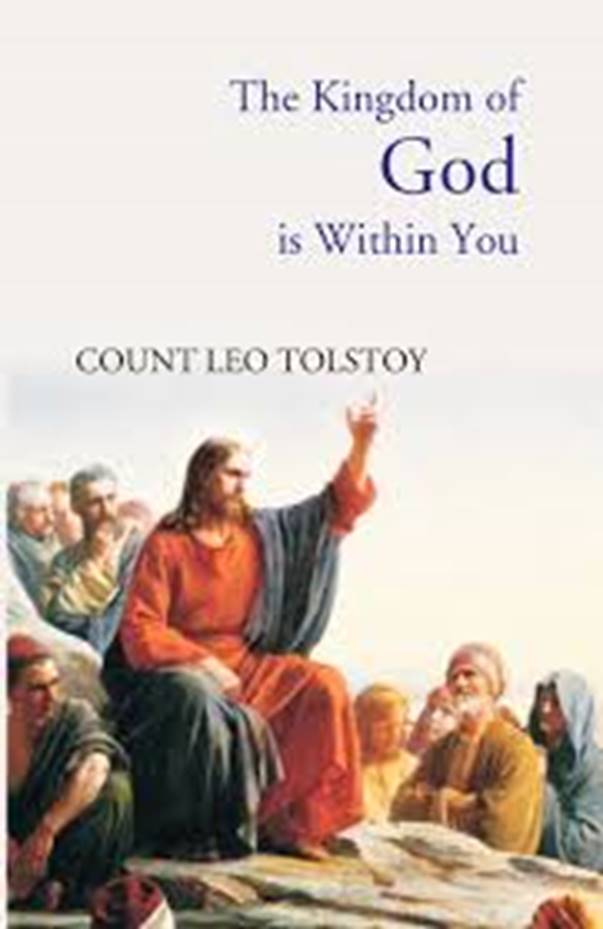
When Russia again fought in the Caucasus to stop Chechnya from becoming independent, Tolstoy played a role in bringing peace—this time through A Prisoner of the Caucasus (1996), a film adaptation of Tolstoy’s story which had been updated and set during the current war. Shortly after the film was screened privately for Russian President Boris Yeltsin, he reportedly changed his position on Chechnya and decided to negotiate. A few months later, Russia and Chechnya signed an agreement ending the war – Photo European Film Awards
300,000 copies when it was published in 1995. When Russia again fought in the Caucasus to stop Chechnya from becoming independent, Tolstoy played a role in bringing peace—this time through A Prisoner of the Caucasus (1996), a film adaptation of Tolstoy’s story which had been updated and set during the current war. Shortly after the film was screened privately for Russian President Boris Yeltsin, he reportedly changed his position on Chechnya and decided to negotiate. A few months later, Russia and Chechnya signed an agreement ending the war.
Yet a few years later Russia was once again at war in Chechnya, this time under its new leader Vladimir Putin, and Putin would go on to wage further large-scale wars. Under Putin, Russia experienced increasing totalitarian rule, surging nationalism, and, in its war in Ukraine, nearly two million soldiers have been killed, wounded, or are missing. While Tolstoy is among Putin’s favorite authors who he has quoted in public, the opposition leader Alexei Navalny, who died in a Russian arctic penal colony, also prominently invoked Tolstoy in his activism. Putin commemorated Tolstoy by naming a major government award after him, the annual Leo Tolstoy International Peace Prize. Putin also announced that Russia will celebrate the 200 th anniversary of Tolstoy’s birth in 2028, considering, he said, “the outstanding contribution of Leo Tolstoy to national and world culture.”
Striving for the ideal
By the end of Tolstoy’s life, he was seen by many as a tragic figure and dangerous radical—first and foremost by the Russian government. It is not difficult to see why. Tolstoy, who was widely adored and could easily have continued creating his artistic works without voicing his evolving opinions so explicitly, instead came to publicly oppose the existence of the modern state, national borders, private property, the military, police, and prisons. Even today, there is an enduring image of him as a rather eccentric bearded old man living on his estate in his peasant clothing late in life, for example, as seen in the film The Last Station (2009)—Isaiah Berlin memorably described him as “a desperate old man, beyond human aid, wandering self-blinded” like Oedipus. In other words, unable to reconcile himself with reality. While he was and still is described as an “anarchist,” Tolstoy stated, “I am not an anarchist, but a Christian. My anarchism is only the application of Christianity to human relationships”
And yet there was, and there remains a misunderstanding concerning Tolstoy’s thinking, and particularly his views on politics and how one should live their lives. Tolstoy, in keeping with his understanding of world religions and following the message of Jesus, was concerned with pursuing an ideal. If people follow the precepts of the world religions centered on the Golden Rule, for example, as presented in A Calendar of Wisdom, Tolstoy believed, then in the future we will not need the institutions of the modern state which are based on coercive power. Tolstoy wanted to shake us out of our complacency, our common belief that this is simply how modern states are, that armies of millions must massacre each other for our nation to survive, that workers must work for pittances while a small elite runs societies, and that there is nothing we can do about it. As Tolstoy put it, “in order to have real justice, it is necessary for our striving and our ideal to embody self-denial and love…In order to hit the target it is necessary to aim above and beyond it.”
Thus, conceptualizing and then pursuing an ideal is central to his thinking. Considering the ideal, Tolstoy argued, focuses us on what he called “the contradiction between what is and what ought to be.” While “Compromise will inevitably come in practice,” we should never compromise the ideal itself. Even concerning violence carried out by the state in the present time, a circumstance could occur in which it might be necessary, but we should work towards a “future government in which violence will not be necessary.”
By concentrating us on distant targets like a world without violence and war, he was reminding us of the necessity of at least moving in that direction. This is exactly what the founders of world religions did, according to Tolstoy. These great figures assisted a progression of humanity towards greater love for one another—they were able to “change the environment little by little, pointing the way to an eternally remote state of perfection, pointing the way there…little by little the environment changes.” The process is not easy, and involves “an infinite number of steps.” As Tolstoy wrote, “An ideal is essential for life. But an ideal is only an ideal when it is PERFECTION. The direction can only be indicated when it is indicated mathematically by a straight line which doesn’t exist in reality.” If you don’t “preach to people an equal love for ALL,” Tolstoy argued, including people different from the majority group and “one’s enemies,” then “there won’t be and can’t be any deliverance from evil, there will only be what comes most naturally: one’s fatherland, one’s people, its defense, armies, and war.”
Through his writings, including his great artistic works and activism, Tolstoy sought to move humanity in this direction. Art in particular had an immense power, he believed, and a “spiritual effect” on people in eliciting empathy and love for one another and bringing people together. It can shape our consciousness, and lead us towards coexistence and embracing the “Other.” Through art, Tolstoy said, “you are transported into other people, you want to feel through them.” Art works by “calling up the feelings of brotherhood and love in people under imaginary conditions…uniting the most diverse people in one feeling and abolishing separation…the joy of general union beyond the barriers set up by life.”
Thus, like John Lennon after him, Tolstoy asked us to imagine a different world and future: “why should we not imagine chaste people, struggling against their lusts, living in loving communion with their neighbors amid fruitful fields, gardens and woods, with tame, well-fed animal friends…they do not consider the land to be anyone’s private property, do not themselves belong to any particular nation, do not pay taxes or duties, prepare for war, or fight anybody; but on the contrary, have more and more of peaceful intercourse with every race?” “I imagined that all men believed in this,” Tolstoy said, “and I asked myself what would then be.”
Philip W. D. Martin, “Shaking up the World? Or Shaped by It?,” The New York Times, February 2, 1997.
Sekirin, “Tolstoy and the Creation of A Calendar of Wisdom,” p. 10.
Philip W. D. Martin, “Shaking up the World? Or Shaped by It?,” The New York Times, February 2, 1997.
Helene Cooper, “Troop Casualties in Ukraine War Near 2 Million, Study Finds,” The New York Times, January 27, 2026.
“Used and abused by Russian rulers, Tolstoy has always resisted,” The Economist, June 29, 2023.
“Used and abused by Russian rulers, Tolstoy has always resisted,” The Economist, June 29, 2023.
Isaiah Berlin, The Hedgehog and the Fox: An Essay on Tolstoy’s View of History. Edited by Henry Hardy. (Princeton: Princeton University Press, 2013), p. 90.
Tolstoy’s Diaries, Volume II, p. 555.
Tolstoy’s Diaries, Volume II, p. 507.
Tolstoy, The Kingdom of God is Within You, p. 74.
Tolstoy, Tolstoy’s Letters: Volume II, p. 456.
Tolstoy, A Calendar of Wisdom, p. 299.
Tolstoy’s Diaries, Volume II, p. 599.
Leo Tolstoy, The Slavery of Our Times. Translated by Alymer Maude. (Maldon, Essex: The Free Age Press, 1900), p. 121.
Tolstoy’s Diaries, Volume II, p. 647.
Tolstoy’s Diaries, Volume II, p. 647.
Tolstoy’s Diaries, Volume II, p. 469.
See Tolstoy, What is Art?
Tolstoy’s Diaries, Volume II, p. 671.
Tolstoy, What is Art?, pp. 166-167.
Tolstoy, “The Meaning of the Russian Revolution,” p. 49.
Tolstóy, “My Religion,” p. 91.
In works like The Kingdom of God is Within You, Tolstoy argues that the struggle to live up to the ideal of love and unity should start within. One begins by recognizing the inner light of the divine whole within human beings and working to cultivate love, within oneself and then towards others, and to turn away from all forms of violence. It is this internal awareness that Tolstoy sought to cultivate in all. With all of us working on ourselves, we can then link up with others doing the same thing, and the world will change. “It always seems to us that we are loved because we are good,” Tolstoy taught, “But we don’t suspect that we are loved because those who love us are good.” Little by little, the love in society increases.
This is because Tolstoy believed that the true power in every society does not lie in the group with the most coercive power or force, but in what he called “public opinion.” He encourages us to use our own voice to change it for the better, for example, when we see people using violence, we can always “try to convince them not to” using “wise, convincing arguments, appealing…to their higher spiritual understanding.” People operating within modern state structures have a particular potential to set positive examples and move society in the right direction—Tolstoy appealed to Tsar Alexander III to act in such a manner by forgiving the people who assassinated his father. “There is nothing more important than an example,” Tolstoy said, “It leads us to do good deeds which would be impossible without this example.”
Tolstoy had no doubt that people proceeding in this manner could fundamentally alter their own societies. He described public opinion as “the spiritual force which moves the world,” “the only power in our control,” and “a million times stronger than any laws and armies.” What yesterday was “the new opinion of one man, becomes to-day the public opinion of the majority. And as soon as this opinion becomes established, at once, gradually, imperceptibly, but irresistibly, men begin to alter their conduct.” We can see how effective public opinion is in the spread of religions like Christianity and Islam, Tolstoy believed. Any attempt to impose such religions by force would have had the opposite effect because “Force can never suppress what is sanctioned by public opinion.” The use of force can, however, swing public opinion against those who use it. As Tolstoy put it, “Dynamite and daggers, as experience shows us, only provoke reaction and destroy the most valuable power” of public opinion.
Tolstoy explains that cultivating our inner self towards loving others will never be a perfect process or produce a perfect result—what is important is that we are aware of the problem in modern society and are attempting to move in the right direction. Tolstoy stated, “The most common reproach levelled against people who express their convictions is that they don’t live in accordance with them, and that therefore their convictions are insincere. But if you think about it seriously, you will realize that it’s just the opposite. Can an intelligent man who expresses convictions with which his way of life is not in accord help seeing this discrepancy? But if, nevertheless, he expresses convictions which do not accord with his way of life, this only shows that he is so sincere that he cannot help expressing what exposes his weakness, and that he is not doing what the majority of people do—tailoring his convictions to suit his weakness.”
As an example, Tolstoy noted, “Not every man can renounce the possession of capital (there are some who do), or the use of articles defended by violence, but each man can, by diminishing his own requirements, be less and less in need of articles which provoke other people to envy.” Speaking up is also encouraged—“Words can unite people” and “you can always recognize the truth and refuse to tell a lie about it.” Even a single good thought we might have, which we then apply to our own life, can improve the world. What Tolstoy is asking us to do is to make an effort, as “even the effort itself gives the biggest blessing of life.”
Pursuing an ideal is also important when confronting explanations of human life and international relations which attempt to prove that “conflict” is natural and thus should be accepted and even encouraged, such as the idea of the “survival of the fittest.” As Tolstoy contended, “to admit…that each man loves himself more than he loves others, can in no way prove that it ought so to be. On the contrary, the whole concern of all humanity, and of every individual, lies in suppressing these preferences and aversions, in battling with them, and in deliberately behaving toward other nations and toward individual foreigners, exactly as toward one’s own nation and fellow-countrymen.” Indeed, if people believe that violence is inevitable and natural, Tolstoy reasoned, they can just as easily “believe in the law of love.”
Tolstoy’s lessons for the world
While the East often looks at the West on a philosophic level and dismisses it as morally vacuous, materialistic, atheistic, and a source of aggression and nationalism, Tolstoy is a clear alternative and challenge to this perception. Tolstoy, steeped in Western culture from childhood, has deep insights concerning how to retain our humanity and spirituality in the face of accelerated societal transformations which are equally applicable to the West and the rest of the world.
In our current difficult, tumultuous, and dangerous time in which religion too often serves to divide people and hatred flows freely, Tolstoy’s lessons about pursuing the ideals of love and unity cannot be more relevant. The threat of nuclear destruction, in addition to the ramifications of advanced weapons systems such as the drones discussed above and AI weaponry are constant concerns. We are also increasingly individually isolated from one another, and society is growing more atomized and divided. Again, we can turn to Tolstoy, who was always conscious of his individuality and the isolation and despair that can result from a state of disconnection, and consequently sought union and communion with others.
In Tolstoy’s work, we have a clear direction towards appreciating and embracing the “Other.” Tolstoy speaks to us with an urgency that cuts across the more than one century separating his life from ours. He asks, “what time is the most important? What person? And what act? The time is now, this minute; the person is the one you are now dealing with; and the act is to save your own soul, i.e. to perform an act of love.” He wants us to embrace love with confidence and to not be afraid to do so. Now is the time to revive his example.
It is important to note that despite his exhortations against modern “civilization,” Tolstoy was not against technology or scientific progress as such but wished to call attention to the level of love and desire for the welfare of others among people who are developing and utilizing such innovations. As Tolstoy explained, “When people’s lives are immoral and their relationships are based not on love but on egoism, all technical improvements, the increase of man’s power over nature—steam, electricity, telegraphs, all kinds of machines, powder, dynamite, roburite—create the impression of dangerous toys which have been put into the hands of children.” “Metals dug out of the ground,” he points out, “can be used for the comforts of life or for cannons.” We can imagine Tolstoy saying similar things about the digital age, mass media, and AI.
What Tolstoy asks repeatedly of us is to not ignore our own inner moral voice. There is much we all can do to promote better relations between peoples. Small actions matter in leading the world towards what Tolstoy called a “brotherhood of the nations.” The Golden Rule is as relevant today as ever. Tolstoy tells us that while people say that if we don’t fight our “enemies…they will kill us all,” the reality is that “If we did indeed love our enemies…we would have no enemy.” “[G]ood relations between people,” Tolstoy taught, is the “most valuable thing on earth.” The approach for bringing this about is simple, in Tolstoy’s view, “one should remove that which disunites people and substitute that which unites them.”
Tolstoy asks us to open our hearts, minds, hospitality, and human groups to the “Other,” to extend “the sphere of love.” He argues, “every exclusive union limits the circle of fellowship and deprives man of the chief source of welfare, possibility of loving communion with all on earth.” He implores us, people from whichever nation to which we happen to belong, to “understand that all your real human interests, whatever they may be—agricultural, industrial, commercial, artistic or scientific—as well as your pleasures and joys, in no way run counter to the interests of other peoples or States; and that you are united, by mutual co-operation, by interchange of services, by the joy of wide brotherly intercourse, and by the interchange not merely of goods but also of thoughts and feelings, with the folk of other lands.”
It is “a change of outlook on life” which is most important. Tolstoy repeatedly stresses the importance of education, not just about the “Other” but about the great insights that other faiths, traditions, and cultures can shed on being human and how we should behave in the world. Lest we think Tolstoy himself is particularly wise, he constantly repeats that he is only sharing the message of Jesus and that of the great religious sages of history. Love can change our lives and those of others, and save the world from destruction.
Perhaps most important of all, Tolstoy reminds us to be joyful for the miracle of life, to stay optimistic, and to try to make the world “a better and more joyous place to live, for those who live with us and those who come after us.” The meaning of life itself, Tolstoy asserts, is “the pursuit of happiness,” and we become truly happy only by living for others which connects us to the underlying unity of all things. “Life can’t have any other purpose except good, except joy,” he says, “Only this purpose—joy—is fully worthy of life…there are sources of joy which never dry up: the beauty of nature, animals and human beings which is never absent…And the main source is love—my love for people and their love for me.”
“Rejoice! Rejoice!,” he exclaims, “Rejoice at the sky, the sun, the stars, the grass, the trees, animals, people. And take care that nothing disturbs this joy. If this joy is disturbed it means that you’ve made a mistake somewhere—find that mistake and correct it.” “One has only to love, and what one loves becomes beautiful,” Tolstoy states. In this way love is a “magician.” The more someone loves, Tolstoy affirms, “the more one is united with other people” and “the more not only does he become happy and joyous, but the more happy and joyous does he make other people.” Thus, “love evokes love in others,” a chain reaction. He asks us to “spread a network of love everywhere. No matter who gets into this net, catch them all and fill them with love.” “Just as one candle lights another and can light thousands of other candles,” Tolstoy taught, “so one heart illuminates another heart and can illuminate thousands of other hearts.”
While loving others may seem difficult, unrealistic, or overly idealistic, Tolstoy advises we start with small steps: “To know surely in how far the doctrine of Love is applicable—try it! Test it. Resolve for a certain period to follow the doctrine of Love in all things; to live so as in all things to remember first of all, with every man—thief, drunkard, rough officer, or dependent—not to swerve from Love; that is to say, in the business you have with him, to remember his need rather than your own…Test this: try, instead of returning the offender evil for evil, instead of condemning behind his back a man who lives badly, and so on—instead of all this, try to respond to evil with good, and say no evil of any man. Treat not even a cow or a dog harshly, but treat them kindly and affectionately, and live in this way for a day, or two, or more, as an experiment, and compare the state of your soul with what it was before. Make the experiment, and you will see how, instead of a surly, angry, and depressed condition, you will be bright, merry, and joyous.”
Let us conclude with Tolstoy’s rendition of the Lord’s Prayer which captures his hopes for humanity: “Our Father, hallowed be Thy essence, love, that the kingdom of love may come; Thy will—that all should be ruled by love (by Thee)—be done here on earth as it is, I believe, in heaven. And give me life, i.e. a part in bringing this about here and now. And eliminate the consequences of my mistakes which could be…a hindrance to me, just as I eliminate in my own consciousness the consequences of the mistakes of other people which are apparent to me, and which could hinder me from loving them. And lead me not into temptation—physical suffering, clouding of the mind, desire—which are obstacles to the realisation of love, and above all save me from the main obstacle within myself—from the evil in my own heart. Yes, only one thing is necessary for this life, and for all life, one thing—love—and its increase.”
Akbar Ahmed
Ambassador Akbar Ahmed is Distinguished Professor of International Relations and holds the Ibn Khaldun Chair of Islamic Studies at the American University, School of International Service. He was also a global fellow at the Wilson Center Washington DC. Ahmed dedicated more than three decades to the Civil Service of Pakistan, where his posts included Commissioner in Balochistan, Political Agent in the Tribal Areas, and Pakistan High Commissioner to the UK and Ireland.
Frankie Martin
Frankie Martin is a doctoral candidate in anthropology at American University and a senior researcher for Akbar Ahmed’s quartet of Brookings Institution Press studies on Western-Islamic relations.
Amineh Hoti
Amineh Ahmed Hoti is Fellow-Commoner at Lucy Cavendish College, University of Cambridge. She was also a senior researcher for Akbar Ahmed’s quartet of Brookings Institution Press studies on Western-Islamic relations. Her most recent book is Gems and Jewels: The Religions of Pakistan (2021).
Tolstoy’s Diaries, Volume II, p. 451.
Tolstoy, A Calendar of Wisdom, p. 211.
Christoyannopoulos, Tolstoy’s Political Thought, p. 180.
Tolstoy, A Calendar of Wisdom, p. 315.
Tolstoy, Christianity and Patriotism, p. 94.
Tolstoy’s Diaries, Volume II, p. 399.
Tolstoy’s Diaries, Volume II, p. 440.
Tolstoy, Christianity and Patriotism, pp. 94-95.
Tolstoy, The Kingdom of God is Within You, pp. 163-164.
Tolstoy’s Diaries, Volume II, p. 399.
Tolstoy’s Diaries, Volume II, p. 672.
Tolstoy, The Slavery of Our Times, p. 120.
Tolstoy, A Calendar of Wisdom, p. 58.
Tolstoy, The Kingdom of God is Within You, p. 233.
Tolstoy, A Calendar of Wisdom, p. 175.
Tolstoy, A Calendar of Wisdom, p. 191.
Tolstoy, “A Reply to Criticisms,” p. 178.
Tolstoy, The Inevitable Revolution, p. 24.
Tolstoy’s Diaries, Volume II, p. 458; See also, Leo Tolstoy, “Three Questions.” Translated by Aylmer Maude. In Leo Tolstoy, Last Steps: The Late Writings of Leo Tolstoy. Edited by Jay Parini. (London: Penguin Books, 2009), pp. 195-199.
Tolstoy’s Diaries, Volume II, p. 512.
Tolstoy’s Diaries, Volume II, p. 594.
Tolstoy, Christianity and Patriotism, p. 88.
Tolstoi, Bethink Yourselves!, p. 79.
Tolstoy’s Diaries, Volume II, p. 470.
Leo Tolstoy, “The Crisis in Russia.” In Leo Tolstoy, The End of the Age (On the Approaching Revolution), Preceded by The Crisis in Russia. Translated by V. Tchertkoff and I. F. Mayo. (London: William Heinemann, 1906), p. 15.
Tolstoy, The Kingdom of God is Within You, p. 67.
Tolstoï, The Christian Teaching, p. 141.
Tolstoy, “Patriotism and Government,” pp. 139-140.
Tolstoy’s Diaries, Volume II, p. 504.
Tolstoy, A Calendar of Wisdom, p. 340.
See Leo Tolstoy, On Life: A Critical Edition. Edited by Inessa Medzhibovskaya. Translated by Michael Denner and Inessa Medzhibovskaya. (Evanston, IL: Northwestern University Press, 2019).
Tolstoy’s Diaries, Volume I, p. 320.
Tolstoy’s Diaries, Volume I, p. 264.
Tolstoy’s Diaries, Volume II, p. 416.
Tolstoy’s Diaries, Volume II, p. 416.
Tolstoy, “Love One Another,” p. 26.
Tolstóy, “Thoughts on God,” p. 428.
Tolstoy, A Calendar of Wisdom, p. 157.
Tolstoy, A Calendar of Wisdom, p. 343.
Tolstoy, “Love One Another,” p. 31.
Tolstoy’s Diaries, Volume I, p. 280.
