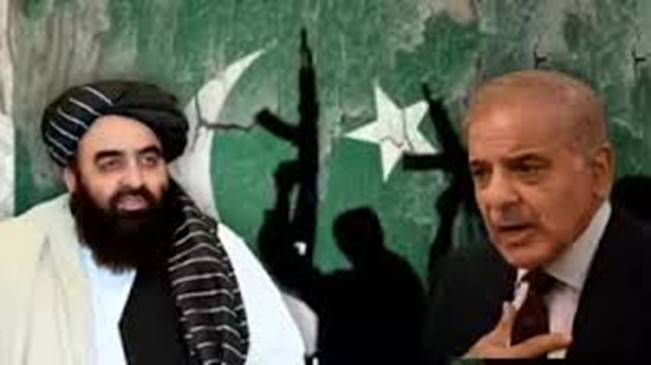
The unedifying outcome of talks while TTP attacks surged and claimed rising casualties led Islamabad to conclude the Taliban were not prepared to break with TTP. Having exhausted diplomatic avenues, Pakistani officials felt the only option was to mount sustained pressure on Kabul to make it change course. This is where things stand at present
Frozen Relationship
By Maleeha Lodhi
Pakistan

The terrorist attack on an imambargah earlier this month — the worst in the federal capital for over a decade — prompted Pakistani leaders to again accuse Afghanistan of providing sanctuary to violent groups that threaten Pakistan’s security. The militant IS-K (Islamic State-Khorasan) group that claimed responsibility is based in Afghanistan and estimated to have 2,000 fighters. Initial investigation by Pakistan’s security agencies found that the mastermind of the Feb 6 bombing belonged to Da’esh and trained in Afghanistan.
In a statement, President Asif Ali Zardari called out the Taliban regime for harboring terrorist organizations. In similar vein, several ministers pointed the finger at Kabul and alleged that its ‘collusion’ with India was behind the attack. For its part, Kabul condemned the mosque bombing, saying it “contradicted Islamic and humanitarian values”. This was unsurprising as IS-K is the Taliban’s bitter foe. But the denunciation did nothing to lower tensions between the two neighbors.
Relations between Pakistan and Afghanistan have continued to deteriorate in the past several months and remain in a frozen state. Diplomatic engagement has ground to a virtual halt, though embassies are open in both countries. Trade is suspended and the border has been closed since last October, when deadly clashes erupted and led to open hostilities. That followed a major TTP attack in Kurram in which several Pakistani soldiers were killed. After that, Pakistan launched air strikes against militant targets in Afghanistan, including in Kabul. Afghan military forces then attacked multiple border posts in response. The situation escalated further with fierce cross-border retaliatory strikes by Pakistan.
A ceasefire was reached through mediation by Qatar and Turkiye. But subsequent talks between Pakistan and Afghanistan ended in deadlock over the issue of the Tehreek-i-Taliban Pakistan that has been stepping up attacks on Pakistan’s security forces from Afghan soil. To Islamabad’s demand that TTP should be disarmed and its violent activities stopped, the Taliban apparently gave unverifiable verbal assurances but declined to give a written commitment. Cross-border attacks by TTP fighters, that number around 6,000 in Afghanistan, have surged since the Taliban reclaimed power. Last year saw around 600 TTP attacks, making 2025 the deadliest year in a decade for Pakistani casualties. Over 3,500 have been killed in Pakistan in TTP attacks since 2021.
The February 2026 report of the UN Security Council’s analytical support and sanctions monitoring team notes the increase in TTP attacks and says Afghan authorities continue to provide a permissive environment for the militant organization and other terrorist groups. An earlier UN report of November 2025 said TTP attacks have led to military confrontation between the two countries, closure of border-crossings and economic consequences, which it casts as “the greatest short-term threat to the de facto [Taliban] authorities’ stability”.
Before the October 2025 breakdown in relations, Pakistan tried a carrot-and-stick policy to persuade Taliban leaders to address its security concerns about TTP. The stick was evident in the coercive policy pursued in the past two years. This had three elements: kinetic air strikes at TTP hideouts in Afghanistan, tightening of transit trade restrictions and expulsion of illegally resident Afghan refugees from Pakistan. The carrot was reflected in revived diplomatic engagement with Taliban authorities, which reached a high point in April 2025 when deputy prime minister and foreign minister Ishaq Dar visited Kabul. Pakistan acceded to several Taliban requests on bilateral and transit trade issues and offered to upgrade relations. Dar visited Kabul three times last year as part of high-level dialogue.
The Taliban, for their part, pledged to ‘contain’ the TTP. But, as in the past, this turned out to be an empty promise. Publicly, Kabul always denied there were TTP hideouts in Afghanistan. But privately, in talks with Pakistani officials, Taliban leaders, of course, acknowledged the TTP presence. In successive rounds of talks, they offered to take action while urging Pakistani interlocutors to talk to TTP and show flexibility on two of the group’s core demands — withdrawal of military forces from the tribal areas and reversal of Fata’s merger into KP. These demands are, of course, non-negotiable for Pakistan.
The unedifying outcome of talks while TTP attacks surged and claimed rising casualties led Islamabad to conclude the Taliban were not prepared to break with TTP. Having exhausted diplomatic avenues, Pakistani officials felt the only option was to mount sustained pressure on Kabul to make it change course. This is where things stand at present.
Islamabad’s strategy is, for now, aimed at raising the costs for Kabul for its non-action on TTP. Having made it clear to the Taliban that mass casualty attacks from Afghan soil will invite a kinetic response, Pakistan has been conducting cross-border strikes against TTP bases and targeting individuals. Some strikes have been deeper in Afghan territory.
Meanwhile, the prolonged closure of the border and halt in trade are key levers Pakistan is using to pressure Kabul. This involves significant loss in revenues for the Taliban regime, estimated at $400 million a year. Then there is the loss in export earnings for Afghanistan. Exports to Pakistan have ranged between $880m and $566m in recent years. Moreover, the suspension of transit trade entails detrimental consequences for Afghanistan and its people. All this is apart from the smuggling that takes place across open borders from which the Taliban benefit.
Islamabad’s calculation is that economic pressure will also start to affect the Afghan public, which could then direct its resentment at the regime. Moreover, there are indications that not all Taliban factions are wedded to TTP, and some see it as a source of unnecessary friction with Pakistan. This is also the finding of the UN’s 2025 report, which says, “Within the Taliban there are varying degrees of sympathy for and allegiance with TTP. Some senior members increasingly view TTP as a liability, unnecessarily disrupting and antagonizing relations with Pakistan, while others remain supportive of it.” Pressure by Pakistan aims to widen these internal contradictions. Also, as all Afghanistan’s neighbors are affected by cross-border terrorism, Islamabad seeks to coordinate with them to mount collective pressure on Kabul.
The coming months will show how far this effort to wear down the Taliban by a strategy of attrition will yield an outcome Pakistan has long sought.
(The writer is a former ambassador to the US, UK and UN. - Dawn)