
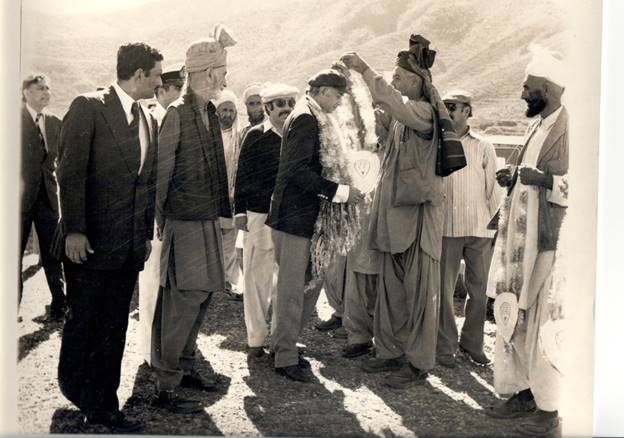
The author as Political Agent Orakzai agency is seen above on the left of PM ZA Bhutto
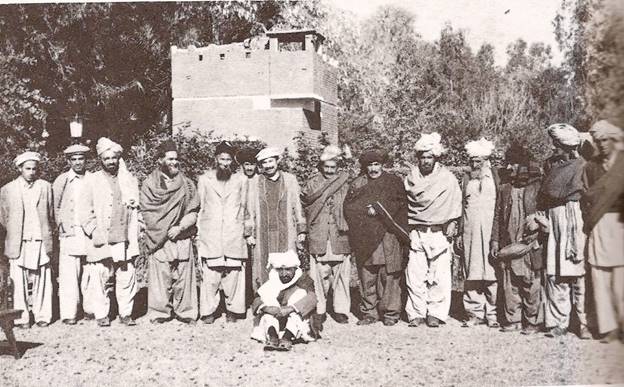
With elders of the south Waziristan agency who negotiated the surrender of the wanted man and brought him to the PA’s house in Tank. The author is in the middle of the Jirga of elders, wearing the Joga with a mustache!
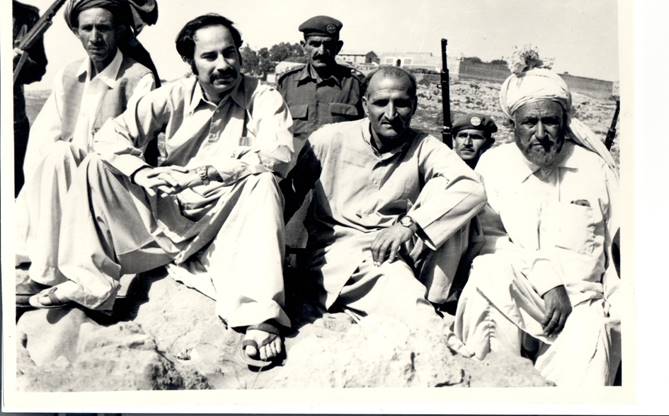
The author (second from left) with his tribal bodyguard and others
Administering Waziristan
By Dr Akbar Ahmed
American University
Washington, DC

In my 2013 book The Thistle and the Drone: How America’s War on Terror Became a Global War on Tribal Islam, I examined Muslim tribal societies living on the periphery of modern states such as the Pukhtun, Yeminis, Somalis, and Kurds and the ways in which they have been drawn into the war on terror with devastating effects for local people.
In the study I wrote about the adversarial relationship that often exists between tribes and central governments, which can reach a critical point when “terrorists” are understood to hide in tribal regions. The state tends to use overwhelming force against these terrorists and militants, assisted by technologies like the drone.
Yet from the perspective of the tribes, this approach is often counterproductive because the tribes have their own ways of administering their areas, apprehending troublemakers, and negotiating and dealing with central authority. Tribes function and govern themselves through councils of male elders, who governments must deal with in order to be successful in tribal regions. It is certainly possible to enforce the writ of the state in such regions but it must be done with the culture of the tribes in mind. Using overwhelming force in tribal areas can antagonize the public at large and trigger the tribal code of revenge, thus contributing to the never-ending cycles of violence we are currently seeing in the Pakistan-Afghanistan border region and indeed in Muslim tribal societies across the world.In this case study, I was able to apprehend hostile figures to government through working with the tribal elders and by respecting local customs.
Here I present a fascinating case study of administration in a tribal society from which we can learn. In this case it is from my time in charge of South Waziristan some four decades ago. Although things have changed in significant ways from the time of the case study, such as the Soviet invasion of Afghanistan, the rise of the Taliban, 9/11 and the American led War on Terror,the excessive use of drones in the area, the merger of the Federally Administered Tribal Areas with Khyber Pakhtunkhwa province and the repeal of the Frontier Crimes Regulation, we can perhaps still take lessons about how to conduct government affairs in a tribal society from the case study.
On the eve of the Soviet invasion of Afghanistan in the late 1970s as Political Agent in charge of South Waziristan Agency, I was faced with bringing in the outlaw Safar Khan, the most wanted man in my area. Like the terrorists and militants in the same region in the current era,I believed Safar Khan needed to be brought to justice for the safety of the agency.
As it happened, I got my man alive without a single shot being fired. The writ of the government was established, justice served, and the guilty man brought to book, all without antagonizing the local people or disrupting their lives. The difference with what appears to be happening these days was that I worked entirely within the tribal framework and traditional social structure.
Safar Khan (pronounced Sappar Khan), a Pukhtun of the Mando Khel clan from Baluchistan, had resorted to an infamous life of crime, raiding, and kidnapping after concluding he had been treated unfairly by the Political Agent of his agency following a land dispute with a neighboring clan. I had discovered that breaches of law such as shooting at or even kidnapping government officials were sometimes a desperate attempt to draw attention to an imagined or real grievance. It was the equivalent of presenting a written petition for redress to the administration. Safar Khan was involved in outright criminal acts, however, and had to be dealt with accordingly.
Safar eventually allied himself with the Kharoti Pukhtun outlaw Nemat, a”most wanted man” in both Zhob Agency in Baluchistan and South Waziristan Agency for having killed two officers of the Zhob Militia, a paramilitary force linked to and manned by the Pakistan army. In the 1960s and 1970s, Safar Khan’s notoriety grew as the major offenses attributed to him mounted, among them the destruction of railway bridges and the abduction of government officials, both civil and military. Various councils of elders, or jirgas, and raiding parties had failed to capture him as he moved adroitly between distinct tribal, agency, provincial,and international boundaries.He crossed provincial and even international borders to always keep one step ahead of the law.
Then, in a daring and perfectly executed operation in November 1979, Safar Khan kidnapped Lance-Naik (Lance Corporal) Baramat Khan of the Zhob Militia and escaped with his prey across the border into Afghanistan. The militia’s colonel and the inspector general of the Baluchistan Frontier Corps, General Alam Jan Mahsud, were furious about Khan’s apparent ability to operate without check. Both officers were Pukhtun themselves - in fact, Alam Jan was from South Waziristan-and felt that their honor was at stake. They threatened to conduct commando raids.
The general, a friend of mine, challenged me, half in earnest: either to “bag Safar Khan” or step aside and let him use his tactics. As civilian head of the agency, I strongly felt that the use of military force to solve a tribal problem implied a failure of the civil administration and would complicate matters further. Advising the general to be patient, I concentrated on the capture of Safar Khan. Once word got out, I simply had to get my man and do so within a certain time frame. My prestige was on the line. It was a high-risk strategy. If I failed, my administration would have been considered ineffective, and others would have been encouraged to challenge it. The tribes would have said I could not live upto my word, that my threats and promises were hollow.
As so often happens on the frontier, I was thrown into a risky situation not of my choosing in which failure or success would determine my reputation. The question was how to proceed when the effectiveness of a political officer was defined by factors outside his control. I decided to send messages to Safar Khan in Afghanistan through the Wazir, a tribe whose members lived on both sides of the international border and were harbouring him. I had won over the Wazir only a few months earlier when I had made a dramatic and risky visit to the grave of their ancestor, Musa Nikka at Birmal, along the lawless and un-demarcated international border, often referred to as the Durand Line. No government official, British or Pakistani, until that time had ever visited this dangerous area before.
The tribesmen, alienated by the previous administration, saw the visit as a gesture of respect for their ancestor. At the same time, I contacted the outlaw Nemat through Abdul Maalik, a prominent Mahsud elder of the Shabi Khel clan, who was hostile to the administration until I appealed to his sense of honor and earned his loyalty. After lengthy negotiations, Safar was promised a fair trial by jirga in Balochistan, where his crimes were committed, if he surrendered to me. I assured him that I would also speak with the Political Agent in Zhob to request that he be treated fairly under tribal custom, but I could only do this if he came to me unconditionally. The exchanges were thick with the words ‘trust’ and ‘honour’. Safar agreed.
In January 1980, accompanied by the leading Wazir and Mahsud maliks (elders), Safar formally surrendered to me along with Nemat, who swore loyalty to Pakistan. Safar was brought to the Political Agent’s bungalow in Tank, South Waziristan, and in the photograph taken on the occasion — of him, myself, and the elders — he is crouched sullenly at our feet while the rest of us are standing. The picture, can be found in my book Resistance and Control in Pakistan, it illustrates not only the unity between the elders and the Political Agent regarding Safar but also the reality that like many men with a fearsome reputation, he was rather unimpressive in person.
After I had detailed conversations with senior officials in Balochistan, the jirga travelled to Balochistan like a victory procession with Safar Khan as their prize. The Zhob Militia escorted him from the border. Safar’s traditional rivals suspended their animosity and held a dinner for the jirga, in keeping with Pashtunwali, or the honour code of the Pashtun, to indicate their desire for peace and a healing of past wounds.
The jirga, after concluding its often tense proceedings, announced a settlement of the original land dispute that was largely satisfactory to both parties involved, binding them to sureties worth 200,000 rupees each. Moreover, the jirga ensured Safar’s future good behaviour. From my opening moves to reach Safar to the tribal jirga in Balochistan, the long months were filled with intense negotiations, lengthy meetings, favours called in, theatrical flourishes that conveyed threats and promises, and the determination to persevere with the patience of a saint.
The slightest thing, even an imagined insult, could have caused the entire proceedings to unravel. By working within traditional tribal structures based on codes of honour and negotiating with various clans, particularly the fearsome Shabi Khel — from which would later emerge the most notorious of the Taliban mutations, the Tehrik-e-Taliban Pakistan (TTP) — I was able to ‘bag my man’ without bloodshed.
The above example shows that impartiality, honesty, and culturally sensitive administration working with tribal elders will not only ensure the successful maintenance of law and order, but will also be widely accepted in tribal society. If the military had resorted to bombing the area where Safar Khan was, for example, the community would have turned against the government. This is not to say that the use of force is unwarranted or unwise — on the contrary it is an essential tool of the government. But it must be used judiciously, sparingly and only after other methods have failed.
“I will not hesitate to say,” the Colonel of the Zhob Militia wrote to me on behalf of his unit, “that where all possible force failed to achieve desired results your political manoeuvre was unique for unconditional and prompt recovery of the individual Ferari. I must appreciate that this is such a precedence which has never been set by any civil administration, particularly in the agency area in the past.” The Governor of Balochistan, in a rare gesture of appreciation crossing provincial boundaries, wrote to Governor KP requesting him “to convey his appreciation” to Political Agent, South Waziristan Agency: ‘The Governor of Balochistan has conveyed that but for your resolute efforts and skilful handling the surrender of Safar Khan Mando khel of Zhob would not have been possible.”
Today in the era of the war on terror the opposite seems to be happening. The use of military force seems to be the first rather than the last option and we have seen how difficult counterinsurgency campaigns can be in Muslim tribal regions, bogging down governments in conflicts which can seem interminable. However, if the approach I am discussing here is conducted in the correct way and with understanding, no problem in the field is too great to resolve.
In conclusion, in my earlier book on Waziristan, Resistance and Control in Pakistan, I had pointed to its “speculative and exploratory nature” and expressed the hope that the study “has indicated areas for future research.” Much work still remains to be done in this field.
(Akbar Ahmed is Distinguished Professor and the Ibn Khaldun Chair of Islamic Studies, School of International Service, American University, and Wilson Center Global Fellow, Washington DC. He is a former Pakistan High Commissioner to the UK and Ireland.)
