
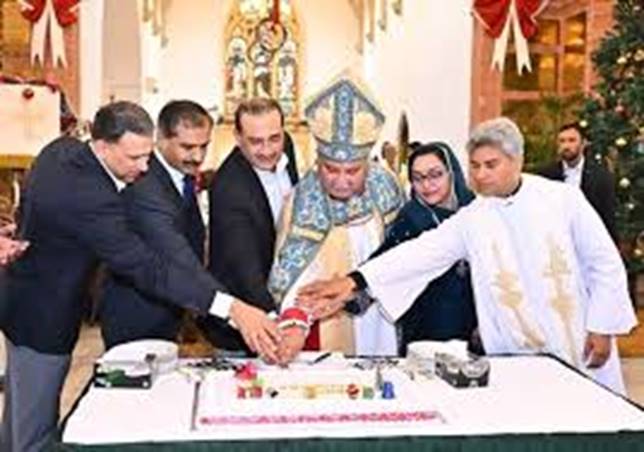
Living in a Pure Land does not mean uniformity, but peaceful coexistence despite differences. It requires dialogue over confrontation, empathy over prejudice, and justice over exclusion. This Christmas demonstrated that vision, as Pakistan’s institutions put principle into practice and reinforced a sense of belonging for all communities. By embracing diversity, protecting rights, and valuing citizenship equally, the nation has shown that unity and social cohesion are achievable. Such actions send a strong message to the international community that inclusive governance and respect for minority rights are vital for national stability and progress – Photo Christian Daily International
Pakistan, the Meaning of a Pure Land
By John Bosco
London, UK

In my childhood, as a growing boy in school, we were taught the meaning of Pakistan, derived from Pak Sar Zameen, meaning the “Pure Land.” In its broadest sense, a Pure Land represents a place free from hatred, injustice, fear, and discrimination, a society built on compassion, equality, peace, and mutual respect. This meaning extends beyond religion and reflects humanity’s universal desire for coexistence and harmony.
For me, born and raised in Karachi, Pakistan’s largest and most diverse city, the city once represented a beautiful bouquet of different religions, cultures, ethnicities, and languages, a truly plural society. It would be unjust if I did not mention Misquita Bakery, founded by Joseph Cajetan Misquita in 1858, and the old Pereira Bakery in the Saddar area, a historic district of Karachi, where I used to buy Christmas cakes and eagerly wait for Christmas. These bakeries were not only visited by Christians but by people from all communities, and during the season, the entire atmosphere reflected Christmas and nothing else.
Pakistan was envisioned as a Pure Land, a homeland where people could live with dignity, freedom, and security. The name “Pakistan” symbolizes the land of the pure, not only in a religious sense but also in moral values such as honesty, tolerance, justice, and respect for human rights. The founders imagined a state where faith would unite rather than divide, and citizens of all religions would enjoy equal rights and opportunities.
In an ideal Pakistan, people of different religions, Muslims, Christians, Hindus, Sikhs, and others would live together in peace. Diversity would be valued as a strength, places of worship would stand side by side as symbols of unity, and religious identity would never be a basis for discrimination. Every citizen would feel safe practicing their beliefs while respecting those of others.
Encouragingly, this vision has become increasingly visible in recent years. During this Christmas season, the state of Pakistan celebrated religious festivals in an inclusive manner. When Christmas is officially recognized, public decorations are displayed, messages of goodwill are shared, and national leaders extend greetings to the Christian community. It reflects a spirit of unity

It would be unjust if I did not mention Misquita Bakery, founded by Joseph Cajetan Misquita in 1858, and the old Pereira Bakery in the Saddar area, a historic district of Karachi, where I used to buy Christmas cakes and eagerly wait for Christmas. These bakeries were not only visited by Christians but by people from all communities, and during the season, the entire atmosphere reflected Christmas and nothing else - Facebook
that resonates beyond symbolism. Such actions send a clear message that religious minorities are not outsiders, but an integral part of the nation.
I firmly believe that actions speak louder than words. Words can promise inclusion and harmony, but visible actions demonstrate whether those promises are genuine. In this context, the events surrounding Christmas in Pakistan provided a powerful illustration. When senior state leadership, including the Field Marshal, the Prime Minister, and the President of Pakistan, attended Christmas church services or participated in Christmas cake-cutting ceremonies, they conveyed a message that went beyond official speeches. Their presence in churches represented practical respect, solidarity, and recognition of the Christian community as an essential part of Pakistan’s national fabric.
In Punjab, Pakistan’s most populous province and home to many Christians, provincial leadership actively supported Christmas celebrations, translating constitutional guarantees of religious freedom into practice. In Lahore, hundreds of Christians joined the province’s first government-sponsored Christmas rally, led by Catholic and Protestant clergy alongside the provincial Minister for Minority Affairs, moving from the historic Sacred Heart Cathedral to the city center with carols, chants, and festively decorated vehicles. The judiciary also played an important role. In Islamabad and Lahore, High Courts marked Christmas with cake-cutting ceremonies attended by chief justices, judges, church leaders, lawyers, and Christian staff. Judicial leaders reaffirmed the constitution’s commitment to equality, religious freedom, and dignity, and acknowledged the longstanding contributions of Christians to Pakistan’s legal and public life.
A similar spirit was evident in Sindh Province, where the provincial government organized multiple Christmas events. The Governor of Sindh’s participation in cake-cutting ceremonies and public interaction reinforced the message that leadership stands alongside citizens rather than above them.
Other provinces reflected this inclusive approach as well. In Balochistan, senior provincial and military officials attended a ceremony in Quetta honoring Christian martyrs and expressing solidarity with the Christian community. In Khyber Pakhtunkhwa, the Governor House hosted a Christmas celebration emphasizing respect, inclusivity, and peaceful coexistence among all communities.
Collectively, these actions spoke louder than any official statement could. They demonstrated inclusivity, interfaith harmony, and respect for diversity in a visible and meaningful way. Pakistan’s leadership showed that a genuine commitment to minority rights and national unity is best expressed through participation rather than rhetoric.
In a truly harmonious Pakistan, this same enthusiasm would extend to all religious festivals, including Eid, Holi, Diwali, Christmas, Easter, and Vaisakhi. Furthermore, Pakistan would benefit from incorporating education about different faiths into school and university curricula to promote understanding and acceptance from an early age. Media would highlight stories of interfaith cooperation, and the state would continue to protect all communities while celebrating their contributions to society.
No doubt Christians may constitute only 1.5 to 2 percent of Pakistan’s total population, but one must acknowledge that the freedom and space provided for religious celebration by the government compares favorably with some neighboring countries where Christian populations are larger. Pakistan has demonstrated this commitment through its actions.
The true meaning of a Pure Land lies in building a society where humanity comes before hatred, unity before division, and peace before conflict. A Pakistan where people of all religions live together, celebrate together, and grow together fulfills the promise envisioned at the country’s founding.
Living in a Pure Land does not mean uniformity, but peaceful coexistence despite differences. It requires dialogue over confrontation, empathy over prejudice, and justice over exclusion. This Christmas demonstrated that vision, as Pakistan’s institutions put principle into practice and reinforced a sense of belonging for all communities. By embracing diversity, protecting rights, and valuing citizenship equally, the nation has shown that unity and social cohesion are achievable. Such actions send a strong message to the international community that inclusive governance and respect for minority rights are vital for national stability and progress.
(John Bosco is a free-lance writer from London - bosco_jj@yahoo.com )
