|
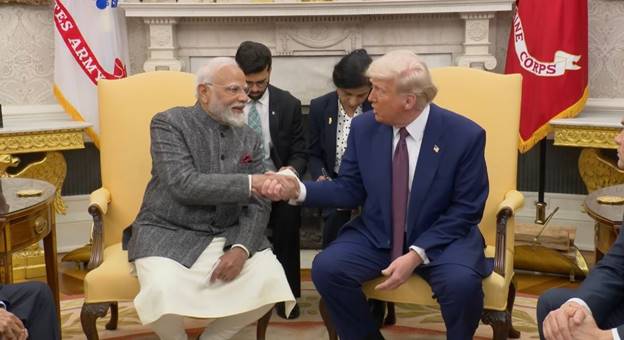 |
United States President Donald Trump and India’s Prime Minister Narendra Modi shake hands in the Oval Office February 2025. India is at a critical point in its relationship with the West. To develop a more balanced partnership the nation must redefine its priorities and its aspirations for itself - Photo White House
Modi’s Trump Embrace: The Hidden Imperial Roots of India’s Bromance with America
By Inderjeet Parmar
University of London
UK

The spectacle is now familiar: Narendra Modi and Donald Trump, arms aloft, basking in the adulation of diaspora supporters in Houston or Ahmedabad, proclaiming an eternal friendship between the world’s oldest and largest democracies.
Yet this is not a new romance born of shared populist energy. It is the latest, unvarnished revelation of Indian foreign policy since 1947. That is, a deep, structural gravitation toward the Anglo-American West whose foundations were laid, ironically, by the very Nehru-led elite that the BJP once loved to hate.
Indian historian and retired naval officer, Dr Atul Bhardwaj, in his ground-breaking study demonstrates that “non-alignment” was never principled equidistance. It was multi-alignment weighted decisively toward the Anglo-American-dominated liberal international order.
‘New Deal’
Nehru’s Harrow-Cambridge-Lincoln’s Inn elite did not break with the Anglo-Saxon world. It negotiated privileged entry into it. The American ‘New Deal’ was the ideological bridge: President Franklin D. Roosevelt’s technocratic developmentalism – rural electrification, river-valley authorities, community projects – was transplanted into colonial India in the 1940s and enthusiastically embraced by the Planning Commission in the 1950s.
The Ford and Rockefeller Foundations, MIT (Massachusetts Institute of Technology) economists, TVA (Tennessee Valley Authority) engineers who built Bhakra-Nangal and Hirakud dams were not imposed; they were invited.
By 1962 the United States had poured more economic aid into India than the Soviet Union would manage in the entire following decade. In return, Commonwealth membership was retained, and sterling balances kept in London. India quietly cooperated with MI6 and the CIA on Tibet and the North-East.
Beneath the anti-imperialist rhetoric, the weighting was always clear.
That same elite also presided over the violent birth of India and Pakistan in 1947, a trauma episode that continues to dictate the limits of Indian strategic autonomy today. Winston Churchill, who despised Indian independence, privately stated that Britain should quit the subcontinent but “ keep a little bit of India ” as a strategic buffer against the Soviet Union and to protect Persian Gulf oil routes, as revealed by veteran editor Sandeep Bamzai in his book “PRINCESTAN: How Nehru, Patel and Mountbatten Made India” (Rupa, 2021).
That “little bit” was the North-West, and above all Kashmir: Muslim-majority, Hindu-ruled, controlling the Indus headwaters and the land bridge to Central Asia. The British military’s strategic thinkers saw Kashmir as “the keystone of the strategic arch of the Indian Ocean” after partition.
The Partition was engineered chaos. Cyril Radcliffe, chair of the boundary-drawing committee, drew the borders in five weeks; 14 million people were displaced, up to two million died. Kashmir became the unfinished business of that bloodbath. Pakistani-backed tribesmen invaded in October 1947; Maharajah Hari Singh, the last princely ruler of Jammu and Kashmir, acceded to India four days later; the first war began. The 1949 ceasefire line was drawn by British officers who had served together months earlier. The Anglo-American stake in keeping the subcontinent divided and tense did not end there. Pakistan joined the Central Treaty Organisation (CENTO) and the Southeast Asia Treaty Organisation (SEATO) in 1954, giving the CIA its U-2 base at Peshawar. India quietly cooperated with Western intelligence agencies.
No more fig leafs
Seventy-eight years later, the prison built in 1947 still holds. Kashmir remains the sticking point that prevents any genuine normalisation with Pakistan, and therefore any genuine strategic autonomy for India. Every trade agreement, every pipeline proposal, every climate initiative on shared rivers is held hostage to the colonial legacy of Kashmir.
The cost is staggering: potential bilateral trade of $37 billion reduced to $2 billion, according to reliable studies. There have been four wars and the 1999 near-nuclear crisis. An insurgency since 1989 has killed over 70,000. And all the while, the United States extracts concessions from both sides by dangling the promise of support on Kashmir that never materialises.
That structural dependence was wrapped in the soothing language of non-alignment, but the weighting was always hidden in plain sight. By 2025, the mask is off in its entirety.
Modi’s India no longer bothers with the fig leaf of non-alignment. The Quadrilateral Security Dialogue is now the centrepiece of foreign policy and discussions ongoing about an AUKUS-lite arrangement – Australia-UK-US security treaty. American nuclear submarines refuel at Indian ports, and India is embedded in a series of defence agreements that ensconce it in a deadly embrace. It is becoming the most privileged non-NATO partner Washington possesses in Asia. The old reflexes run deep.
But the costs are mounting. India’s room for manoeuvre with Russia — the one major-power relationship that actually delivered strategic autonomy is shrinking. The BRICS+ (Brazil, Russia, India, China, South Africa, plus many others) forum, once a modest counterweight, is almost reduced to a photo-op.
This is not strength; it appears more akin to strategic submission, although dressed up as a bromance. So Trump offers to sell overpriced F-35s and Predator drones, having already sold Hellfire missiles. He threatens tariffs on steel and pharmaceuticals, dangles a permanent UN Security Council seat. In return, India accedes to caps on Russian oil purchases. It votes against China at the UN Human Rights Council, and shares intelligence on Chinese researchers. A loyal subaltern, India remains silent on Gaza.
The irony is bitter. The BJP once denounced Nehru as a rootless cosmopolitan who mortgaged India’s pride to the West. Yet Modi has taken that same Anglophone orientation and stripped away even the pretence of balance. Where Nehru balanced American aid with Soviet steel plants, Modi balances American arms purchases with… more American arms purchases. Where Nehru used non-alignment to extract concessions from both sides, Modi offers unilateral concessions for an invitation to Mar-a-Lago.
Break the Spell
It is time to break the spell. The key lies in finally escaping the twin traps of 1947: the Kashmir poison and the Anglo-American embrace.
A genuinely independent Indian foreign policy must begin by compartmentalising Kashmir, exactly as Manmohan Singh and Pervez Musharraf nearly achieved between 2004 and 2008.
During that time, trade quadrupled, bus services crossed the Line of Control, LoC, across Kashmir and back-channel talks produced a workable formula. There was maximum self-governance on both sides, demilitarisation, joint supervision, irrelevant borders. Neither side had to renounce its legal position; the dispute was simply suspended in practice.
Concrete steps today are in theory straightforward:
- Restore and strengthen the 2003 LoC ceasefire with neutral monitoring.
- Reopen cross-LoC trade and travel on the original five points without passports.
- Bring Azad Kashmir and Gilgit-Baltistan representatives into technical discussions on Indus waters.
- Quietly revive the Musharraf-Manmohan framework on a track-two basis.
- Normalise everything else first: full diplomatic relations, MFN trade status, energy pipelines, climate cooperation.
Deepen military-industrial ties with Russia, France, South Korea, Japan; restore balance with Moscow.
The Anglo-American world that engineered division and dependence has moved on. Britain is a nostalgic middle power; Trump’s America favours immediate transactional gain. Neither will reward eternal hostility toward Pakistan, nor eternal subservience from India.
Real strategic autonomy now lies in jointly escaping the prison that London and Washington built in 1947. It is time to neutralise Kashmir as the poison in India-Pakistan relations. Time to neutralise the reflexive need for Anglo-American approval as the poison in India’s global posture.
Until then, every Indian prime minister will remain trapped in the same reflexive hostility toward Pakistan that Churchill designed.
( Inderjeet Parmar is a professor of international politics and associate dean of research in the School of Policy and Global Affairs at City St George’s, University of London, a Fellow of the Academy of Social Sciences, and writes the American Imperium column at The Wire. He is author of Foundations of the American Century (2012), among other books. This is a Sapan News syndicated feature https://www.sapannews.com .)