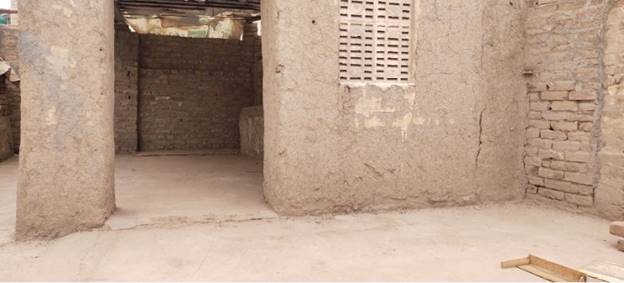
A young girl finds a magical hidden bookshelf in her great-grandfather’s clay-walled room in a village, filled with Persian books. Pakistan’s 2022 floods took away the room, and the grief lingers until she finds a piece of fiction that gives her a language to understand what that loss meant. Above: The remains of the writer’s great grandfather’s room in Gambat, Pakistan
The Room That Shaped Me: Reading Naiyer Masud after a Childhood Loss
By Areeba Pirzada
Gambat, Pakistan

“We know more than we can use. Look at all this stuff I’ve got in my head: rockets and Venetian churches, David Bowie and Diderot, nuoc mam and Big Macs, sunglasses and orgasms… And we don’t know nearly enough,” writes Susan Sontag.
This excerpt is from Sontag’s story Debriefing, which appears in her last book of essays and speeches At the Same Time (2007), which she compiled before succumbing to her third bout of cancer.
The quote sums up with utmost brevity the feeling I get every weekend when I don’t find myself in the school staff room with my spine perfectly straight and my face expressionless.
But the ‘stuff’ in my head is very different from what Sontag writes about. What my head is heavy with is images of places I have been to; with couplets of Munir Niazi, Khayyam and Neruda; longing for something unintelligible; and an often-occurring yearning for a room I lost, which feels like paradise lost.
I grew up in a two-portioned house in Gambat, a small town in Pakistan’s interior Sindh region.
And the place that really helped me to become who I am – a writer, literature enthusiast and teacher – was my great-grandfather’s room, situated in another portion of our house.
As a child, I was as silent as the dead. Growing up in a male-dominated society that values men’s needs, dreams and words, I sought refuge in wordlessness. I learned that to avoid unnecessary drama and uninvited trouble, I must learn to not give my voice away. I must embrace silence, and think of it not as an attribute but an appendage attached to my being.
My great-grandfather’s room played an important role in solidifying my silence.
As a child, I would climb the narrow, steep ladders made of clay and red bricks leading to the terrace, the chhat, which housed my abode, that room – my very own wonderland.
When the 2022 floods in Pakistan swept away entire villages, I also lost my great grandfather’s room, which collapsed during heavy rains one night.
It was almost 80 years old, an archaic study made of thick clay walls which came up against the harrowing currents of climate change. I heard a sound like a sedated blast followed by the clatter of falling clay tablets. In the blink of an eye, I lost the space where I had learned to observe, to read, to listen, and most importantly, to live.
At the age of 20, I did not know how to deal with grief so unfamiliar yet so profound.
Silent absence
After the room’s disappearance, I never felt at home in Gambat. I would go upstairs and see just a wall and the empty entrance – remains of the room. My mind would recreate the rest of the place. It was like witnessing a phoenix rising from its ashes. However, the phoenix of my self-crafted mirage never lasted longer than a few minutes.
So, I decided to stay away from Gambat as much as possible because the string that bound me to the city was broken. It was never going to come back. My curious case of place attachment transformed me for a while into a vagabond, heading towards big cities like Lahore, Hyderabad, and Karachi. It is not merely as an escape, but a search for belonging in dynamic metropolises.
What troubled me the most was not that my home within a home was gone, but the realization that I could not make anyone understand the significance of a room that I treated as a temple of abandoned things left by my great grandfather – which everyone else in the house considered useless stuff.
It was not until the following year that a teacher noticed my ‘eye’ for Franz Kafka and suggested I read Seemiya (The Occult, 1984), a short story collection by Naiyer Masud.
For the first time in my life, I read something which resonated so much with my place-obsessed nature. The story titled Ojhal (The Hidden) was my gateway to Masud’s world where places mattered as much as humans did. The protagonist of Ojhal is a house inspector (a job I had never heard of) who keeps finding ‘the domains of fear and desire’ in the houses he inspects.
“Looking for these domains of fear and desire became a vocation with me and, ultimately, this vocation proved harmful to my business. Because I was becoming convinced, asking the least bit of proof, that it was impossible to assess the life span of homes when they contained these domains of fear and desire … Then one day I discovered a house where fear and desire existed in the same domain,” says the narrator. (English translation by Mohammad Umer Memon, 2013).
I felt as if Masud was himself an occultist who, despite never knowing of my existence, knew what I was like. Whatever the protagonist of Ojhal said about finding the domains of fear and desire was very similar to my belief, as a child, that in my great grandfather’s room existed the spots of mystery and reality. It still seems impossible to me that I have formed such a belief at age 11. But my journals, filled with such half-baked ideas, are proof that I did.
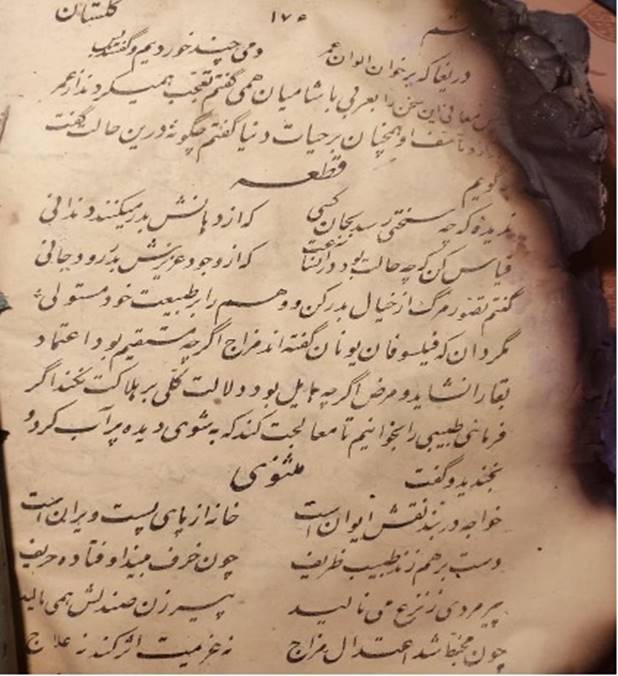
A page from a copy of Gulistan owned by the author - Photo Areeba Pirzada
For me, the clay bookshelf embedded in the wall of the room containing old editions of Sa’adi’s Gulistan, other Persian books and scientific manuscripts was the spot of mystery. The corner table, where great-grandfather’s pots, glass beakers, and tiny bottles filled with mercury and powdered silver rested, was the spot housing reality.
Places transform
In order to find out if other people think that places have transformative power, I asked my colleagues and teachers: Do you think the places we spend most of our time in change us significantly, and have you experienced it yourself?
They answered my question in detailed written responses over text.
“Places definitely impact us as people,” said Dr Javeria Farooqui, a literature professor and researcher at COMSATS University, Lahore.
About her workspace she added, “The campus is pretty green, and most buildings have brickwork done on them… the beauty and safety of the space helped me so much with my research productivity.”
My senior at the University of Sindh and a column writer in Sindhi papers, Wajahat Ahmed said he used to visit places like the Sindh Museum, the Arts Faculty Park at Sindh University, and hotels in Hyderabad, where he spent “wonderful moments with comrades discussing a wide range of topics and learning a great deal”.
“These experiences have transformed the way I perceive reality, and I must say that some places hold great significance in my life,” he added.
Taking other people’s opinion on the matter of places being the entities capable of transforming us, my own journey of becoming who I am while occupying my great grandfather’s room started to seem less fantastical. Instead, it came to feel more like a natural phenomenon.
Candle in the dark
But if I had not read Masud’s fiction, I wouldn’t have been able to communicate my love for places to others. His short stories helped me to understand deeply what I always knew – that there are people out there to whom places were more than mere backdrops.
His characters, such as the librarian in the short story Kitaabdaar in the collection Ganjifa (2008), offered me a companion who changes with the deterioration of the places around him.
Kitaabdaar taught me that places can be stationary yet able to move us in manners we cannot entirely understand with the limited faculty of logic.
To me, Masud’s writing, despite its surreal quality, is concretely real. His writings are not fantasy even while containing this air of secrecy.
“As for fantasy, I try very hard to steer clear of it. My stories are not fantasies, at least not in the sense of the fantastic. You cannot say their events don’t occur in real life,” Masud told Asif Farrukhi the Pakistani writer and translator, in an early 1990s interview at Adabistan, Masud’s residence in Lucknow.
Scent of memory
When I was in grade six, I loved telling my classmates stories about weird happenings in my great-grandfather’s room. Some stories were the paranormal accounts I had heard as a child from my Amaa Jeejal (my grandma), that I would sensationalize. Their awed reactions were tinged with disbelief.
Some stories were about my day-to-day sit-ins in the room with an old copy of Pakistan’s popular Urdu magazine Akhbar-e-Jahaan in which I loved to read the travel writer Mustansar Hussain Tarar’s column Karwaan Saraaye.
And finally, some were my own creations about ghosts falling in love with spectacularly beautiful archaic rooms. I learned to take my classmates’ incredulity as a peculiar way of praising my storytelling skills. For me, as a child, my stories were the real occurrences that came to life in that room.
In Masud’s 1990 short fiction collection Itr-e-Kafoor (The Essence of Camphor), the perfumist protagonist talks about the feeling of forlornness imparted by the fragrance of camphor. The description offers the same lack of clarity I encounter when I think of my lost room.
To me that room revealed so much, like the reading preferences of my great-grandfather; his interest in sciences, philosophy, poetry and religion. However, there was much which felt hidden and unintelligible, like my unflinching attachment to it; my nervous anticipation as I looked up at the Persian books on the top shelves that I could never reach, reading the emboldened titles on the books’ spines.
To live peacefully with the unknown and incomprehensible was attained after I read Itr-e-Kafoor where many plot details appeared concealed cleverly and deliberately by the author.
“It is this forlornness that the perfume-maker, like a signature, hides in his perfumes. In a strange irony, the signature – which in an artwork is always the moment of revelation and, thereby, possession – finds no name in Masud’s story, no language and, contextually put, no distinct aroma,” writes Indian scholar Mantra Mukim in an essay, commenting on Masud’s habit of hiding things in his fiction.
Being surrounded by unfamiliarity and the unknown becomes a part of life and yet strangely familiar in Masud’s fiction. Eventually, I followed the path of acquiescence and it no longer bothered me to be unaware of so much in a place – the room — I knew like the back of my hand.
When I read Itr-e-Kafoor for the first time, I felt as if I could smell the thawed scent of clay walls in my lost room. The memory of the scent invoked in me a sense of melancholy.
It seems strange now to me that as a child I chose to stay detached from the rest of the house and embrace the vicinity of a room forgotten by other family members. I would feel a sadness arising from feeling abandoned. It surprises me how a place can make you feel something which you didn’t even know had a name – forlornness.
Sometimes, now at the age of 23, I still feel abandoned by a place. And, I will always be grateful to that room for shaping me into an observer; for providing me with a space to keep the stuff of my head – the poets, the peculiarities, the ideas.
I am not the protagonist of a short story by Masud, but I owe much of my understanding of the world around me and within me to his characters.
(Areeba Pirzada is a writer from Gambat, Sindh. She writes about culture, art, literature and humanities. Currently she is working to promote literature and writing in her hometown via her community organization “Seen Se Soch”. http://www.sapannews.com)