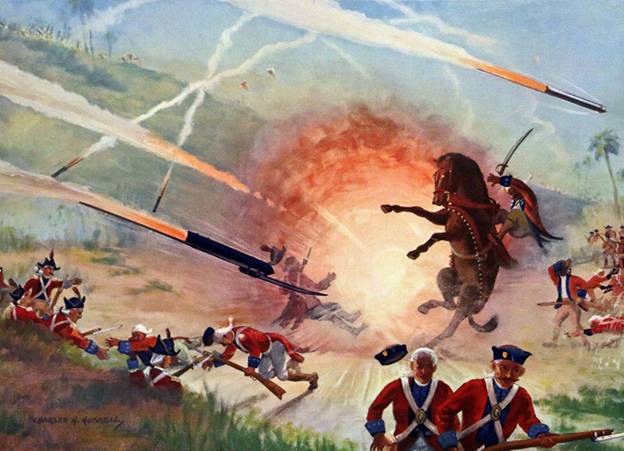
A painting showing the British forces confronted with Mysorean rockets - Wikipedia
From Tipu to V2- Reclaiming the Heritage of Solid Propellant Rockets
By Dr Nazeer Ahmed
Concord, CA

The modern history of rocketry is often narrated as a European-American twentieth-century achievement culminating in the German V-2 rockets. This narrative needs reexamination. The intellectual and technological lineage of solid-fuel rockets stretches back at least to late-eighteenth-century South India, where Tipu Sultan of Mysore pioneered military rocket technology that decisively influenced global warfare. From the battlefields of Mysore to the laboratories of Germany, the story of solid-fuel rockets is one of cross-civilizational transmission, adaptation, and innovation.
Tipu Sultan and the Birth of Modern Military Rocketry
Rocket weapons existed for centuries before Tipu Sultan, particularly in China, where gunpowder rockets were used for signaling and limited battlefield roles. What distinguished Tipu Sultan (1750–1799) was not the mere use of rockets, but their systematization, industrialization, and doctrinal integration into warfare.
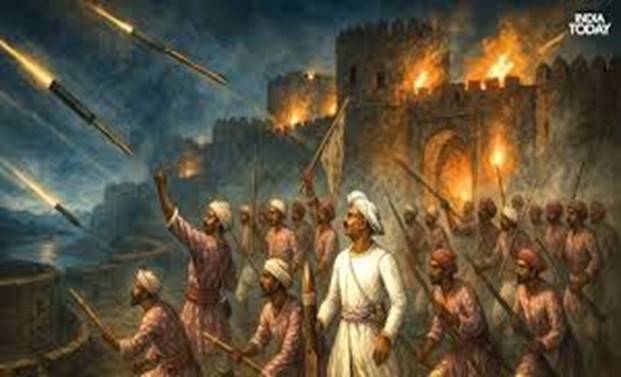
Under Tipu and his father Hyder Ali, Mysore developed the world’s first large-scale, state-sponsored rocket corps. Contemporary accounts indicate that between 3,000 and 5,000 trained rocketeers operated as organized units, with standardized designs and tactics. The critical technological leap was the iron casing. By replacing fragile paper or bamboo tubes with wrought iron cylinders, the Mysore engineers dramatically increased internal combustion pressure, yielding longer range, greater velocity, and more destructive impact.
These rockets could reach distances approaching two kilometers and were capable of bouncing trajectories after impact—an unintended but devastating feature that caused panic among enemy infantry and cavalry. Rockets were mounted on bamboo shafts and fitted with sword blades, allowing them to function both as projectiles and as anti-personnel weapons upon landing.
The effectiveness of these weapons was demonstrated repeatedly during the Anglo-Mysore Wars. At the Battle of Pollilur (1780), British formations were broken by coordinated rocket attacks, contributing to East India Company’s worst defeat on Indian soil.
Recognizing this heritage of solid-propellant rockets does more than correct the historical record. It reminds us that scientific and technological revolutions are not confined to one civilization. The path from the skies of Mysore to the stratosphere above America and Europe was long, cumulative, and shared — and it began not in twentieth-century Europe or America, but on the battlefields of eighteenth-century South Asia
British Adaptation and the Napoleonic Wars
The fall of Seringapatam in 1799 and the death of Tipu Sultan marked not the end, but the globalization of Mysore’s rocket technology. British forces captured hundreds of rockets and technical descriptions of their manufacture. They were transported to Britain, where they came under the study of William Congreve at the Woolwich Arsenal near London.
Congreve reverse-engineered and modeled his rockets on Mysore designs. He retained the iron casing, improved propellant mixtures, standardized calibers, and adapted rockets for naval and siege warfare. By the early nineteenth century, Congreve rockets had become an official part of British military arsenals.
During the Napoleonic Wars, these rockets were deployed against French forces, most notably in the bombardment of Copenhagen (1807). These rocket attacks caused widespread fires and civilian panic, reinforcing the psychological dimension of rocketry first exploited by Tipu Sultan.
The Anglo-American Wars
British rocket technology soon reached the New World. During the War of 1812, Congreve rockets were used against American targets, including the bombardment of Fort McHenry in 1814. The vivid imagery of “the rockets’ red glare” in the US national anthem bears testimony to the impact of Mysore rockets modified by Congreve.
American engineers and military planners took note. Though rockets were not immediately embraced due to accuracy limitations, the conceptual shift was profound: weapons no longer needed barrels or recoil systems. Propulsion itself became the weapon. This insight would later resurface in American rocketry research during the twentieth century.
Russian Theoretical Foundations
While nineteenth-century military rocketry stagnated, the theoretical groundwork for modern rocketry was laid in Russia. Konstantin Tsiolkovsky (1857–1935) transformed rocketry from an empirical craft into a mathematical science. His work on reaction propulsion, rocket equations, and multi-stage vehicles provided the theoretical foundation for all later rocket development.
Although Tsiolkovsky focused primarily on spaceflight rather than weapons, his insights applied equally to solid propulsion. Crucially, he framed rockets as autonomous systems governed by conservation laws—an abstraction that allowed engineers to move beyond trial-and-error designs inherited from earlier centuries.
Russian contributions thus bridged the gap between the practical legacy of Tipu Sultan and the technological sophistication of the twentieth century
American Engineering and Experimental Rocketry
In the United States, early twentieth-century rocketry was shaped by Robert H. Goddard (1882-1945), whose experiments with solid and liquid fuels established rocketry as an experimental science. Goddard recognized the advantages of solid fuels — simplicity, storability, and reliability — qualities already evident in Tipu Sultan’s rockets. He combined them with Gyroscopic stabilization and steering with gimbals to achieve greater stability and accuracy.
Although Goddard’s work focused on peaceful exploration, American military interest in rockets expanded rapidly during World War II, particularly in solid-fuel boosters and artillery rockets. The conceptual linkage from Congreve rockets to modern solid-fuel systems became increasingly explicit.
The Second World War and the German V-2 Rockets
The German V-2 rocket that wreaked havoc on London during the later stages of the Second World War, represented the first large-scale realization of long-range guided rocketry. Although it was powered by liquid fuel, its conceptual ancestry lay in the same principles that governed solid-fuel rockets: self-contained propulsion, independence from gun barrels, and ballistic-plus-propulsive trajectories.
Engineers such as the German-American Werner Von Braun (1912-1977) combined theoretical rigor with industrial capacity. Yet the military logic of the V-2 — the idea that rockets could bypass traditional defenses and strike deep into enemy territory — was already implicit in Tipu Sultan’s battlefield doctrine.
Indeed, the V-2 was less a rupture than an escalation: greater range, greater payload, greater abstraction—but rooted in an eighteenth-century insight that propulsion itself could be weaponized.
For South Asians - Reclaiming a Lost Heritage
From the iron-cased rockets of Tipu to the thunderous ascent of the V-2, the history of solid-fuel rocketry is a continuous, global story. Tipu Sultan stands at its origin, not as a footnote, but as a pioneer who transformed rockets into disciplined instruments of state power. British, American, Russian, and German contributions did not erase this origin; they built upon it.
Recognizing this heritage of solid-propellant rockets does more than correct the historical record. It reminds us that scientific and technological revolutions are not confined to one civilization. The path from the skies of Mysore to the stratosphere above America and Europe was long, cumulative, and shared — and it began not in twentieth-century Europe or America, but on the battlefields of eighteenth-century South Asia.
(The author is Director, World Organization for Resource Development and Education, Washington, DC; Director, American Institute of Islamic History and Culture, CA; Member, State Knowledge Commission, Bangalore; and Chairman, Delixus Group.)