

As migration reshapes economies and societies, the World Migration Report 2026 highlights the growing need for safer migration routes, international cooperation, and policies focused on humanitarian and economic realities. Above Image: Migrants make their way through the Darién Gap, 66 miles of remote jungle connecting North and South America. Screenshot via CBS Sunday Morning report ‘Migrants’ dangerous journey north’
From Gulf Labor to Climate Pressure: South Asia’s Migration Story
By Regina Johnson

A review of the recently released World Migration Report 2026 makes it clear that South Asia today is one of the most influential areas shaping global migration patterns.
The region is home to some of the world’s largest migrant populations, and sits at the crossroads of labor mobility, economic dependence on remittances, climate vulnerability, and displacement. South Asia is not only a source of migration but a region increasingly central to the future of global mobility, according to the report.
As of mid-2024, about 304 million people were living in a country different from the one where they were born, or about 3.7 percent of the world’s population, according to the migration report. Launched 5 May by the International Organization for Migration, it was released during the International Migration Review Forum in New York in early May.
“The aim of this report is to put migration into perspective,” IOM spokesperson Zoe Brennan said during a 5 May press briefing at the UN. Brennan went on to say that when people come into communities, those communities must be prepared to support them. “When migration is well managed, people feel that there is a sense of control, because everybody benefits when migration works well,” she added.
One of those benefits is financial. Afghanistan, Bangladesh, India, Nepal, and Sri Lanka send millions of workers abroad each year, particularly to the Gulf states, Europe, Southeast Asia, and North America. The labor demand in construction, healthcare, domestic work, and hospitality drives most of this migration. Those workers also send billions back home, which helps sustain not just families but economies across the region. In fact, India continues to rank as the world’s largest recipient of remittances, while other South Asian countries like Bangladesh and Pakistan are not far behind, according to data provided in the report.
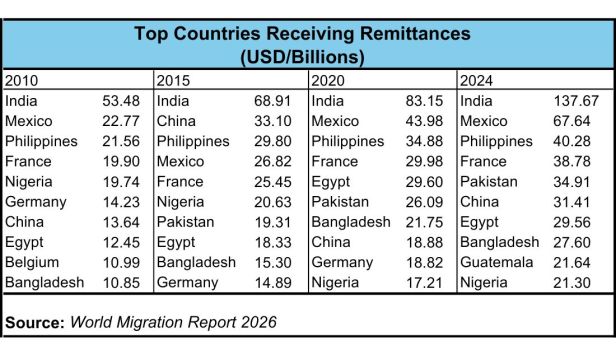
CHART: Top countries sending remittances between 2010 and 2024
The report also sheds light on the vulnerability of many South Asian migrants, noting that limiting legal pathways increases risks for migrants, raises costs for states, and reduces the broader benefits migration can provide. Recruitment costs, exploitative labor practices, wage theft, and unsafe working conditions continue to affect migrant workers.
Women migrants working in domestic labor remain especially vulnerable to abuse and limited legal protection. Expanding safer and more regular migration opportunities, alongside stronger labor protections and fair recruitment systems, is essential to reducing exploitation, says the report.
Climate change is another major driver reshaping migration in South Asia. Bangladesh and Pakistan are experiencing growing levels of climate-related displacement, with millions forced to move internally following environmental disasters. In 2024, there were 45.8 million new internal displacements triggered by disasters, mostly by storms (25.2 million) and floods (19.1 million). But people also moved within their homeland for better jobs, improved living conditions and education. These displacements occurred across 163 countries and territories, according to the report.
Recognizing that the key challenges to addressing this problem are limited funding and political support, experts suggest strengthening city and local government leadership in areas like planned relocation. They also call for improving regional and international cooperation to manage displacement and mobility more effectively and ensure that people in the affected areas participate in decision-making processes.
Jonathan Prentice, Head of Secretariat, United Nations Network on Migration at IOM stressed in the press briefing that most migration is not a crisis and happens through “legitimate, safe pathways” but problems start when people feel like they must move and “enter irregular situations” like entering a country on a valid visa and overstaying. That “fuels public concern and anti-migration sentiment” he noted.
Prentice argued that governments should strengthen and improve legal labor and cooperate more effectively to combat trafficking and smuggling networks that heighten migrant’s ricks.
Conflict and political instability also continue to shape migration dynamics in the region. Afghanistan remains one of the world’s largest displacement crises, with millions of Afghans living as refugees or migrants across neighboring like Tajikistan and as far away as Virginia in the US . The Afghanistan-to-Iran corridor has seen over 3.7 million migrants on the move over the last four decades according to the Washington, DC based non-profit Migration Policy Institute.
The World Migration report highlights the strain that long-term displacement places on both migrants and host countries, particularly in regions already facing economic and political problems. By the end of 2024, global displacement surpassed 120 million people, including a record 83 million internally displaced persons.
Alongside international migration, internal migration within South Asian countries is growing. Urbanization, industrial growth, and environmental pressures are driving millions from rural communities into expanding cities. This movement is reshaping labor markets, housing systems, infrastructure demands, and social services across the region.
The World Migration Report 2026 portrays South Asia as both deeply dependent on migration and transformed by it. Migration continues to generate economic opportunities, but it also exposes widening inequalities and vulnerabilities.
South Asia’s future will depend heavily on whether governments can create safer migration systems, strengthen worker protections, and prepare for the growing pressures of climate and displacement in the decades ahead.
(Regina Johnson is coordinating editor, Sapan News. She has extensively reported on America’s energy policy at S&P Global. A versatile journalist specializing in feature writing across multiple beats, her articles have appeared in LATINA Style, Advisors Magazine, Thrive Magazine and Cargo Facts Magazine. Email: regina@sapannews.com )
This is a Sapan News syndicated feature https://www.sapannews.com
|
