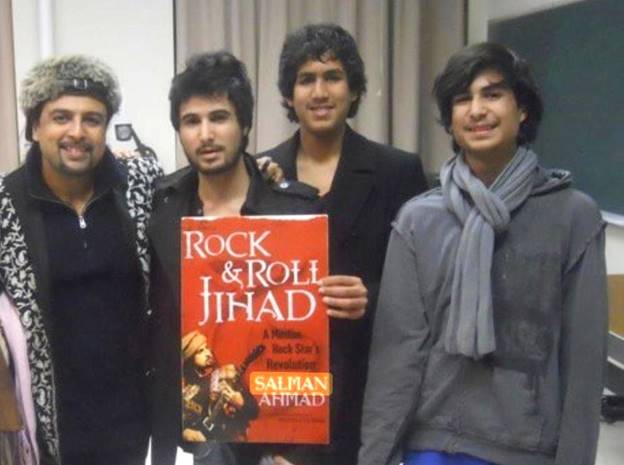
Across generations, my family’s journey reflects that same principle. My mother encountered America as possibility. My parents built a life grounded in contribution. I moved between medicine and music, between Pakistan and the United States, translating one world to another. My children, raised here, now add their own voices to the evolving soundtrack of American life
At 250, America’s Strength Is Its Ability to Connect Worlds
By Dr Salman Ahmad
US
Today, on July 4, as America enters its 250th year, the question is not only what we celebrate, but who we recognize as authors of its story. The American experiment has never been static. It is renewed, generation after generation, by those who arrive, adapt, and contribute. I know this not as theory, but as lived experience.
My American story began with my mother, Shahine. In 1961, at 18, she came to the United States through the American Field Service program, attending high school in Oakland, California. That summer, she stood at the White House among students from around the world and met President John F. Kennedy. She carried that moment not as spectacle, but as possibility. To her, America was a place where faith, effort, and openness could shape a meaningful life.
Together, my mother and father, Ejaz Ahmad, an airline executive, acted on that belief with foresight and courage. They built a home here, became naturalized citizens, and planted roots not only for their family, but within the life of the nation itself. Their contributions were not abstract. They were lived—through work, through community, through the sharing of culture and cuisine, and through active participation in the American economy. In quiet, steady ways, they embodied the promise that America extends to those willing to believe in it.
They passed that belief on to us.
When my father’s work brought our family to Washington, DC, and later New York, I experienced that promise firsthand. Nowhere was it more fully realized than at Tappan Zee High School. It was there, in classrooms, concert stages, and baseball fields, that I learned what it meant to belong—and to strive.
Our music program, shaped by teachers like Dr Hughes and Maggio, was not just excellent; it was transformative. They instilled in us a spirit of excellence and spontaneity, encouraging us to explore, improvise, and push beyond boundaries. In many ways, that environment helped lay the foundation for what would later become Junoon, and even earlier, the seeds of Vital Signs. It was a place where creativity was not only permitted, but expected.
On the baseball field, our coaches taught a different but equally enduring set of values: fearlessness, fairness, and what I would later understand as force multiplication—the idea that individuals, working together with trust and discipline, can achieve far more than they ever could alone. Those lessons extended far beyond sport. They became part of how I approached life, music, and collaboration.
In those formative years, despite my accent and background, I was accepted as American—not in theory, but in practice. That sense of belonging—quiet, unremarkable, and real—shaped everything that followed.
In New York, music became my language of identity. Classic rock was not just rebellion; it was initiation into a shared cultural current. I worked as a busboy in Rockland County, saved what I could, and bought my first guitar. That instrument became more than wood and wire—it became a passport, a translator, a way to speak across difference.
Like many immigrants, I lived between expectations. I returned to Pakistan for medical school, built a career, and started a family. But music—what I would later call “junoon,” a kind of sacred restlessness—never left me. Through bands like Vital Signs and Junoon, we blended rock with South Asian spiritual and cultural traditions, reaching audiences across borders. It was not simply fusion; it was conversation. It was the sound of identities refusing to be confined.
That role as a bridge became even more urgent after September 11, 2001. At a time when identities like mine were often viewed with suspicion, America still offered something essential: the space to belong, to contribute, and to redefine oneself. It reinforced a truth I had sensed early on—that America’s strength lies not in uniformity, but in its ability to absorb complexity and turn it into a shared civic identity.
A bridge, however, only matters if people are willing to cross it.
Some of those crossings have been deeply personal. Friends from my days at Tappan Zee High School—Brian O’Connell and John Alec—and from my son’s generation, like Taylor Simpson, have stepped onto that bridge in ways that go beyond symbolism. Through their engagement with Junoon and its music, they have embraced cultures far from their own beginnings: developing a taste for slow-cooked nihari, following cricket with genuine passion, and finding meaning in Bhangra rhythms and the devotional power of Nusrat Fateh Ali Khan’s qawwali.
These are not superficial borrowings. They are acts of curiosity, respect, and transformation. In their own way, they have become cultural ambassadors—evidence that the American story is not about preserving distance, but about closing it.
Across generations, my family’s journey reflects that same principle. My mother encountered America as possibility. My parents built a life grounded in contribution. I moved between medicine and music, between Pakistan and the United States, translating one world to another. My children, raised here, now add their own voices to the evolving soundtrack of American life. This is what the American dream looks like in practice: not a single narrative, but a continuum of participation.
It is also a vision echoed in my own tradition. As Surah Al-Hujurat teaches, humanity was made into peoples and tribes so that we may know one another, not fear one another. The purpose of difference, in this view, is not division, but understanding. [Qur’an +2]
That idea feels deeply aligned with the best of America.
As the nation enters its 250th year, its future will depend on whether it continues to embrace that principle—not as rhetoric, but as reality. The American identity is not diminished by those who come from elsewhere. It is strengthened by their presence, their work, and their willingness to build connections across lines that once seemed fixed.
And perhaps that is why, in America, we continue to believe in improbable dreams—whether it is the hope of the New York Knicks finally winning again after more than half a century, or the vision of a US soccer team reaching a World Cup final. These are not just sports fantasies; they are expressions of something deeper: a national instinct to imagine beyond limitation.
Albert Einstein is widely credited with saying, “Logic will get you from A to B. Imagination will take you everywhere.” America, at its best, is that imagination made real—a place where identities are not erased but composed, where differences are not feared but explored, and where the future remains open to those willing to build it. [azquotes]
To be American is not simply to belong. It is to imagine, to create, and to keep that possibility alive—for the next 250 years.
(Dr Salman Ahmad is a Pakistani-American musician, physician, and founder of Junoon. He is the author of Rock and Roll Jihad and an advocate for music as a bridge between cultures)