
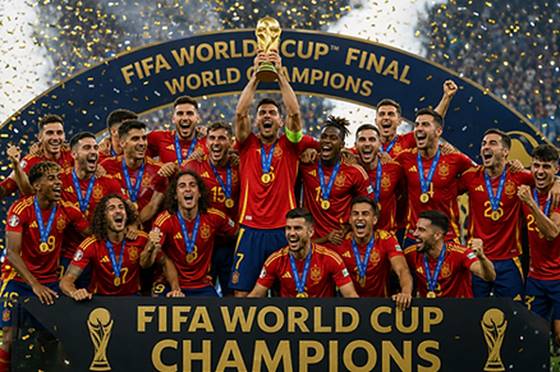
The triumph symbolizes the extraordinary transformation of a country that once expelled Muslims and Jews but today embraces citizens of every faith and ethnicity as equal partners in building the nation. The Spain that lifted the World Cup is not the Spain that history remembers for the Inquisition. Modern Spain does not erase history; it increasingly engages with it
FIFA Glory returns to Spain: From the Inquisition to Inclusion
By Dr Aslam Abdullah
CA

Spain has once again captured the world's imagination. By winning the FIFA World Cup for the second time, La Roja not only reaffirmed its place among football's greatest nations but also offered a powerful image of the Spain of the twenty-first century—a nation whose strength lies in the diversity of its people.
The celebrations were not confined to Madrid, Barcelona, or Seville. They echoed throughout Latin America, including Argentina, where more than half a million people of Arab descent joined millions of other football lovers in applauding Spain's remarkable achievement. Across the Middle East and North Africa, too, many celebrated the success of a team whose players reflected the changing face of modern Europe.
Among the architects of Spain's triumph were Muslim players, most notably the extraordinary young talent Lamine Yamal, whose brilliance has inspired millions around the world. Their success is more than a sporting accomplishment. It symbolizes the extraordinary transformation of a country that once expelled Muslims and Jews but today embraces citizens of every faith and ethnicity as equal partners in building the nation. The Spain that lifted the World Cup is not the Spain that history remembers for the Inquisition.
A Civilization that Once Illuminated Europe
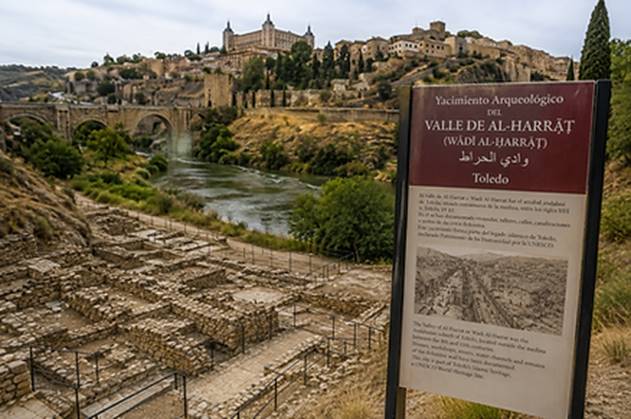
For nearly eight centuries (711–1492), Muslim Spain—al-Andalus—stood among the world's greatest centers of civilization. Cities such as Cordoba, Granada, Toledo, and Seville attracted scholars, physicians, astronomers, philosophers, architects, and poets from across Europe, North Africa, and the Middle East. The Great Mosque of Cordoba, magnificent libraries, hospitals, observatories, universities, sophisticated irrigation systems, and flourishing markets testified to a civilization where knowledge was revered. Muslim, Jewish, and Christian scholars translated one another's works, debated philosophy, advanced medicine, and preserved classical learning at a time when much of Europe was emerging from the early medieval period. The legacy of al-Andalus became part of the intellectual foundation of the European Renaissance.
The Fall of Granada
Everything changed in 1492. When the last Muslim ruler surrendered Granada to King Ferdinand and Queen Isabella, the Treaty of Granada promised Muslims freedom to practice their religion, preserve their language, and protect their property. Those guarantees, however, soon disappeared. Mosques were closed or converted into churches. Arabic books were burned in public squares. The Arabic language was forbidden. Islamic dress and customs were outlawed. Baptism was no longer a matter of faith but of survival.
The same fate befell Spain's Jewish community. The Alhambra Decree ordered Jews to convert to Christianity or leave the country. Thousands abandoned homes their families had occupied for centuries. Those who remained often did so under compulsion, living with the constant fear that any suspicion could bring ruin upon their households.
The Machinery of Fear
The Spanish Inquisition, established in 1478, became one of history's most notorious instruments of religious persecution. It did not merely punish religious dissent; it created an atmosphere in which fear entered every home. A grandmother washing before prayer could become evidence of secretly practicing Islam. Refusing pork or wine might invite suspicion. Lighting candles on a Friday evening could be interpreted as evidence of Jewish observance. Speaking Arabic, reciting familiar prayers, preparing traditional foods, or teaching children the customs of their ancestors, could become grounds for investigation. Neighbors informed on neighbors. Servants informed on employers. Even members of the same family sometimes testified against one another to save themselves. Rumor became evidence. Suspicion became guilt. The accused rarely knew who had denounced them.
Many disappeared into prisons for months or years. Families lost not only loved ones but also homes, businesses, and inheritances, all confiscated by the authorities. Then came the dreaded auto-da-fé. In public squares crowded with spectators, prisoners dressed in garments painted with symbols of their alleged crimes were marched before the population. Some were sentenced to imprisonment, others to forced labor, while those condemned as unrepentant were handed to secular authorities for execution, often by burning.
The flames consumed more than human beings. They consumed libraries painstakingly assembled over generations. They consumed manuscripts containing scientific discoveries. They consumed works of philosophy, medicine, astronomy, poetry, and law. Above all, they consumed the trust that binds neighbors together.
When Religion Was Used to Justify Persecution
One of history's greatest tragedies is that religion, whose highest purpose is to elevate humanity, can sometimes be employed to justify its oppression. Many influential members of the ecclesiastical establishment sincerely believed that religious uniformity was necessary for the salvation of society. The Church and the Crown increasingly became partners in enforcing conformity. Religious courts investigated conscience while political authorities enforced punishment.
Not every cleric supported every excess, and historians rightly distinguish among different individuals and institutions. Yet many prominent religious leaders gave theological legitimacy to policies that denied Muslims and Jews the freedom to worship according to their conscience. The irony remains painful. The Gospel speaks of mercy, compassion, forgiveness, and love of one's neighbor. Yet institutions acting in Christianity's name often employed coercion, confiscation, torture, and exile. History reminds us that whenever religion becomes an instrument of political domination rather than moral guidance, both religion and humanity suffer.
The Exile of a Civilization
The expulsion of Spain's Jews in 1492 and the removal of the Moriscos between 1609 and 1614 were among Europe's greatest human tragedies. Imagine families locking the doors of homes they knew they would never see again. Imagine elderly scholars abandoning libraries collected over a lifetime. Imagine mothers carrying infants toward unfamiliar shores while fathers looked back one final time at the mosques, synagogues, orchards, vineyards, and villages where generations of their ancestors lay buried.
Many crossed the Mediterranean to North Africa. Others found refuge in the Ottoman Empire. They carried little beyond their memories, their faith, and the hope that somewhere their children could live without fear. Spain, too, paid a heavy price. It lost physicians who healed the sick. Engineers who built irrigation systems. Merchants who connected continents. Craftsmen whose skills had taken generations to perfect. Poets, philosophers, mathematicians, architects, and scholars whose knowledge enriched an entire civilization. The country did not simply lose minorities. It lost part of its own soul.
Remembering without Remaining Prisoners of the Past
Even today, some Spanish communities celebrate annual Moros y Cristianos festivals commemorating victories during the Reconquista. Many participants regard these events as expressions of local heritage and historical memory. Others question whether some portrayals unintentionally perpetuate painful memories of religious conflict. Such debates are signs of a democratic society willing to reflect on its past. Modern Spain does not erase history; it increasingly engages with it.
A Different Spain
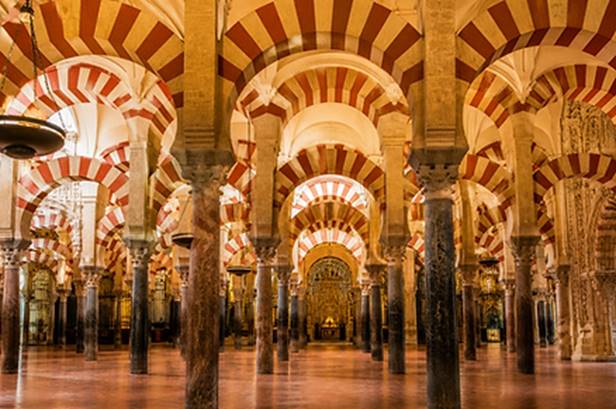
The democratic Spain that emerged after the Constitution of 1978 represents one of Europe's most remarkable transformations. Freedom of religion is constitutionally protected. Mosques have been built across the country. Islamic schools, cultural centers, charities, and businesses contribute openly to Spanish society. Today millions of Muslims live peacefully in Spain, participating in every sphere of national life—from universities and hospitals to business, science, public service, and sports. The magnificent Mosque-Cathedral of Cordoba remains a Christian cathedral while continuing to stand as one of the world's greatest monuments to Islamic civilization, reminding visitors that Spain's history belongs to many peoples and many faiths.
Standing with Justice
Modern Spain has also emerged as one of Europe's strongest voices in support of Palestinian rights and international humanitarian law. By recognizing the State of Palestine and repeatedly calling for an end to civilian suffering, Spain has sought to place human dignity above geopolitical expediency. Whether one agrees with every aspect of its foreign policy or not, Spain's willingness to speak about justice reflects the moral confidence of a democratic society that has itself traveled a long road from intolerance toward pluralism.

Perhaps nowhere is Spain's transformation more visible than on the football field. The cheers that greeted Lamine Yamal did not ask whether he was Muslim. They celebrated him because he was Spanish
Football Mirrors Society
Perhaps nowhere is Spain's transformation more visible than on the football field. The cheers that greeted Lamine Yamal did not ask whether he was Muslim. They celebrated him because he was Spanish. His teammates came from different regions, cultures, ethnic backgrounds, and family histories, yet together they represented one nation. That image would have been unimaginable during the centuries when religious identity determined one's place in society. Today it has become a source of national pride.
History's Greatest Victory
Spain's second FIFA World Cup is undoubtedly a magnificent sporting achievement. Yet an even greater victory has unfolded over the course of centuries. A nation once known for expelling Muslims and Jews now counts Muslims among its national heroes. A country that once silenced religious diversity now protects it under law. A society once divided by faith increasingly finds unity in shared citizenship. History cannot erase the suffering of those who endured the Inquisition, nor should it. The memories of families uprooted, books burned, lives destroyed, and civilizations scattered remain an enduring reminder of the terrible cost of intolerance. But history also teaches something equally important: nations can change. They can confront painful chapters honestly. They can replace fear with freedom. They can exchange exclusion for inclusion. They can choose justice over domination.
Spain's journey from the darkness of the Inquisition to the celebration of Muslim athletes wearing the national colors is a testament to the power of moral transformation. When a society becomes genuinely pluralistic—when it protects every citizen regardless of religion, ethnicity, or origin—and when it chooses to stand consistently on the side of justice rather than prejudice, it does more than become prosperous or successful. It becomes peaceful. Football trophies may be lifted for a season. But the triumph of justice, religious freedom, and human dignity is a victory that belongs to every generation.
(Dr Aslam Abdullah is the resident scholar at Islamicity.org, the largest internet portal on Islam. He has served as Director of the Islamic Society of Nevada and Masjid Ibrahim, Las Vegas. Dr Abdullah has also been the Editor-in-Chief of the Minaret Magazine since 1989. He was an associate editor of The Arabia in the 1980s. He also served as vice chairman of the Muslim Public Affairs Council. Not only that, but he is involved in interfaith dialogue and has represented Muslims in several interfaith conferences. He has published several books and more than 1,000 articles and papers in magazines worldwide. Originally from India, he is based in Southern California and has appeared on several TV and Radio shows.)
