
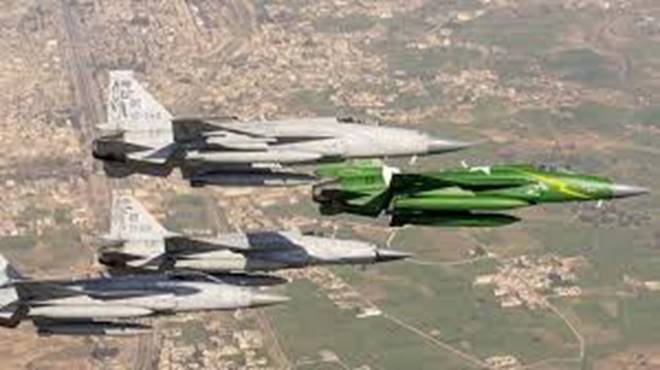
The Economist wrote that Chinese weapons gave Pakistan "a new edge against India," describing a four-day aerial battle in which Pakistan's jets reportedly prevailed, marking the first reported combat loss of a French-made Rafale fighter jet in the history of modern warfare – Photo The Friday Times
One Year Later — The Truth India Doesn't Want You to Know
By Arif Zafar Mansuri
President, PL Publications
CA
Just about a year ago, on the night of May 7, 2025, two nuclear-armed nations went to war. And the world held its breath.
India sent its warplanes. Pakistan sent a message.
A country its critics had written off, economically pressured, politically tested, diplomatically targeted, looked the most powerful military in South Asia directly in the eye and did not blink.
Tonight, on the first anniversary of what Pakistan calls Marka-e-Haq, the Battle for Truth, this is not the story India told. It is not the story Pakistani television told. It is the story the world told. Because the most powerful witnesses in this story are not Pakistanis or Indians. They are Americans, Swiss, British, French, and the rest of the global community, and they have been saying things for twelve months that India wishes they would stop saying.
It Started with a Lie Nobody Could Prove
Before the first missile flew, there was Pahalgam.
On April 22, 2025, 26 innocent tourists were killed in Indian-occupied Kashmir. Fathers. Newlyweds. Young men on holiday. Shot in cold blood. It was a tragedy that broke hearts around the world, including in Pakistan.
But within hours, before investigators had reached the scene, before a single fingerprint had been lifted, before one piece of forensic evidence had been gathered, India pointed its finger at Pakistan. The accusation was instant. The evidence was nonexistent.
Pakistan did what only a country with nothing to hide does. Prime Minister Shehbaz Sharif stood before the cadets at PMA Kakul and said, clearly, publicly, and on the record: "Pakistan is open to any neutral, transparent, and credible investigation." It was a direct challenge. A clean offer. Come, investigate together, and let the truth speak.
India's response? Silence. Then missiles.
Four Days That Changed Everything
On the night of May 7, 2025, India launched Operation Sindoor, striking Pakistani territory in the most aggressive military action between these two countries since 1971. Pakistan, coolly, swiftly, and with devastating precision, hit back. Four days. That is how long it lasted. Four days that changed everything.
Now, almost one full year later, India has not produced a single verifiable piece of evidence linking Pakistan to Pahalgam. Not one piece.
Pakistan's military spokesperson stood before the world and asked the questions that still have no answers. Pahalgam is more than 200 kilometers from the nearest point in Pakistan. The terrain is mountainous. There are no all-weather roads. The geography alone makes the Indian story fall apart.
And here is the detail that stopped many people cold. Even a former chief of India's own intelligence agency, the RAW, publicly said that homegrown elements could not be ruled out. That was an Indian voice raising doubts about India's own narrative.
Think about what this means. India launched a military strike on a sovereign nuclear-armed nation, the most dangerous act in modern South Asian history, without a single verified piece of evidence to show the world. And India's own independent newspaper, The Wire, said it plainly: "No significant country unambiguously backed Indian actions, neither in the neighborhood nor in the wider world."
When you go to war without proof, you go to war alone.
The Turn Nobody in New Delhi Saw Coming
While India was telling the world it won, the President of the United States was telling a very different story.
President Donald Trump, standing before the United States Congress in his State of the Union address, told the American people and the world that without American intervention, India and Pakistan would have had a nuclear war. He said Pakistan's Prime Minister Shehbaz Sharif told him personally that as many as 35 million people could have been killed if America had not stepped in to stop it. Trump has said this, in Washington, London, Riyadh, Tokyo, and Miami, more than 60 times. President Trump himself also stated that multiple Indian aircraft were downed by Pakistan during the conflict.
Prime Minister Modi, meanwhile, stood before India's parliament and said, quote, "No world leader asked us to stop the operation."
But here is the problem that will not go away. The President of the United States, India's most important strategic partner, keeps saying otherwise. In public. Repeatedly. On the record. More than sixty times.
Winners do not need saving. India needed saving. Trump said so. Sixty times.
What the World Said, In Its Own Words
The world was watching. And the world was taking notes.
The Financial Times , one of the most powerful newspapers on earth, said the ceasefire gave Islamabad "the diplomatic upper hand." The Economist wrote that Chinese weapons gave Pakistan "a new edge against India," describing a four-day aerial battle in which Pakistan's jets reportedly prevailed, marking the first reported combat loss of a French-made Rafale fighter jet in the history of modern warfare. Switzerland's Neue Zürcher Zeitung wrote that Operation Sindoor "turned into a disaster" for India. Asia Times reported that India "overplayed its hand" and emerged "diplomatically isolated and strategically diminished."
These are not Pakistani voices. These are global observers calling it as they saw it.
The Scoreboard That Stunned New Delhi
Then came the numbers that truly stunned New Delhi.
India sent parliamentary delegations to more than 33 countries, every continent, every major capital, in an expensive, exhaustive, and desperate attempt to get the world to stand with it. And at the end of all that travel, all those meetings, all that lobbying, not a single significant country gave India its unambiguous support. Thirty-three trips. Zero endorsements.
Pakistan, meanwhile, was not running around the world begging for support. The world came to Pakistan.
When the United Nations General Assembly voted for Security Council membership, Pakistan received 182 votes out of 193 member states. One hundred and eighty-two countries quietly, clearly, and officially said: we trust Pakistan.
And then came the moment that must have been the hardest for India to swallow. India had spent years and enormous diplomatic capital trying to brand Pakistan as a state sponsor of terrorism, trying to isolate it, trying to shut every door against it. The international community's response was to appoint Pakistan as Chair of the United Nations Security Council's Counter-Terrorism Committee and hand Pakistan the gavel at the world's most important counter-terrorism table. That is not a small thing. That is the world rendering its verdict.
This Is Not a Celebration of War
Pakistan could have responded with rage. It chose restraint. It could have matched aggression with aggression. It chose discipline.
When we mark Marka-e-Haq, we are not marking a celebration of war. Marka-e-Haq represents something far more powerful, a celebration of courage under fire. Pakistan does not celebrate bloodshed. It mourns every life lost, including the 26 innocent souls in Pahalgam, whoever was truly responsible, and however that tragedy was politically exploited.
What this anniversary marks is the story of a nation that has carried a weight the world rarely acknowledges. Pakistan has lost more than 90,000 of its own people fighting terrorism. It has absorbed more than 600 billion rupees in economic damage. It has been blamed without evidence, sanctioned without justice, and accused without proof.
And yet, when the most defining moment in a generation arrived, Pakistan did not panic. Pakistan did not escalate blindly. Pakistan defended itself, with discipline, with precision, and with its head held high.
The Question History Will Not Let Go Of
So here we are. One year later.
If India had genuine proof of Pakistani involvement in Pahalgam, why, after 365 days, has it not shown the world? One year. Zero evidence. A war launched on accusations. A ceasefire accepted under American pressure that India still refuses to acknowledge. And a nation that said from day one, investigate with us, find the truth together, still waiting.
Here is what one year has taught us. When a small man tries to bully his neighbor and the neighbor stands firm, the neighborhood notices. When a powerful country goes to war without proof and loses the argument in front of the entire world, that is not just a military failure. That is a failure of character.
And when a nation of 240 million people, attacked without proof, blamed without evidence, whose restraint was taken for weakness, stands before the entire world with dignity and resolve, with its head held high, with truth and sincerity on its side, and is believed, that is the moment a country stops being a target and becomes a force.
Pakistan is that force.
(Arif Zaffar Mansuri is President of PL Publications, publisher of Pakistan Link and Urdu Link, and host of The Mansuri Show on ARY Digital TV. A veteran real estate investor, entrepreneur, industrialist, journalist, and community leader, he is dedicated to amplifying the voices of the Pakistani American community. Watch his show at YouTube.com/@MansuriShow or reach him at Salam@PakistanLink.com )
