
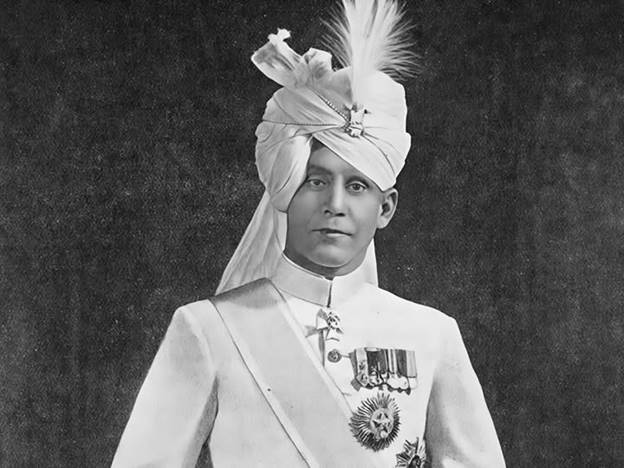
The Prince Educated at MAO College
By Dr Syed Amir
Bethesda, MD
Among India’s princely rulers, His Highness Hafiz Sir Hamidullah Khan, the last ruling Nawab of Bhopal, was unique in having attended a public institution, the Mohammedan Anglo-Oriental (MAO) College at Aligarh, where he earned a BA in 1915. His mother, Nawab Sultan Jahan Begum, insisted that he attend college as an ordinary student, experience the everyday problems and joys of student life, and receive no special treatment.
However, Hamidullah Khan did not live in one of the legendary halls of residence; instead, he rented a house nearby and spent much of his time visiting friends, fully experiencing College’s residential life. We don’t know whether he excelled academically, but we do know that he emerged as a star in sports, especially in cricket, and served as the college team's captain. One of his classmates noted that his behavior and demeanor were so unpretentious that no one could have guessed he was destined to be the ruler of a princely state.
The famous Urdu writer, poet, and critic Hakeem Ahmad Shujah Pasha has recounted an interesting story in the publication Dastan-e-Aligarh about Hamidullah Khan, who was his classmate at MAO College. As a friend, the prince invited him to visit him in Bhopal. Years later, after both had left Aligarh, the author was passing through Bhopal, and the memory of the invitation returned. Almost on a whim, he decided to break his journey and meet the prince, who was still the crown prince. Unsure whether the prince would remember him, he sent him a short note from the station. Sure, he remembered him well. Soon, a whole state armada arrived to pick him up and lodge him at the state guest house. He was royally treated while he and the prince shared reminiscences of Aligarh days.
Several others who were his contemporaries at Aligarh have also recounted their experiences. Mohammad Zubair, who worked for four decades at the University’s central Lytton Library and retired in 1964, has provided an eyewitness account of celebrities who visited the MAO College, which later became the University, most notably, Sultan Jahan Begum of Bhopal. She served as the first Chancellor from 1920 to 1930. In November 1926, she came to lay the foundation stone for the science college and the Nasrullah Hostel, named after her deceased son. By this time, she had abdicated as ruler of Bhopal in favor of her son, Hamidullah Khan, who accompanied her.
It was an emotional and joyous occasion for the AMU as one of its most illustrious sons returned to honor his alma mater, address the convocation, and lay the foundation stone for the science college. The audience was electrified as Hamidullah Khan played an exhibition cricket match with the team, rekindling memories of the golden days
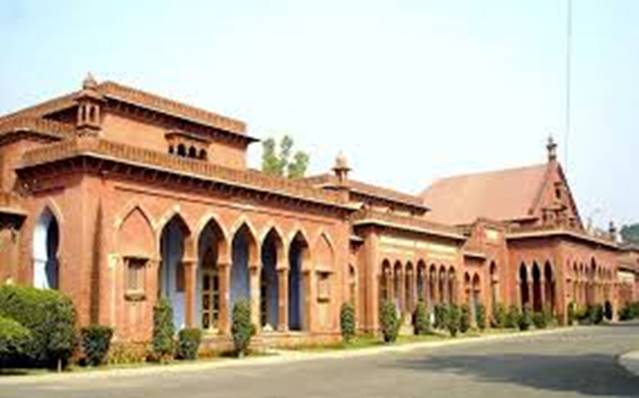
Aligarh Muslim University – SciSpace
when he was captain. Nawab Hamidullah Khan also served as the chancellor of AMU from 1930 to 1935.
Hamidullah Khan was a close friend of the Quaid-i-Azam Jinnah, and it was expected that after independence, he would migrate to Pakistan and succeed him as Governor-General. But it never happened. Hamidullah Khan’s grandson, Shaharyar Khan, born in pre-partition India, migrated to Pakistan with his mother and later joined the Pakistan Foreign Service. He served as a distinguished foreign secretary and later as president of the Pakistan Cricket Control Board. After retiring, Shaharyar Khan wrote a scholarly book about the Begums of Bhopal, a veritable storehouse of knowledge and history about the ruling family of Bhopal, including his grandfather and great-grandmother, Nawab Sultan Jahan Begum.
In his book, he speaks glowingly of his grandmother, Sultan Jahan Begum, highlighting her greatest contribution: leading the women of Bhopal, indeed of India, toward education and progress. Her pioneering efforts were recognized through her election as chancellor of Aligarh Muslim University and as chairperson of the All-India Women’s Conference on Education. She attended official functions with other senior British officials wearing a burqa, which she later abandoned in 1928.
Shaharyar Khan describes how Nawab Hamidullah Khan appointed highly talented friends from Aligarh to important positions in the state Government. Allama Iqbal, who served as an advisor, dedicated his seminal philosophical poetry collection, Zarb-e-Kaleem, to Hamidullah Khan. Borrowing a famous verse from a poem by Emperor Jahangir’s poet laureate, Talib Aamli, he declared that he was entrusting the nation’s destiny to him, as “In your hands, the roses remain fresher far longer than the branch they came from,” and thus your wisdom and blessings would similarly benefit the nation.
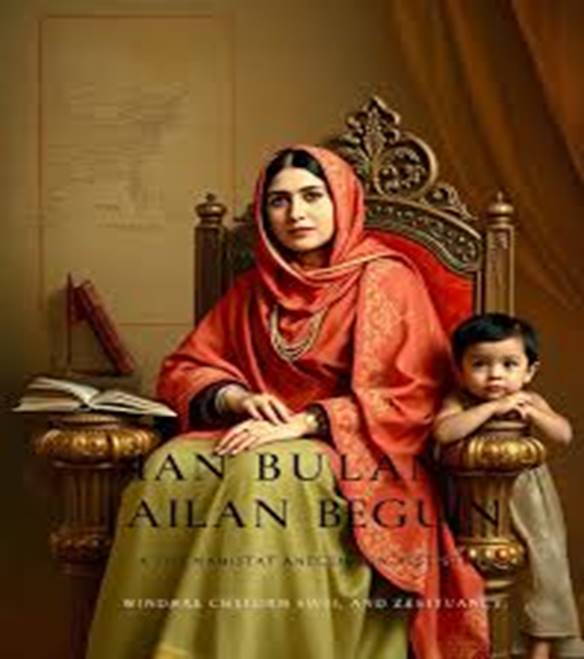
In the heart of British India, amidst a time of suppression, colonial dominance, and social stagnation, emerged a woman who would re-write the narrative of Muslim women in power — Nawab Sultan Jahan Begum of Bhopal – Photo Vocal Media
Nawab Hamidullah Khan ascended the throne after a series of grave family tragedies. The state of Bhopal had an unusual history. A succession of female rulers had reigned over the state until the accession of Nawab Hamidullah Khan. and a hard-fought legal battle over succession. The two eldest sons in line for the throne, Nasrullah Khan and his younger brother, Obaidullah Khan, both died of natural causes. Nawab Sultan Jahan Begum named her youngest son, Hamidullah Khan, the heir. However, Nasrullah Khan’s eldest son contested the decision and claimed to be recognized as the lawful heir. After extensive litigation, Hamidullah Khan was recognized as the crown prince.
Mr Mukhtar Masood, a renowned author, a proud alumnus of the AMU, and a senior member of the Pakistan Civil Service, in his best-selling book Aawaz-e-Dost, reprised a speech that Hamidullah Khan delivered at the Students’ Union in December 1939 while Masood was still a high school student. The following account is adapted from the book. “When he stood up to give the talk, in our minds, his status as an Aligarian superseded all his other identities. It was a low-key but captivating speech.”
Hamidullah Khan started wistfully: “The golden period of my life when I used to be a student here has long passed, and now I am a mere Old Boy. Yet, God knows, there is some ethereal, mystical quality to the environment of this institution–so unique, so inimitable. Whenever I set foot on this hallowed ground, the vision of the time I spent here returns with amazing alacrity. As I sat in this historic Union Hall, the memory of the speech I gave here as a student many, many years ago came rushing back, and with my mind’s eye I could envision that entire occasion vividly as if it happened only yesterday. The images seemed so authentic, so real that I started to fantasize–why did they re-invite me so soon?”
Hamidullah Khan concluded his talk by directly addressing the Union vice president: “Sir,” he exclaimed in a somber voice, “I noticed that your fingers were inching toward the bell, indicating that my time was nearly up. I dread it, as I don’t know when the next opportunity will come for us to meet again.”
It is unknown whether Nawab Hamidullah Khan ever returned to his beloved institution. He died on February 4, 1960, at age 65.
(Dr Syed Amir is a former Assistant Professor, Harvard Medical School, and a health science administrator, US National Institutes of Health)
