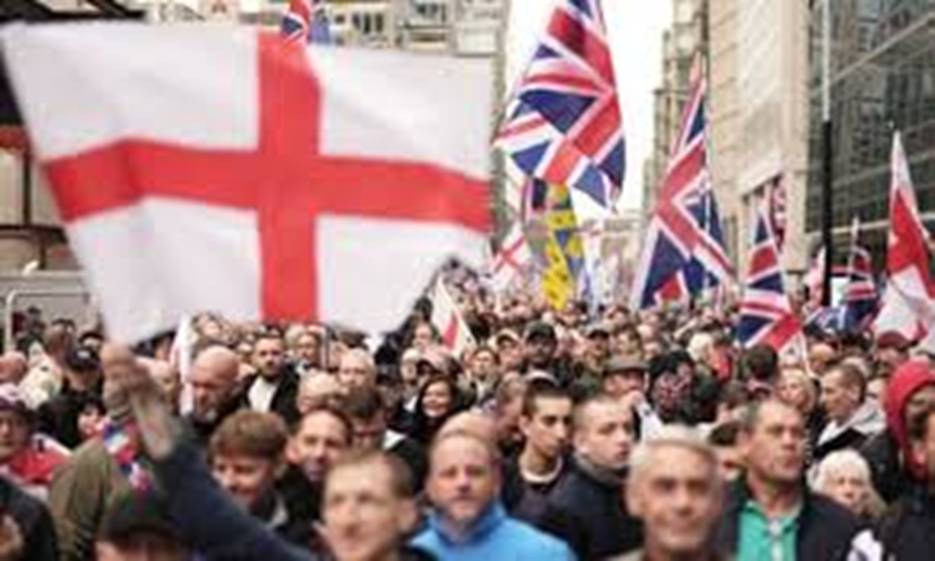
 Recent demonstrations in London, combined with major shifts in local election results, have highlighted rising dissatisfaction with traditional political parties and increasing concern about the future direction of Britain – The Guardian
The United Kingdom at a Crossroads - Identity, Unity and Political Change
By John Bosco
London, UK

The United Kingdom is entering a period of significant political and social change as public debate over immigration, national identity, economic pressure, and political leadership continues to grow across the country. Recent demonstrations in London, combined with major shifts in local election results, have highlighted rising dissatisfaction with traditional political parties and increasing concern about the future direction of Britain.
For centuries, the United Kingdom has been shaped by strong institutions, parliamentary democracy, and the influence of the monarchy. From the unification of England under King Athelstan in 927 AD to the development of the modern constitutional monarchy, Britain built a political system that became known around the world for stability, law, and national unity.
The Royal Family continues to play an important role in British public life despite the country being governed by elected politicians. Many citizens view the monarchy as a symbol of continuity, tradition, and service during periods of political uncertainty and social change. National events involving the Royal Family often bring together people from different backgrounds, regions, and political views, reinforcing a sense of shared national identity.
Britain also became internationally recognized as a multicultural society after the Second World War when migrants from former British colonies helped rebuild the economy and strengthen public services. Immigration contributed to the development of industries, healthcare, transport, and education across the country. For many decades, multiculturalism became an accepted part of modern British society.
However, in recent years, growing pressure on housing, healthcare, schools, and the rising cost of living has increased public frustration. Many voters believe that successive governments failed to manage immigration effectively while also struggling to improve public services and economic conditions. Concerns about border control, community cohesion, and national identity have become increasingly influential in political discussions, particularly in England.
Recent demonstrations in London reflected these growing tensions within British society. Large crowds gathered to express concern over illegal immigration, border security, and cultural change, while counter protesters defended multiculturalism, diversity, and social tolerance. The scale of the demonstrations required one of the largest policing operations seen in recent years, involving thousands of officers, mounted police, helicopters, drones, and police dogs.
Many protesters carried British flags and displayed patriotic slogans calling for stronger border protection and the preservation of traditional British values. Some participants argued that rapid demographic and social change is placing pressure on public services and weakening community identity. Christianity, national traditions, and the Union Jack were frequently used as symbols representing stability, continuity, and cultural heritage.
At the center of the demonstrations was political activist Tommy Robinson, whose supporters describe him as someone willing to speak openly about immigration and national identity issues that they believe mainstream politicians avoid. Critics, however, accuse him of encouraging division and hostility toward minority communities. The demonstrations revealed how deeply divided Britain has become over immigration, religion, and cultural identity.
Counter protesters argued that migrants should not be blamed for Britain’s economic and political difficulties. Anti-racism groups and pro-Palestinian activists warned that inflammatory rhetoric could increase social division and damage Britain’s long standing reputation as a tolerant and democratic society. Police and government officials closely monitored the demonstrations to prevent disorder and potential hate speech violations.
The protests demonstrated that immigration is no longer viewed simply as an economic issue. It has become closely linked to wider debates surrounding identity, religion, community cohesion, and the future cultural direction of the country. Many citizens now feel uncertain about how Britain should balance diversity with social stability and national unity.
These concerns are also reshaping the political landscape. Recent local elections across England revealed growing dissatisfaction with both the Conservative Party and the Labor Party. Many voters used the elections to express frustration over rising living costs, economic pressure, public service challenges, and political instability.
The Conservative Party faced criticism after years in government for failing to deliver on promises related to immigration control, Brexit, and economic management. Frequent leadership changes and internal divisions weakened public confidence and created an image of political instability.
Labor also faced difficulties despite being in government nationally. Some working-class voters, particularly in northern England and smaller towns, felt the party no longer fully represented their concerns. Issues such as immigration, economic inequality, and national identity became increasingly important among voters who believed mainstream politicians were avoiding difficult conversations.
As support for the traditional parties weakened, Reform UK gained significant political momentum in many parts of England. The party focused its campaign on immigration control, national sovereignty, lower taxes, criticism of political elites, and the protection of traditional British values. Reform UK also performed strongly in areas that previously supported Brexit, where many voters believed the political establishment had failed to fully respect the outcome of the 2016 referendum.
Political analysts believe the recent election results reflect a broader change within British politics. Public loyalty to the traditional two-party system appears to be weakening as voters increasingly support smaller parties to express dissatisfaction with the political establishment.
At the same time, experts caution that protest voting does not always translate into long-term political stability. Questions remain about whether newer political movements can maintain public support, develop detailed policies, and govern effectively if given greater responsibility in the future.
Nevertheless, the recent demonstrations and election results indicate that Britain is entering a more fragmented and politically polarized era. Debates about immigration, national identity, economic pressure, religion, and cultural values are becoming increasingly central to public life.
The United Kingdom has faced many periods of transformation throughout its history and has repeatedly adapted during times of political and social change. Supporters of political reform argue that the country now needs stronger leadership, economic stability, secure borders, and renewed public confidence in national institutions. Others continue to emphasize the importance of diversity, democratic freedoms, and social inclusion.
The coming years are likely to shape the future direction of Britain in significant ways. The growing debate over identity, unity, and political leadership reflects a nation attempting to define its place in a rapidly changing world while balancing tradition with modern social realities.
Recent public demonstrations and election outcomes suggest that many citizens are searching for stronger representation, greater stability, and a renewed sense of national purpose. How political leaders respond to these concerns may determine the future character and unity of the United Kingdom for years to come.
(John Bosco is a freelance writer from London. – bosco_jj@yahoo.com )