
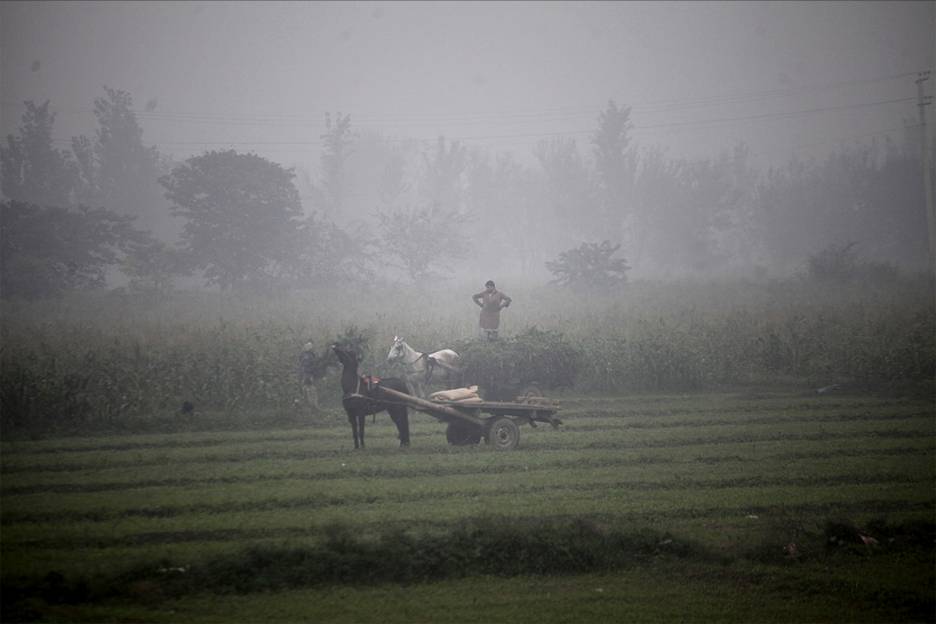
Pakistani farmers working in their field blanketed by smog in Peshawar, November 2019 - Image by AP Photo/Muhammad Sajjad
In Punjab, Toxic Air Threatens Wildlife amid a Monitoring Blind Spot
By Muhammad Talal

Each November, a suffocating blanket of particulate matter envelops Pakistan’s Punjab province, turning the sky into a hazardous grey canopy. While the public health catastrophe for more than 20 million residents rightfully dominates headlines, a silent crisis unfolds across the region’s agricultural fields, urban green spaces and remaining wetlands.
We know exactly what this toxic air does to human lungs, and we even track its precise impact on agricultural assets. A 2023 baseline study closely monitored 10 livestock farms, each housing 90-275 animals across the Lahore and Kasur districts, tracking the exact micrograms of fine particulate matter, carbon dioxide and potentially toxic trace elements inside cattle sheds. Researchers even screened the air for opportunistic bacterial pathogens like Staphylococcus aureus to safeguard the health of livestock.
Yet, if a wild bird or mammal landed directly outside those monitored facilities, science would suddenly turn a blind eye. In a region choked by seasonal pollution, wildlife is suffering in a massive monitoring void.
Sidra Safdar, associate professor of Wildlife and Ecology at the University of Veterinary and Animal Sciences (UVAS) in Pakistan and a co-author of the 2023 livestock study, explicitly identifies the root of this discrepancy: lack of funding, and political will.
“One reason for a massive data gap in wildlife monitoring associated with poor air quality is the lack of suitable resources and specialized equipment,” Safdar notes, emphasizing that real-time air quality tracking demands costly annual calibration.
While limited, micro-scale monitoring happens occasionally, such as small-scale tracking at the Lahore Zoo. Capturing a true regional picture would require expensive macro-scale stations that demand steep maintenance budgets.
At the government level, Safdar says, animal welfare is “still not a priority agenda” when tackling air pollution.
The Punjab Wildlife and Parks Department disputes this characterization, stating that ignoring wildlife is “absolutely not the case.” While he does not detail specific funding for air-quality sensors, Muhammad Ramzan, the department’s deputy chief wildlife ranger for publicity, notes the deployment of monitoring teams to migratory sites and strict veterinary observation for captive animals. Regarding unmonitored wild populations, Ramzan states that “native animals and birds generally possess a certain degree of natural adaptability and resilience, enabling them to withstand seasonal variations and environmental stresses to some extent.”
The sheer scale of the pollution makes exposure inevitable. In January 2026, Lahore’s air quality index (AQI) spiked above 500, deep into the “hazardous” category, temporarily making it the second-most polluted major city on the planet, according to IQAir . In 2025, Pakistan’s average concentration of fine particulate matter exceeded World Health Organization guidelines by more than 13 times , according to the air quality monitoring platform .
A 2024 review analyzing the impact of smog on wildlife outlines a grim physiological reality. Ground-level ozone and fine particulates easily infiltrate the respiratory tracts of wild animals, triggering chronic inflammation, restricting oxygen intake and causing irreversible lung damage.
Beyond severe breathing difficulties, the chemical cocktail of winter smog, often laced with heavy metals and volatile organic compounds, acts as an environmental endocrine disruptor . These pollutants can hijack sex hormones, leading to severely depressed fertility rates and developmental deformities in wildlife embryos.
To understand why this pollution becomes so lethal in November, one must look at Punjab’s specific emission sources and winter meteorology.
Throughout the year, the region generates massive baseline pollution from vehicles, industrial emissions and thousands of brick kilns. This load spikes heavily in November when farmers burn crop leftovers to clear their fields for winter planting.
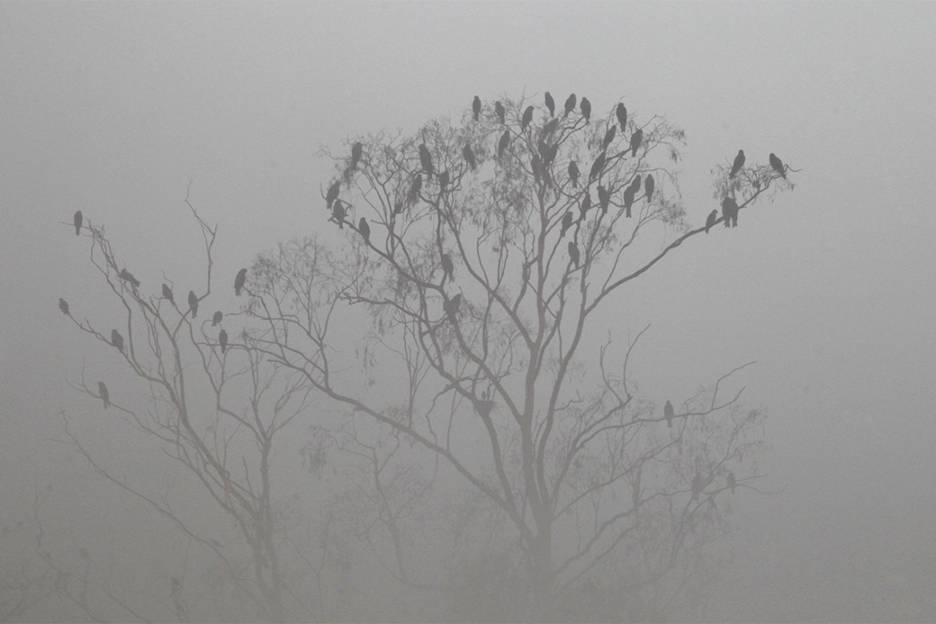
Birds sit on a tree in the dense smog in Lahore, November 2016 - Image by AP Photo/K.M. Chaudary
As seasonal temperatures drop, a meteorological phenomenon known as a “temperature inversion” occurs: A layer of cold air becomes trapped near the Earth’s surface by warmer air above it. Combined with stagnant winter wind speeds, this inversion acts as a physical lid. It prevents the combined agricultural smoke and urban exhaust from dispersing into the upper atmosphere, locking the toxic haze at ground level exactly where local wildlife lives and breathes.
At veterinary clinics across Lahore, the theoretical damage described in academic journals translates into everyday emergencies.
Dr Syed Muhammad Faheem Ahmad, a veterinary surgeon and lecturer at the UVAS Pet Centre, treats the immediate victims.
“Yes, we do see a massive increase in cases during smog; just like in humans, they also experience the same symptoms and face a lot of problems,” Faheem said.
The veterinary surgeon pointed out that his animal patients — birds, cats, dogs, and wildlife — were consistently presented with severe respiratory and ocular irritation, characterized by sneezing, nasal discharge, lethargy, and labored breathing.
For animals with preexisting respiratory conditions, the winter haze severely aggravates these illnesses.
According to the 2024 review, the thick shroud of pollution also actively alters how animals interact with their ecosystem. The sheer physical density of the fog limits visibility, which severely hampers the ability of predators to successfully hunt and herbivores to safely locate adequate forage.
The researchers also noted that for migratory birds that rely on visual cues like star constellations or species that utilize specific scents and magnetic fields to navigate, the nitrogen oxides and heavy metals in smog effectively blind their sensory organs, knocking them off their ancient migratory routes. While recent 2026 reporting from WWF-Pakistan regarding the Indus Flyway, a major global migration corridor crossing Pakistan, shows a steep decline in visiting migratory bird populations due to environmental pressures, researchers cannot yet quantify how much of this drop is caused by winter smog versus general habitat loss or other factors. Amid the monitoring void, the data simply do not exist yet.
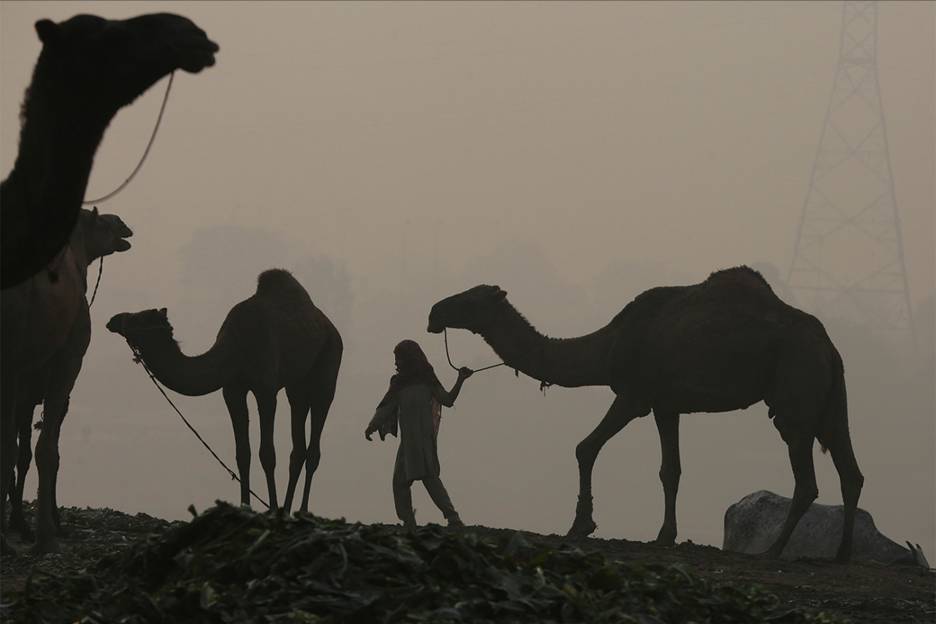
A girl walks with her camels through heavy smog in Lahore, November 2021 - Image by AP Photo/K.M. Chaudary
Muhammad Jamshed Iqbal Chaudhry, a researcher and ornithologist with WWF-Pakistan, warns that ignoring these ecological indicators is a dangerous oversight.
“The absence of comprehensive bird-health data from Punjab should not be mistaken for evidence that wildlife is safe,” Chaudhry said, noting that while the exact population decline attributed solely to smog in Punjab remains unmeasured, the current science clearly establishes “credible pathways of harm” for the region’s avian populations.
Global conservationists increasingly advocate for the “ One Health” framework — the understanding that human, animal, and ecosystem health are inextricably bound together and must be studied in tandem. When toxic airborne chemicals settle onto local foliage and permeate the water table, they contaminate the foundational food web, ensuring the legacy of the smog outlasts the winter season.
Until coordinated, multiyear biomonitoring programs are funded and deployed to track these contaminants across Punjab’s wildlife, the region is only measuring half of the tragedy. “The responsible response … is not complacency but precaution,” Chaudhry emphasizes. “Reduce emissions while urgently building the monitoring needed to discover which species, habitats and life stages are most at risk.” – mongaby.com
Citations:
Jamil, M., Sidra, S., Hussain, A., Imran, M., & Sheikh, A. A. (2023). Assessment of air quality of livestock farms in district Kasur and Lahore. Pakistan Journal of Zoology, 57(1). doi: 10.17582/journal.pjz/20230224040218
Altaf, M., Ansari, Z. S., Ameen, M., & Abid, N. B. (2024). Smoke and Fog: Smog Impacts on Wildlife. Journal of Wildlife and Ecology. Retrieved from https://jwepak.com/wp-content/uploads/2025/01/JWE-835.pdf
Saleem, A., Awan, T., & Akhtar, M. F. (2024). A comprehensive review on endocrine toxicity of gaseous components and particulate matter in smog. Frontiers in Endocrinology, 15. doi: 10.3389/fendo.2024.1294205
Colborn, T., Vom Saal, F. S., & Soto, A. M. (1993). Developmental effects of endocrine-disrupting chemicals in wildlife and humans. Environmental Health Perspectives, 101(5), 378-384. doi: 10.1289/ehp.93101378
