
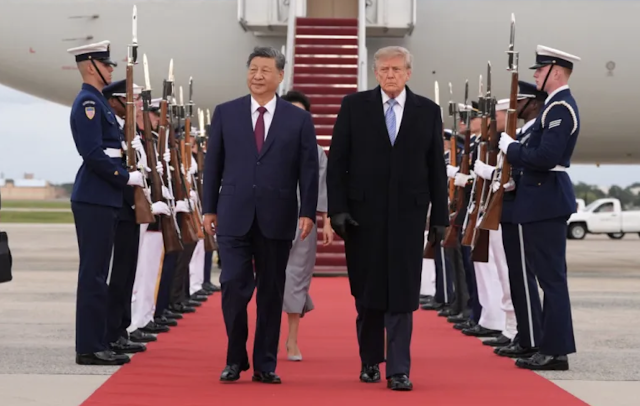
President Trump receives President Xi at the Andrews Air Force Base
Xi-Trump Summit: US-China G2 Rapprochement to Avoid Thucydides Trap
By Riaz Haq
CA

The summit meeting of the leaders of China and the United States in Washington appears to signal a rapprochement between the two superpowers. President Trump has repeatedly referred to what he calls "G2", without mentioning "G7" or "G20", the groups that include many more countries. This development is seen as positive for world peace, but it diminishes India's significance as a "counterweight to China" and the benefits Indians expected to flow from the US-China confrontation in Asia.
The fact that President Trump personally received President Xi at Andrews Air Force Base on his arrival is yet another indication that the US now recognizes China as a peer competitor. President Xi, for his part, has talked about the need for the two superpowers to avoid the "Thucydides Trap", a reference to the potential for war between an established superpower and a rising superpower.
Top American officials have been preparing for this moment for several years. In an interview on Fox News, Secretary of State Marco Rubio told Brian Kilmeade in 2025 that “China is going to be a rich and powerful country. No matter what we do, that’s what – we’re going to have to deal with that. But we have to deal with the reality. What we cannot have is a world where China is so powerful, we depend on them. And that’s right now where we’re headed, unfortunately. That’s going to change. That’s going to change under President Trump”.
Anthony Blinken who preceded Secretary Rubio made a similar acknowledgement earlier in 2022: “China is the only country with both the intent to reshape the international order and, increasingly, the economic, diplomatic, military and technological power to do it.”
"One of the most complex and arguably most important relationships we have is the one with China. There are aspects of contestation, there are aspects of cooperation, and we want to avoid conflict. They're a lot bigger than we are, their market's a lot bigger, their manufacturing is three times ours, they've got more ships, they put forward more papers, and more patents. As strong and as powerful as we are, playing one-on-one can be tough", Blinken added later in 2023.
The Beijing-Washington rapprochement is clearly in Pakistan's interest. Islamabad has long sought to balance its foreign policy between China and the United States through a pragmatic hedging strategy, gaining economic, military, and diplomatic benefits from both superpowers while maintaining a strategic autonomy. But the relationship between Pakistan and China is not the same as the one between Pakistan and the United States. Pakistan's ties with China are strategic while those with the United States remain tactical and transactional. What has changed recently is that Pakistan is no longer waging war to help the United States as it did during the " Cold War " and the " War on Terror ". Instead, Pakistan has emerged as a peacemaker between the US and Iran.
(Riaz Haq is a Silicon Valley-based Pakistani American analyst and writer. He blogs at www.riazhaq.com )
