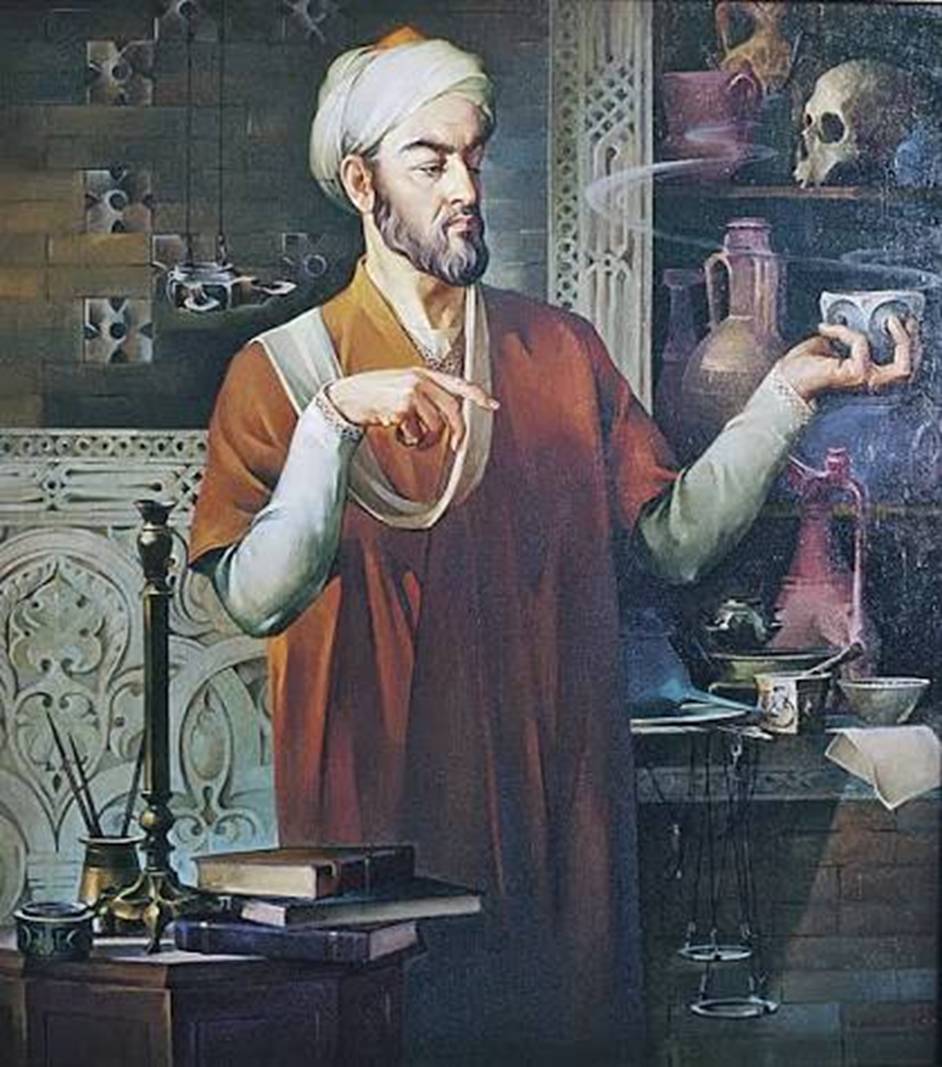
The most noteworthy contribution of Ibn Sina was Canon of Medicine, a million-word encyclopedia on various diseases he studied. The original Arabic text was translated into Latin in 1279 , which became so popular that it was used in the European medical schools until the late 17 th century. It served as the chief medical science guide in the West and is said to have influenced Leonardo da Vinci
The Islamic Contributions to Medicine - Part V: Superstars Ibn Sina and Ibn Al-Nafis
By Abdul-Majeed Azad
Technologist (formerly at NASA-Jet Propulsion Laboratory)
Pasadena, CA

The spread of Islam beyond the Arab peninsula witnessed steady expansion of Islamic Caliphate which was eager to educate its subjects. The Caliphs were great patrons of science and culture. They fully understood the real meaning of the famous saying of Prophet Mohammad (peace be upon him) that in search of knowledge, one should go to lands as far as China! This sentiment led to the rise of prominent Muslim scholars – well-versed in religion and physical and natural sciences alike. They played an immense role in the advancement of various sciences, medicine and medical research in the 9 th to 12 th CE.
Long-lasting momentous strides and great advancements were made during this era of Islamic expansion. This was the basis of Western awakening (famously known as European Renaissance), in areas of physical and natural sciences in which Muslims had left indelible footprints several centuries earlier.
Personalities such as Ibn Rushd, Ar-Razi, Ibn Sina and Ibn Al-Nafis, were some of the true stalwarts of discoveries of illnesses and their treatments in their times. Thanks to their invaluable contributions, modern medical field benefited and progressed in the Western world as seen today.
Ibn Sina: Abū ʿAlī al-Ḥusayn ibn ʿAbd Allāh ibn al-Ḥasan ibn ʿAlī ibn Sīnā (popularly known as Ibn Sina and as Avicenna in the West ) is called the Prince of Physicians. Like Al-Razi, he too was one of the most prominent philosophers and physicians of his time. He was a seminal figure of the Islamic Golden Age. He served in the courts of various Muslim rulers. His writings left indelible footprints on medieval European medical and scholastic thoughts, making huge impact on how medicine is taught in medical schools today.
Ibn Sina was born in 980 AD in Afshona, Iran (modern day Isfahan in Uzbekistan). His father, a respected scholar had his son educated at Bukhara . He memorized Qur’an by the age of 7 and a great amount of Persian poetry at a very young age. Ibn Sina was well known for his independent thoughts from an early age. His extraordinary memory allowed him to get far in the education by the time he was merely 14. By the time he was 16, he was ready to go into medicine. In addition to learning theories of medicine, he also discovered new methods of treatment. Ibn Sina became a full-fledged physician when he was only 18 years old. His fame spread quickly as he came to be known as the one who would treat his patients often without a fee.
The most noteworthy contribution of Ibn Sina was Canon of Medicine, a million-word encyclopedia on various diseases he studied. The original Arabic text was translated into Latin in 1279 , which became so popular that it was used in the European medical schools until the late 17 th century. It served as the chief medical science guide in the West and is said to have influenced Leonardo da Vinci . Its encyclopedic content, systematic arrangement and philosophical plan soon worked its way into prominent medical schools of Europe, replacing the works of Galen . It included numerous accounts dealing with the discovery of contagious diseases and the introduction of quarantine protocol for the containment of the spread of infectious diseases .
The Canon is divided into twelve chapters dealing with different topics. The text begins with Ibn Sina’s own definition of medicine: Medicine is a science from which one learns the status of the human body with respect to what is healthy and what is not, in order to preserve good health when it is existing and restore when it is lacking.
Chapter 1 of Canon deals with the basic principles of medicine. It deals with three elements of earth (water, air and fire) as well as four body fluids: yellow bile, black bile, blood and phlegm, known as the four humors, that govern a person’s temperament. It was believed that one’s health depended on a balance among these humors. If something was wrong with one or more of these, it would lead to certain illnesses. Chapter 1 also emphases the importance of good hygiene and its preservation. It states that so long as air is good and clean and not mixed with anything incompatible with patient’s temperament, good health will materialize. Chapter 2 discusses more than 700 medicinal plants that could be used for treatment. For many centuries, plants were believed to be the most comprehensive source of medicinal products. Chapter 3 and 4 discuss various symptoms and diseases (such as, fever, poisoning, rashes, wounds and fractures) associated with a given part of the body. Here, the remedy of problems pertaining to anorexia and overweight are mentioned. Chapter 5 discusses the procedures for mixing constituents and fixing doses for administering. Seven rules for testing drugs are described, strongly advising their trials in animals before on humans. It is interesting that these seven rules are very similar to the modern-day drug trial protocols that pharmaceutical companies go through, prior to producing and marketing drugs.
Ibn Sina proposed that a person could die from excess blood flow to the head, caused by brain hemorrhage and/or tumor. At that time, this was thought to be an implausible concept but proved to be true later. He was the first to diagnose tuberculosis as a contagious disease that mandated quarantine. He correctly identified that ancylostomiasis - also known as the hookworm infection - was caused by intestinal worms. Thus, Ibn Sina’s contributions to humanity are plenty. The Christians invasion and conquest of Spain, destroyed the works of Greeks, such as, Plato and Aristotle, because the church had banned them, declaring that they were of pagan origin. Thanks to the generosity of Muslim rulers in terms of their rich endowments to advance the quest of knowledge, Ibn Rushd, his predecessors and contemporaries played a crucial role in translating the Greek works into Arabic, which was later translated into Latin by the Europeans. This eventually led to what we know as the Western Renaissance and Enlightenment.
Ibn Al-Nafis: ʿAlāʾ al-Dīn Abū al-Ḥasan ʿAlī ibn Abī Ḥazm al-Qarashī (famously known as Ibn al-Nafīs) was born in Damascus, Syria in 1210. He attended the Medical College hospital in Damascus. In 1236 , he moved to Egypt , where he worked first at the Al-Nassri hospital then at the Al-Mansouri hospital and became Sultan’s personal physician. His resume is very impressive as he dabbled in a variety of fields, that include medicine, surgery, physiology, anatomy, biology, Islamic studies, jurisprudence, and philosophy. He is the one who first described the pulmonary circulation of blood. Ibn Rushd’ illuminating work immensely contributed to the discoveries made by Ibn Al-Nafis.
Al-Shamil Fi Al-Tibb (The Comprehensive Book on Medicine) was the largest volume of work written by Al-Nafis. It is believed to have been longer than Ibn Sina’s Canon of Medicine. Originally, it was meant to comprise of 300 volumes but only 80 volumes could be written by the time he died. Most of these dealt with surgery. He maintained that for a surgical procedure to be successful, three vital stages must be given attention. The first stage is called the pre-operation period; that is, when the surgeon carries out an analysis of the affected area of the patient’s body. That is when he gives a diagnosis of the disease and suggests a method of treatment. The second stage is the actual operation when the surgeon repairs the affected organ(s ) of the patient. The third stage is the post-operation period, when the patient is taken care of by the physician, nurses and later by himself and his family. The third stage continues until the patient recovers fully by the will of God. This is precisely more or less the same sequence followed in modern medical practice.
Ibn Al-Nafis’ medical contributions were greatly influenced by his critical analysis of Ibn Sina’s The Canon of Medicine. He discovered and wrote extensively on the pulmonary system of the human body. He identified various parts of the heart and correlated them to the anatomy of the lungs. For example, he discovered that the pulmonary artery is the primary pathway that connects the heart to the lungs via right ventricle. It is through this channel that blood is oxidized and subsequently pumped via aorta to the rest of the body. He identified the right and left ventricle as separate routes, separated by a septum that keeps blood in respective chambers, thus facilitating that oxidized and deoxidized blood do not mix when traveling through the heart. Furthermore, Ibn Al-Nafis recognized alveoli – the tiny balloon-like air sacs at the very end of the breathing tubes in the lungs – where oxygen (from the breathed air) and carbon dioxide ( from blood in the heart) are exchanged. There is also an extensive discussion on the arteria venosa, the vena arteriosa, and the bronchi and how these structures are vital to the composition and function of lungs.
Ibn Al-Nafis was dedicated in his field. He was also very charitable. Upon his death in 1288 AD, he donated his house, library and clinic to the Al-Mansouri hospital.