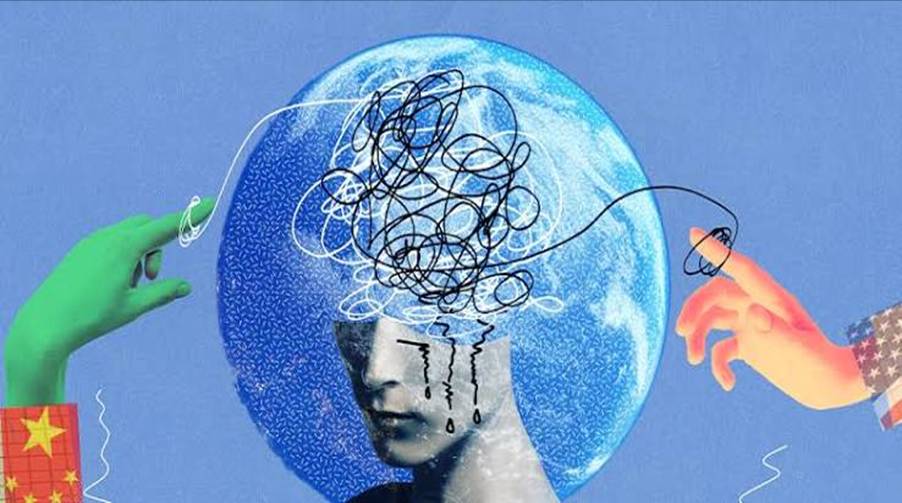
The biggest challenge is therefore not simply managing the next protest or responding to the next international crisis. It is addressing the underlying causes that continue to create instability. How can wars be ended? How can poverty and inequality be reduced? How can governments restore trust in public institutions? – Image OMFIF
A World under Pressure
By John Bosco
London, UK

There is no single cause of what many people increasingly describe as “worldwide chaos”. The present global environment is better understood as the result of several structural weaknesses being activated simultaneously by war, economic pressure, political instability, climate shocks and technological disruption.
Chaos means a state of complete disorder, confusion or lack of control. Yet the world we are witnessing today is more complicated than the word suggests. Since I first became interested in global current affairs and started reading the news, I cannot remember a single day when there was no major crisis somewhere in the world.
As a child, I learned about the Vietnam War and the enormous disruption it caused, not only to the countries directly involved but also to economies and societies around the world. Inflation and economic hardship affected many countries, with developing nations often suffering the most. Later, we witnessed conflicts involving Israel, Lebanon and Palestine, which repeatedly divided communities and governments while influencing international politics, economies and public opinion far beyond the region. The Soviet–Afghan War and, decades later, the war in Afghanistan involving the United States and its allies further demonstrated how conflicts could reshape international politics for generations.
At the same time, the way people receive information has changed dramatically. Television news was followed by 24-hour broadcasting, the internet and, more recently, social media. Today, news can reach millions of people within seconds. This has obvious benefits, but it has also created a serious challenge. Media organizations compete for audiences, while social media platforms allow unverified information, misinformation and manipulated content to spread rapidly. People can therefore be surrounded by information while finding it increasingly difficult to distinguish between established facts, political opinion and speculation. In many cases, the speed at which information spreads is greater than the speed at which it can be verified.
Economic pressure has added another dimension to the current instability. Brexit is one example of a major political change that took place during an already difficult period for the global economy. When the United Kingdom left the European Union, it entered a period of significant political and economic adjustment. Brexit cannot, however, be blamed for every economic difficulty that followed. The UK and Europe were simultaneously affected by the COVID-19 pandemic, supply-chain disruption, energy-market volatility and wider geopolitical tensions. Together, these pressures contributed to inflation and a severe cost-of-living crisis. Energy bills, food prices, rents, mortgages and transport costs increased, making it increasingly difficult for many households to maintain their previous standard of living.
The impact has been particularly severe for lower-income families, but the middle class has also felt considerable pressure. Governments face a difficult balancing act: they must maintain healthcare, education, transport and other public services while dealing with high debt and budget deficits. At the same time, they are under pressure to increase spending on defense, infrastructure and energy security. Raising taxes or reducing public expenditure can generate public anger, while failing to address government debt can create longer-term economic problems. This tension is now visible across Europe, where citizens are demanding better services and greater economic security at a time when governments have limited financial flexibility.
The war in Ukraine has further intensified these pressures. Although the conflict has deeper historical and political roots, it entered a dramatically more destructive phase in February 2022 when Russia launched its full-scale invasion of Ukraine. The war has had consequences far beyond the battlefield. Millions of people have been displaced, European governments have increased defense spending and relations between Russia and the West have fundamentally changed. For ordinary people across Europe, the conflict has also been experienced through higher energy and food prices, increased transportation costs and greater economic uncertainty. The crisis demonstrated how a war in one part of Europe can quickly affect household bills and businesses thousands of miles away.
Just as Europe was attempting to deal with these pressures, the escalating conflict between Israel and Hamas created another major international crisis. Hamas and other Palestinian militant groups launched coordinated attacks from Gaza into southern Israel, followed by a major Israeli military campaign in Gaza that resulted in a devastating humanitarian crisis and widespread international debate. Demonstrations have taken place across Europe, the United States and other parts of the world. The conflict has also intensified political, religious and social divisions, placing governments under considerable pressure as they attempt to balance security concerns, humanitarian responsibilities and public opinion.
The wider Middle East has added another layer of uncertainty, with tensions involving Israel, Iran, the United States, Saudi Arabia and the Houthi movement raising concerns about a broader regional conflict. The Strait of Hormuz remains particularly important because it is one of the world's most significant energy routes. Any serious disruption could affect oil and LNG supplies, energy prices, transportation costs and inflation around the world. Tensions involving the Houthis and Saudi Arabia have also affected regional security and maritime trade, particularly around the Bab-el-Mandeb Strait, the Red Sea and the Gulf of Aden. Attacks or instability in these areas can force commercial shipping to take longer routes, increasing costs and creating further pressure on global supply chains.
Europe is now dealing with many of these pressures simultaneously. Several countries have experienced protests and social unrest driven by different combinations of rising living costs, expensive housing, pressure on public services, youth unemployment, limited career opportunities and dissatisfaction with governments. Political polarization and declining trust in institutions have added to the frustration. In some parts of Europe, political, social, ethnic and constitutional tensions have added another layer of complexity, making their challenges different from the primarily economic grievances behind some protests elsewhere. Nevertheless, across Europe there is a growing feeling that governments are struggling to respond effectively to the challenges faced by ordinary people.
The question now is what happens next. European countries need to maintain their reputation as safe destinations for visitors, businesses and investors. Images of violence, looting and disorder can damage confidence, discourage tourism and put additional pressure on businesses already struggling with higher costs. Governments must protect the right to peaceful protest while taking firm and proportionate action against those who attack people, businesses or public property. At the same time, security measures alone will not solve the underlying problems. Governments must address the economic and social pressures that are driving public frustration and rebuild confidence among citizens, business owners, investors and visitors.
The biggest challenge is therefore not simply managing the next protest or responding to the next international crisis. It is addressing the underlying causes that continue to create instability. How can wars be ended? How can poverty and inequality be reduced? How can governments restore trust in public institutions? How can economies provide younger generations with affordable housing, secure employment and a realistic opportunity to build a better future? These questions have no simple answers, but they cannot be ignored.
The world has always experienced conflict, uncertainty and economic crisis. What has changed is the speed and scale at which the consequences now travel across borders. A war can affect energy prices in another continent; disruption to a shipping route can increase the cost of goods thousands of miles away; and a social-media post can influence public opinion around the world within minutes. We live in an interconnected world in which instability in one region can quickly become an economic, political or humanitarian concern for everyone else. The challenge for today's leaders is therefore not simply to manage the next crisis, but to address the conditions that create them.
The world does not need more division, misinformation and short-term political responses. It needs responsible leadership, reliable information, economic opportunity, effective diplomacy and a stronger commitment to peace and security. The question is not whether another crisis will come; history tells us that it will. The real test is whether humanity can become better at preventing those crises from turning into chaos.
(John Bosco is a freelance writer in London. Email: bosco_jj@yahoo.com )