
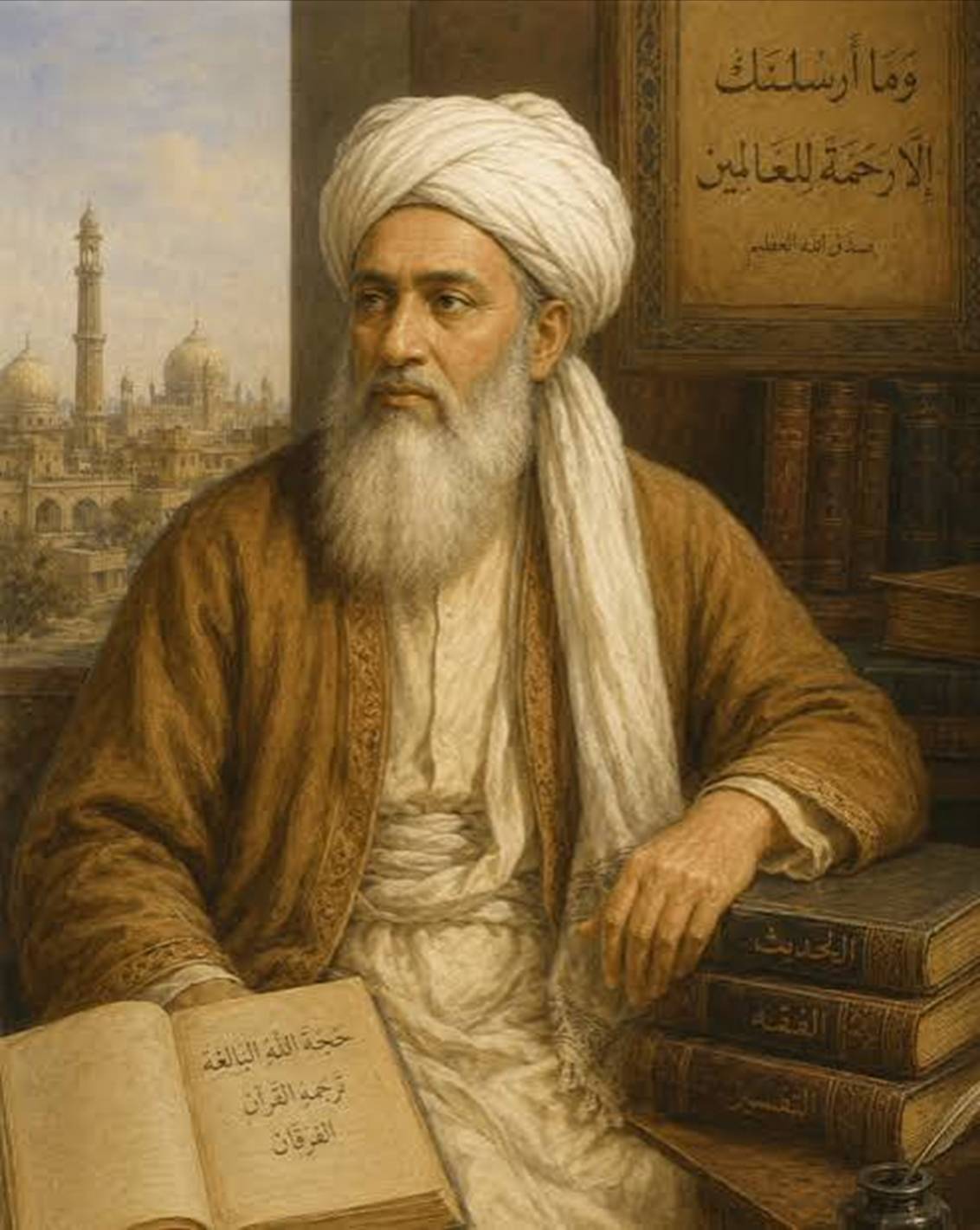
Shah Waliullah of Delhi – Photo ASHA
Reformers Who Made a Difference (1750- 2000)
Excerpts from Dr Nazeer Ahmed’s forthcoming book , “ Science within Faith, Grounded in Divine Unity ”
The Modern Context: From Philosophy to Political Engagement
The modern Muslim intellectual experience emerged from a world profoundly different from that of classical Islam. The great philosophers of the ninth through twelfth centuries wrote within a civilization that was politically expansive, economically prosperous and intellectually self-assured. The Abbasid Caliphate stood at the center of a vast imperial power stretching from Central Asia to the Atlantic. The independent Emirate of al Andalus (Spain) was a beacon of light for Europe. Cities such as Baghdad, Damascus, Nishapur, Cordoba, Cairo, Sijilmasa, Toledo, Timbaktu, Tabriz, Samarqand and Bukhara prospered as leading centers of learning. Philosophy, mathematics, medicine, astronomy, fiqh and theology flourished within institutions sustained by wealth, patronage and political power. Great thinkers such as Al-Farabi, Ibn Sina, Al-Ghazali, Ibn Rushd and al Razi confronted questions of metaphysics, logic, epistemology and the relation between revelation and reason from within a confident civilization.
The modern Muslim condition presented a stark contrast to the classical world of Islam. From the eighteenth century onward, much of the Islamic world entered a prolonged period of political decline, economic dependency, military weakness and civilizational disorientation. Muslim thinkers no longer spoke from the center of world power. They wrote under the shadow of European expansion and colonial domination.
The transformation of Europe through the Scientific Revolution and the Enlightenment produced a new and autonomous scientific framework that gave the West an unprecedented technological and military edge over the older civilizations of Asia, Africa and the Americas. European powers converted this advantage into global political dominance. In the sixteenth century, the Spanish conquered the Aztecs of Mexico and the Incas of Peru and looted the gold and silver of the old world. The Atlantic slave trade, which accelerated in the seventeenth century, devastated large parts of Africa and uprooted millions of human beings.
India became the first great eastern civilization to fall to the West. The Battle of Plassey in 1757 marked a turning point in world history. The wealth extracted from Bengal helped finance the Industrial Revolution in Britain, onset of which is conventionally dated to 1758. By the end of nineteenth century, most of Asia had fallen under European domination. The Indian subcontinent, Indonesia, Malaya, Indochina, Central Asia and vast regions of Africa were colonized. Only the Ottoman Empire held on against heavy odds. This too ended with the First World War. Following the Ottoman defeat in 1918 and the formal abolition of the caliphate in 1924, the Middle East was partitioned and brought under British and French control.
Political subjugation produced intellectual and institutional consequences of immense magnitude. Educational institutions that had once depended on the patronage of Muslim courts and landed endowments stagnated. Madrasa curricula lost their vitality. The older integration of philosophy, mathematics, astronomy, medicine and the rational sciences disappeared. Colonial administrations introduced new educational systems designed to produce clerks, bureaucrats and subordinate functionaries for imperial governance. The physical sciences migrated to Europe. Ambitious Muslim students who sought advanced training in modern science, engineering, economics, philosophy or political thought had to study in London, Paris, or other European cities. It was not surprising that many of the Muslim reformers and intellectuals of the nineteenth and twentieth centuries were products of European educational institutions.
In this new paradigm, the central questions of Muslim thought inevitably changed. Medieval debates over ontology, causality, emanation and the hierarchy of the intellect no longer occupied the foreground. The pressing realities of colonial rule, political subjugation, poverty, educational decay, colonial exploitation and moral dislocation imposed a different intellectual agenda. Modern Muslim reformers were compelled to ask why Islamic civilization had declined, how political sovereignty might be regained, whether Islam could accommodate modern science and constitutionalism and how Muslim societies could recover moral and social coherence in a technological age dominated by the West.
The reformist movements of the nineteenth and twentieth centuries emerged from this historical trauma. Their diversity reflected the depth of the crisis itself. Some sought renewal through religious reformation. Others emphasized rationalism, constitutional reform, scientific education, or political activism. Some looked to the early Islamic community as the model for regeneration. Yet others attempted a selective appropriation of European institutions and intellectual methods. The emphasis was different but as an integrated whole, these were responses to the collapse of an older civilizational order and to the overwhelming challenge posed by modernity and a dominant, exploitative Western power.
In this series of essays, we highlight the work of some of the major intellectual figures who resisted the onslaught of Western ideas and made a difference to the ongoing flow of Islamic history. We hope it will help us understand who we are and our trajectory on the canvas of space-time leading up to the current juncture.
Shah Waliullah of Delhi (1703-1763): Scholar and Reformer
Shah Waliullah of Delhi was one of the foremost architects of Islamic renewal in eighteenth-century South Asia. Confronted with political fragmentation of the decaying Mughal empire, spreading social disorder in northern and central India, and intellectual rigidity of the ulema, he sought to recover the inner coherence of Islam by reintegrating the Qur'an and Sunnah with jurisprudence, Hadith, reason, Sufi spirituality, social justice, and political order. His reforms constituted a comprehensive project for the moral renewal of the individual and the reconstruction of Muslim society.
Born in 1703 into a distinguished scholarly family, Shah Waliullah inherited the rich intellectual traditions of Mughal India. His father, Shah Abd al-Rahim, was an eminent scholar and Sufi associated with the Madrasa-i Rahimiyya in Delhi. Under his father's supervision, Shah Waliullah studied the principal disciplines of the traditional Islamic curriculum, including the Qur'an, Hadith, Arabic, Persian, jurisprudence, theology, logic, and the rational sciences. He was trained principally within the Hanafi legal tradition and received a strong grounding in Sufi spiritual discipline.
The breadth of his intellectual formation became a defining characteristic of his scholarship. His writings reveal sustained engagement with Hadith, jurisprudence, Qur'anic interpretation, Sufism, theology, metaphysics, and the organization of human society. He sought to understand differences within the Islamic tradition historically and systematically, examining the reasons underlying disagreements among jurists, the development of legal schools, and the relationship between outward religious practice and inward spiritual transformation.
His journey to the Hijaz around 1730–31 marked an important stage in his intellectual development. In Makkah and Madinah, he studied with distinguished scholars, including the celebrated Hadith scholar Shaykh Abu Tahir Muhammad ibn Ibrahim al-Kurdi al-Madani, and entered a wider transregional network of Islamic learning. The experience strengthened his engagement with Hadith and broadened his intellectual horizons beyond Mughal India.
After returning to Delhi in 1732, Shah Waliullah devoted himself to teaching, writing, spiritual leadership, and reform. At the heart of his program was the relationship between the foundational sources of Islam and the accumulated traditions of Muslim scholarship. He gave particular importance to the Qur'an and the Sunnah while remaining deeply engaged with the classical schools of law, theology, and Sufism.
One of his most consequential achievements was his Persian translation of the Qur'an. Persian was the major language of administration and high culture in northern India, and the translation made the meaning of the Qur'an accessible to an educated audience lacking full command of Arabic. This formed part of his broader effort to reconnect Muslim society with revelation. His example encouraged later translations into Urdu and other Indian languages, while his sons, Shah Rafi al-Din and Shah Abd al-Qadir, made important contributions to the transmission of Qur'anic meaning in Urdu.
Shah Waliullah sought to strengthen the study of Hadith in South Asia and to clarify its relationship with jurisprudence. He sought to explain why legitimate differences had emerged among jurists and to reconcile the major schools of fiqh within a broader framework of Islamic unity. Variations in the transmission of Hadith, methods of legal reasoning, and historical circumstances could produce different conclusions without destroying the unity of the Islamic tradition.
The unity of the Islamic sciences was one of the most distinctive features of Shah Waliullah's thought. He refused to treat jurisprudence, Hadith, theology, philosophy, and Sufism as isolated domains. Each addressed a different dimension of human existence, yet all belonged within a larger religious order. His engagement with kalam and Islamic philosophy reflected his effort to explain reality, human nature, and the development of society within the wider framework of revelation. He believed that rigorous ijtihad remained essential if Muslims were to confront the problems of their age.
Tasawwuf (Sufism) was equally fundamental to his identity. For Shah Waliullah, purification of the soul was indispensable to religious life. Knowledge without moral transformation was incomplete, while spirituality detached from ethical discipline and the normative teachings of Islam was equally defective. He therefore sought to clarify the relationship between tasawwuf, the Qur'an, the Sunnah, and the Shari'ah.
His conciliatory approach is evident in his treatment of wahdat al-wujud and wahdat al-shuhud. Rather than reproducing inherited polemics, he sought to explain the insights contained in both formulations. Their apparent differences could, in his interpretation, reflect different perspectives or levels of spiritual and metaphysical understanding. This effort reflected a larger characteristic of his thought: the search for unity beneath intellectual diversity.
Shah Waliullah's reformism also extended beyond individual piety to the social and political structures of society. His concept of irtifaqat sought to explain the stages of social development and cooperation through which human communities advance toward increasingly complex forms of organization. Justice stands as the central pole in this analysis. Political authority was necessary to restrain violence, regulate competing interests, and maintain social order, yet political power required moral legitimacy.
He was deeply concerned with economic injustice, excessive taxation, oppression of productive classes, and corruption among ruling elites. For him, economic imbalance weakened social cohesion and contributed to political instability. Religious and social reform were therefore inseparable. A just society required moral individuals, equitable institutions, and political authority directed toward the common good.
The most comprehensive expression of his mature thought is Hujjat Allah al-Balighah, translated as The Conclusive Argument of God. The work addresses a fundamental question: what is the wisdom underlying the teachings, laws, and institutions of Islam? Shah Waliullah explored the asrar al-shari'ah, the inner wisdoms and deeper purposes of the Sacred Law. He sought to demonstrate that the revealed order possessed an intelligible relationship to human nature, moral development, and the organization of society.
The Hujjat addresses worship, moral discipline, social relationships, economic life, political authority, and the development of human communities. It moves beyond a purely formal understanding of religious law by showing how Islamic institutions contribute to the cultivation of the individual and the well-being of society. Worship disciplines the human personality. Ethical norms regulate relationships. Legal institutions restrain injustice. Political authority protects collective order.
For this reason, Hujjat Allah al-Balighah is more than a work of jurisprudence, theology, or Hadith commentary. It is a comprehensive effort to articulate the internal coherence of Islamic civilization, connecting spiritual formation with social organization and the moral responsibilities of political authority.
Shah Waliullah died in Delhi in 1763, leaving behind an intellectual legacy that profoundly shaped subsequent generations of Muslim scholars and reformers in South Asia. Later movements drew selectively upon his emphasis on the Qur'an and Hadith, his critique of intellectual rigidity, his engagement with Sufism, and his reflections on political and social reform. Yet no single movement fully represents the breadth of his thought. His enduring importance lies precisely in the comprehensiveness of his vision. He was at once a scholar of the Qur’an, Hadith, jurisprudence, theology, philosophy, and Sufism, and a thinker deeply concerned with the moral and social disorders of his age. He sought to reconnect law with its purpose, scholarship with revelation, spirituality with ethical discipline, and political authority with justice.
For the breadth of his scholarship, his incisive analysis of the crises confronting Muslim society, and his effort to reconstruct Islamic life upon its intellectual and moral foundations, Shah Waliullah earned the reputation of a mujaddid, a renewer of Islamic civilization. His greatest legacy to Islamic learning lies in his demonstration that renewal does not require the abandonment of tradition. Rather, a living intellectual tradition renews itself by returning critically and creatively to its foundational sources, recovering the purposes that gave its institutions meaning, and applying its accumulated wisdom to the changing circumstances of history.
Shah Waliullah thus stands as a pivotal figure in the history of Islamic thought in South Asia: an heir to the classical tradition, a master of its diverse disciplines, and a reformer who sought to restore its inner unity. His enduring lesson is that faith, reason, law, spirituality, and social justice need not exist as competing spheres of human life. Properly understood, they form an integrated vision through which the individual is morally transformed, society is ordered by justice, and a civilization renews itself from within. (Continued next week)
(The author is Director, World Organization for Resource Development and Education, Washington, DC; Director, American Institute of Islamic History and Culture, CA; Member, State Knowledge Commission, Bangalore; and Chairman, Delixus Group.)
