From
the Editor: Akhtar
Mahmud Faruqui
June 15 , 2025
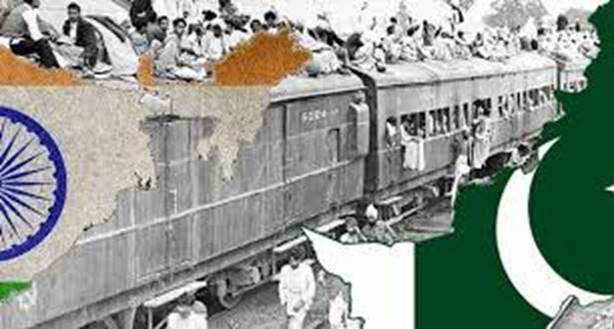
Were the subcontinent Muslims wronged by the departing Englishmen? Were the Socialists in London responsible for the problems that later came to plague the fledgling state of Pakistan and continue to haunt it to this day? Was there something inherently wrong about the Two-Nation Theory? Was a conspiratorial scheme at work to defeat the purpose of the creation of Pakistan and to cause serious doubts about the validity of the Two-Nation Theory in later years? – Photo LinkedIn
The Residents’ Testimony: Revealing Facts about Partition
The Englishmen in the subcontinent during the Raj were most aptly categorized by E. M. Foster in his masterpiece A Passage to India. Ronny, McBryde and their ilk were aloof, nonchalant and distanced, and remained superciliously sequestered in lofty mansions and palatial houses with little or no social rapport with the local populace.
Others like Fielding and Mrs Moore were captivated by the subcontinent’s traditions and were inclined to cultivate the ‘native.’ They made up the perspicacious white mortals who applied themselves to rationalize a social enigma, a political issue, and a religious standpoint.
In later years, men cast in the mold of Olaf Caroe (Governor NWFP and author of The Pathans) and Ian Stephens (Editor of The Statesman and author of Horned Moon) appeared on the scene as the real-life incarnation of the cultured breed.
Following the death of my father I stumbled upon a few letters he had exchanged with some blue-blooded Englishmen with whom he had worked in the pre-Partition era. The writers occupied important positions in undivided India, and I dare say, a place in the hearts of those they came in contact with. Among them figured distinguished names: Sir Arthur Lothian (author of Kingdoms of Yesterday), Sir Duncan Mackenzie, Sir Conrad Corfield (who as Political Advisor to Lord Mountbatten did not agree to implement the Viceroy’s policy vis-à-vis the former Indian States and, in consequence, left India in the last week of July 1947), Sir L.E. Barton, and Sir G.V. B. Gilan.
This correspondence pertained to the pre-and the immediate post-Partition era and spotlighted interesting features of the subcontinent’s social fabric and history. The opinions expressed in these evocative epistles were remarkably forthright and revealing. They seem to acquire
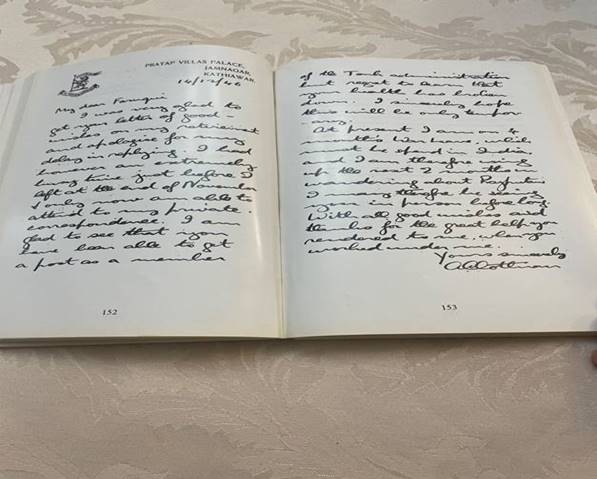
Sir Arthur Lothian’s letter to Khan Sahib Faruqui
special significance today as serious misgivings are aired about the Two-Nation Theory that formed the basis for the division of the subcontinent.
Were the subcontinent Muslims wronged by the departing Englishmen? Were the Socialists in London responsible for the problems that later came to plague the fledgling state of Pakistan and continue to haunt it to this day? Was there something inherently wrong about the Two-Nation Theory? Was a conspiratorial scheme at work to defeat the purpose of the creation of Pakistan and to cause serious doubts about the validity of the Two-Nation Theory in later years? A small sampling of the correspondence my father Khan Sahib Mahmood Ahmad Faruqui had with the former Residents of India seems to furnish a clue to what transpired on the eve of Partition. In a subtle way, the observations serve to vindicate the Two-Nation Theory:
“There is very little doubt that Lord Wavell resigned from the Viceroyalty because he was unwilling to carry out the orders of the Socialist Government and that Mountbatten was sent out as a ji-hazauri who was willing to do what he was told - the more so as he was totally ignorant of India and its problems. It is also highly probable that Field Marshal Auchinleck resigned because he was unable to get a fair deal for Pakistan in the matter of distribution of assets; though there is no actual proof of either of these theories, as both of them were loyal to their government to stir up so much mud…”
- Sir Duncan Mackenzie, 24 Oct 1952
“I felt that the States in particular, and to a less extent, Pakistan, got a poor deal from the late Govt and the last Viceroy. So, while I respect very much what you say about the trend of Pakistani feeling, I am not altogether surprised. I have done what I could to correct the balance in my book, and in two articles on the States published in the January and April issues of the Quarterly Review…”
- Sir Arthur Lothian, 9 June 1952
“…it is difficult for anybody who has served for a long time and whose family had served India for 150 years, not to feel sorrow that the old order has passed away so completely, and that its passing was brought about in such a shameful way. One cannot help feeling that the change - which admittedly had to take place, and indeed had very largely taken place even during my 31 years in India - should have been far more gradual and that more regard should have been paid, not only to the formal treaties with the States, but to the promises so often given that the safety of minorities would be adequately secured. There was indeed a sorry gap between promise and performance…”
- Sir Duncan Mackenzie, 20 January 1949
“I entirely agree with your remarks on what happened in 1947 and notice that even the Socialists have given up their talk of what a ‘far-sighted act of statesmanship’ they committed. Kashmir seems a fair sample…”
- Sir G.V.B. Gillan, 29 December 1952
“I was up in London not long ago and had a long talk with Sir Claude Auchinleck. He goes out East nearly every winter as a traveling Director of Grindlay’s, so manages to keep in touch with things out there much better than I can. He was full of admiration for the spirit of Pakistan, the way she is keeping her end up and (in the Army) the way they have kept up the old Regimental traditions and their pride in them. Incidentally, I gathered indirectly that he was not responsible for the raw deal that Pakistan had in the division of military stores and supplies…”
- Sir Duncan Mackenzie, 23 Dec 1951
“I don’t know whether you share my view that something good has been lost by the destruction of the States, but at all events we share the same view about the ignominious scuttle from our responsibilities in the East. Having once assumed them, you cannot wash your hands of what follows from that hasty abandonment. I might however write volumes on this: so I shall forbear…”
- Sir Arthur Lothian, 18 July 1952
Khan Sahib Mahmood Ahmad Faruqui was equally unsparing and forthright in the summation of events: “… while in Delhi in 1949 I had the privilege of being invited to a luncheon party which His Excellency Mr Mohammad Ismail had given in honor of the Hon’ble Mr Justice Munir, who was one of Pakistan’s representatives on the Punjab Boundary Commission. The after-lunch talk turned to the Boundary Commission’s award. Mr Munir said that just before returning to Delhi, Sir Cyril Radcliffe accompanied by other members of the Commission had a final flight over the canal system and that he (Sir Cyril) told the members that he would be fixing the boundary line about 8 miles east of Jullundur and that he (Mr Munir) and the other Pakistan representatives were pressing him to fix Sutlej (which was some 10-12 miles further east) as a natural boundary. Mr Munir said that he was simply shocked to hear the actual award broadcasted two or three days later which fixed the boundary about 78 miles west of the one indicated by Sir Cyril just before he had left for Delhi. That I think substantiates the charge that the award was altered. Moreover, I have not come across any contradictions of the charge by Sir Cyril himself and shall of course be interested to know your views on the subject…”
- Khan Sahib Mahmood Ahmad Faruqui, 7 November 1952
Revealing disclosures!



