From
the Editor: Akhtar
Mahmud Faruqui
June 15 , 2025
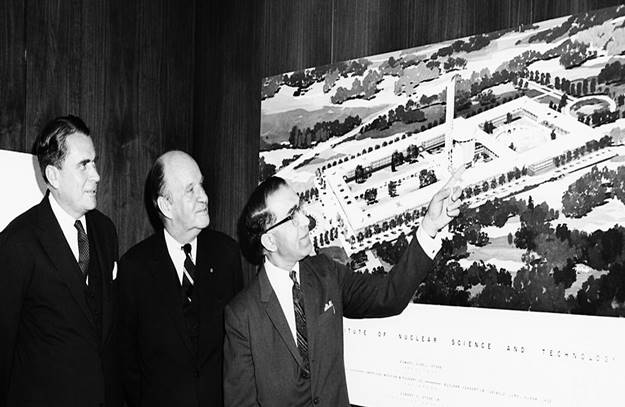
Carter L. Burgess President of American Machine and Foundry (AMF), American architect Edward Durell Stone and Dr I H Usmani Chairman PAEC review Stone's design of PINSTECH
A Pakistani Who Made Dreams Come True!
It was a sultry summer afternoon. The venue: a posh locality in Karachi. The period: sometime before a train of tragic events divided East and West Pakistan. The audience was of a mixed extraction and the mood hushed but excited.
The speaker was vividly articulate. His eloquent King's English seemed to fill the spacious room and beyond to hold the entranced gathering in a state of ecstasy and awe. The expressions on the handsome face changed, now lit up with a smile on a cheerful prospect, now blighted with anguish on a dismal review of events.
But the message was clear - promotion of science - and spelled out with unwavering conviction.
Present in the gathering were quite a few heavyweights: Dr Amir Mohammad who later became Minister for Agriculture under General Zia; Dr Naeem Ahmad Khan who was to assume the responsibility of Chairman, PCSIR; Dr Ishfaq Ahmad who headed the Pakistan Atomic Energy Commission with distinction; and Dr Abdul Mateen Chaudhry who became Vice-Chancellor of the Dacca University after the emergence of Bangladesh.
Suddenly, introspection gave way to retrospection.
What factors precipitated the decline of Muslim science?
The audience sat spellbound as the question was probed with cold logic. Exuding ideas, the captivating mortal appeared as dynamism-personified.
His demeanor and deportment betrayed his background - an ICS who had opted for Pakistan, and, earlier, one of the youngest physicists to obtain his PhD from the University of London under Nobel Laureate G.P. Thomson.
Such was the man called Dr I.H.Usmani who left hundreds of scientists, engineers and science enthusiasts orphaned as he passed away in Karachi on June 17, 1992. Despite his headstrong ways, his commitment to the cause of science promotion was infectious and uncompromising - to be shared in life, and to be cherished after death.
Not surprisingly, his lieutenants made their mark in their respective fields. They shared his zest to strive for the quintessence of excellence.
What made the late Dr Usmani a giant among his contemporary men of accomplishments? First, it was his vision that was too expansive for any canvas. Induction of nuclear power - beginning with KANUPP - in a developing country often disparaged for its bullock-cart image, was truly the work of a visionary. His other singular attribute was his extraordinary perspicacity to produce time-marked results. The third adorable trait was his consummate devotion marked by his rough and tough
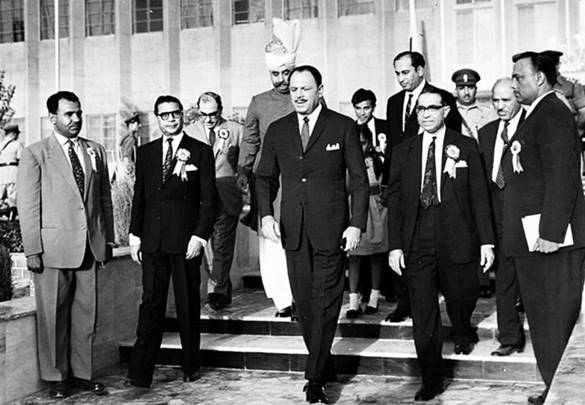
President Ayub Khan coming to inaugurate the Pakistan Atomic Energy Center in Lahore with Chairman PAEC Dr I. H. Usmani
ways. He worked late into the evening, raising the pulsebeat of his lieutenants with peremptory commands and demanding schedules.
A perfectionist to the core, he strove for a better-than-the-best standards. PINSTECH (Pakistan Institute of Nuclear Science and Technology, Nilore, Islamabad) is a living testimony to that vision. Described as `best of both the worlds' by the TIME magazine, the research center was conceived with rich imagination. It would make the Mughal emperors who had built the Taj Mahal "rub their eyes in wonderment" if they were alive today! No mean compliment by TIME.
Another admirable trait was his inspirational leadership which fired the 500 researchers trained by him at the PhD/MS level with an ardent passion to give off their best. In 1965, PARR, the 5 MW research reactor at PINSTECH, attained criticality heralding Pakistan's appearance on the nuclear map. Six years later, KANUPP was successfully commissioned marking Pakistan's entry in the nuclear age as the second developing - and the only Muslim - country to draw energy from the heart of the atom. The visionary's dream had partly come true.
Yet the going was tough: the work ethics conformed to a stringent pattern of discipline which ensured that merit was rewarded, mediocrity discarded, run-ofthe-mill ignored, and casual attitudes shunned. Stinkers would be quickly registered and words of appreciation duly recorded on files and documents. Dr Usmani seemed to act as a catalyst to galvanize talent and had an eye for all that transpired within the four walls of the Commission. His attention would not spare such trivialities as a newspaper supplement's layout or the architectural pattern of the overhead water tank at the Tandojam agricultural research center while he attended to the more critical and pressing issues. The most important and the least important appeared equally weighty. Each was his creation, each turned out to be a work of perfection.
With such deep involvement he became too endearing to the corps of scientists and engineers who began to look up to him as their Patron Saint, father, mentor, and guide. He, in turn, prided on the technical corps that he had raised and which he regarded as a potent catalyst for change, Pakistan's passport to all-round progress. The science divide, he often argued, accounted for economic disparities between the haves and the have-nots. Science needed to be nurtured to bridge the yawning gap between
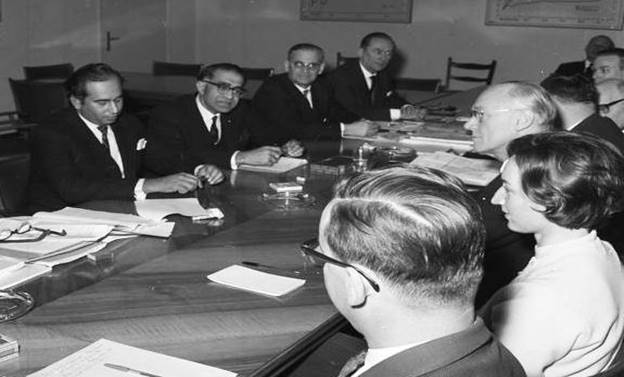
Foreign Minister Bhutto has talks in Germany with Dr I. H. Usmani sitting by his side
the North and the South. He championed its cause and clamored for a Scientific Service, parallel to the Civil Service of Pakistan.
No wonder, in life as well as in death, he remained a deeply endeared man. On the tragic day of June 17, Dr N.M. Butt dashed from PINSTECH to Karachi. His compelling urge to reach the funeral procession on time was writ large on his face. The benumbed eyes gleamed with deep sorrow as he waded through the maze of cars. From 1,000 miles away, came another reminder of undying affection: "I on behalf of my colleagues and on my own behalf would like to express our profound shock and grief at the side demise of Dr I.H.Usmani, an ardent pursuer of science and technology...We gratefully remember his immense contribution and admirable leadership for the development of science and technology, particularly for the peaceful applications of atomic energy..." - Dr M.A. Mannan, Chairman, Bangladesh AEC.
Dr Usmani prided on being "a son of the ideology of Pakistan." The centers he established were located across the length and breadth of the country - along the Cox's Bazar beach, Mymensingh, Chittagong, Dacca, Karachi, Lahore, Peshawar, Tandojam, Multan, D.G. Khan, Faisalabad, and many more.
Dr Usmani was extremely witty and sharp-tongued.
His gutsy outbursts, self-destructive at times, were a reminder of H.G. Wells' guiding principle in life: "If you want to do something, do it and damn the consequences."
In Dr Usmani's case, `say' seemed to have been replaced by `do.' He minced no words and called a spade a spade.
Thus, at one of the functions he rattled the chief guest, the then Minister for Science, Commerce, and Tribal Affairs, with the cutting remark: "We are happy that he (President) has entrusted the task of fostering the cause of science to you, Sir, as Commerce Minister, but we are unhappy also because commerce has nothing to do with science.... We do not want to share our ministry with commerce and our secretariat with tribal affairs...."
On another occasion, he took the Scientific Society of Pakistan to task for its Persianization of Urdu. "Agar basic English ko raij karnae ki kosish kee jarahi hae to ham sadah Urdu ki mohim kiyon naa shuroo karaen?...
Hamaen to yeh chahiae keh jis zaman sae matlab asani sae ada ho jae usay Urdu maen jagah daen aur apna kam chalaen. Haman kiya pari hae keh Arbi aur Farsi kae auraq gardani karate phiraen aur kisi European ya Angrezi zaban ke lafzon par khomakah bandishaen lagaen..." He strongly supported the adoption of English scientific terms in Urdu.
His speeches were a work of erudition. A sampling: "Among the school-goers, the top of the ladder is occupied by those sons and daughters of sahibs and begums who speak English better than their mother tongue, who know the names of the wives of Henry the Eighth but not the names of our caliphs; who have read Shakespeare but not Iqbal. They are ill at ease attending a qawwali, a mushaira....Poet Akbar Allahbadi lamented thus: Kon kehta hae na parh, aqal na seekh Kon kehta hae na kar hasrat-e-London paeda / Bas yeh kehta houn keh mulk kae maanae na bhol /Rah-i-qaumi ka too khud na ho rahzan paeda
And now an intimately time- related observation: "If you look at our school-going generations, you will find yourselves looking into a colorful kaleidoscope with a confusing variety of patterns. The pattern which you may find most colorless and blank is, of course, the one that relates to technical and vocational education. While at school our boys and girls learn no trade or vocation with the result that they do not acquire confidence in themselves and in the dignity of labor. After the schooling is over, there are no institutions to train them in such trades and skills as pottery making, tailoring, plumbing, printing, industrial designing, metal-working, glass- blowing, woodwork, poultry raising, tool-making, electrical and mechanical fitting, food preserving and a hundred and one other vocations for which there is, and should be, an insatiable demand in a developing country like Pakistan..."
With such undiluted perspicacity, it was not surprising that both nationally and internationally, Dr Usmani made his name. He stood out among Science Ministers from several countries who had converged at Trieste, Italy, at the invitation of Nobel Laureate Professor Abdus Salam in late-1988. Despite visible signs of aging, he seemed to outshine others. As I watched him mesmerize the distinguished assemblage with his address, memories of yesteryear returned. A host of outstanding men of science such as Prof Hans Bethe, an eminent personage among Nobel Laureates; Walker Cisler, President, World Energy Conference who electrified post-World War II Europe; and many more had visited Pakistan to find more than a match in the person of Dr I.H. Usmani. As Chairman of the IAEA Board of Governors, and later, as Energy Advisor to the United Nations Secretary General, his performance won superlatives.
Dr Usmani is dead but the centers he had established would live. And so would his memories, his contributions, and his infectious zest. His lieutenants would reach new milestones on the road that he painstakingly, nay, tenaciously, carved out for them.
(The author served as Principal Public Relations Officer, PAEC)



