January 09 , 2026
NBC News
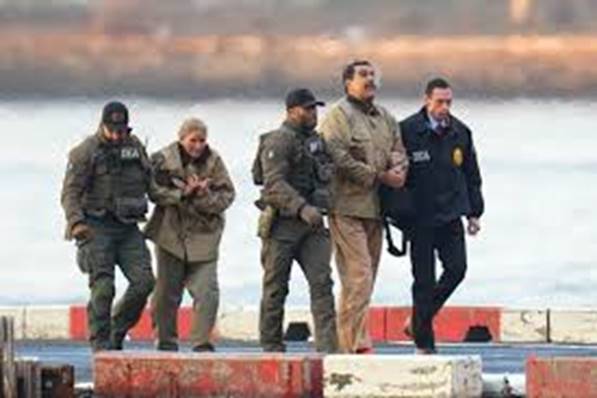
Capture of Maduro
In one of the strangest moves of recent times, the US military carried out the kidnapping of the President of Venezuela Nicolas Maduro. After this dark of night operation, President Trump declared that he was now in charge of the country but declined to explain how he plans to run the nation without any US troops on the ground. Instead, the entire Maduro regime remains intact and in charge, with little clarity as to what happens next.
Maduro has run Venezuela as a dictator since 2013, after succeeding Hugo Chavez, who had been the de facto dictator for over a decade before succumbing to cancer. Chavez led a movement to create “socialism”, but it was not in any way a functioning economy. Venezuela’s income was based almost entirely on exports of oil, and it was in fact a founding member of OPEC. Chavez used the oil money to back those who supported him but never built real growth. Instead, he seized and nationalized most large businesses in Venezuela and ran them into the ground through incompetence. Forty years ago, it was the richest nation in Latin America based on its oil wealth, and it has now slipped to one of the poorest. Over 10 million residents have left the country to find a better life elsewhere in Latin America or the US.
Venezuela used to be a real democracy in the 1980s and still had the trappings of one. There was an election for President last year, and all independent observers felt the opposition candidate had defeated Maduro by a wide margin. But Maduro rigged the results and declared himself the winner. With control of the military and police, and the assistance of 30,000 Cubans who performed such functions as his personal bodyguard and running intelligence, Maduro easily retained power. The Cuban connection is also critical to the story. Cuba is still a Marxist state even though Fidel Castro has been long dead. After the Soviet Union collapsed, Cuba struggled without the subsidies the Soviets provided, but in the last 20 years Venezuela came to its rescue providing much needed oil and dollars to keep its otherwise moribund economy afloat. In exchange the regime in Havana provided Maduro assistance in holding on to power.
The seizure of Maduro appears to have happened without much violence. No Americans were injured or killed, and there are only scattered reports that some of Maduro’s bodyguards may have been shot. This raises an obvious question. Was this an inside job? Did Maduro’s Vice President and the military generals allow the US to grab Maduro? In exchange for the US backing them in staying in power? What’s strange is why the US has not turned to the Venezuelan opposition to take control of the country? Why are they leaving the Maduro faction in charge for now?
There is little to no basis in international law for what has happened. It’s true that Maduro is not the legitimately elected President, and is a dictator running a police state, but that is not sufficient basis for the US to grab him. There have been claims made that Maduro is running drugs, and he is charged in US Federal Court for that crime. But Maduro has access to oil wealth, why would he need to run drugs to the US to make money? Besides, Venezuela is not a known center of cocaine, heroin, or methamphetamine production. The drug charges may in fact be rather flimsy and not result in a conviction, which would really embarrass the Trump team.
The President so far has not spoken about democracy or human rights or reviving the Venezuelan economy. He seems narrowly focused on oil. Venezuela at its peak pumped 3.7 million barrels per day of crude, but due to epic mismanagement and lack of investment it currently only pumps 1 million per day. The nation has massive oil reserves, and it claims to have 300 billion barrels, more than even Saudi Arabia, but those numbers are likely exaggerated. Beyond that, the country produces a very low quality “heavy” crude, which requires special handling and refining. For Venezuela to raise its output of crude back to 3.7 million bpd would take massive investments over a decade. But the American oil majors like Chevron and Exxon have no interest in doing that without knowing for certain that politically stability will be there for the long term.
Trump has seized Maduro and now claims that the US will run the country. But the reality on the ground is that the Maduro team remains in place and has already stated they will resist a US takeover. Without a massive ground invasion and occupation, it is hard to see how this ends with Trump really in charge. This whole scheme looks badly thought out, and there is no obvious plan for the next several weeks or months or years. Meanwhile the opposition in Venezuela is confused and uncertain where things go from here. Can the people rise up and throw out the Maduro regime and bring in a new Venezuela without US involvement? That would be the best solution. If a true democracy is born and massive economic reforms are undertaken to restore free market economy, then an outcome like Eastern Europe enjoyed after the collapse of communism could be possible. But that will require a lot of things to go just right.